Alameda startup breaks ground on next generation nuclear power plant

Round-the clock demand for electricity is rising rapidly due to AI, Data Centers, and cloud computing. Kairos Power, which is headquartered in Alameda, has taken a decisive step forward in order to meet that challenge.
The company is located in a repurposed World War II-era aircraft hangar on the former Alameda Naval Air Station. Inside, CBS News Bay Area met two of the co-founders: CEO Mike Laufer and Chief Technology Officer Edward Blandford.
"We're confident that we can deliver a safe and reliable product," Blandford told CBS News Bay Area.
Laufer added, "We were founded almost 10 years ago. So, we've been working at this for quite a long time."
Kairos Power designs and builds advanced nuclear reactors. These reactors are engineered to be smaller, safer, more efficient, and carbon-free.
"It's a very clean source of electricity," said Blandford.
In the United States, there are about 57 conventional nuclear energy plants with a total of 94 reactors. Most use pressurized water as a coolant and they operate under high pressures and high temperatures.
In California, PG&E operates two pressurized water reactors at the Diablo Canyon facility, located near Avila Beach in San Luis Obispo County.
At Kairos, their system uses a different combination of technologies: instead of water, Kairos uses molten salt. As a coolant, molten salt operates at atmospheric or low pressure, with no danger of a high-pressure explosion.
Kairos also uses a widely recognized nuclear fuel known as TRISO, which are pebbles the size of a golf ball.
Inside each pebble are thousands of kernels of uranium. Each kernel is encased in multiple protective layers, that won't melt, preventing radioactive material from escaping.
Blandford showed CBS News Bay Area a mockup of a pebble.
"It's about the size of a golf ball or ping pong ball and it holds the same amount of energy as you would get with four tons of coal," said the nuclear engineer.
"We have a technology which has a lot of intrinsic safety, and then we use that in a way so that we can do testing and development around the technology to make sure that the system is going to be affordable and reliable," said Laufer.
At the Alameda headquarters, engineers build and repeatedly test components of their hardware, using an iterative process.
"That enables us to move quickly and get that design feedback into the design early and not too late," explained Blandford.
The company said rigorous testing shows the technology is safe. An analysis found is something happened to go wrong, the results were benign.
"Nothing is going to happen that's going to impact the surrounding community and that's really important obligation that we take very seriously," said Laufer, who is also a nuclear and mechanical engineer.
Reactor modules are built at the Kairos Manufacturing Hub that's located in Albuquerque, New Mexico. Modules are then shipped and assembled at a demonstration site in Oak Ridge, Tennessee.
In April, Kairos Power made history and broke ground for what could be North America's first commercial advanced nuclear reactor.
The U.S. Nuclear Regulatory Commission is working with Kairos and issued the construction permit. The reactor, known as Hermes 2, is designed to send clean, reliable energy directly to the Tennessee Valley Authority or TVA's grid.
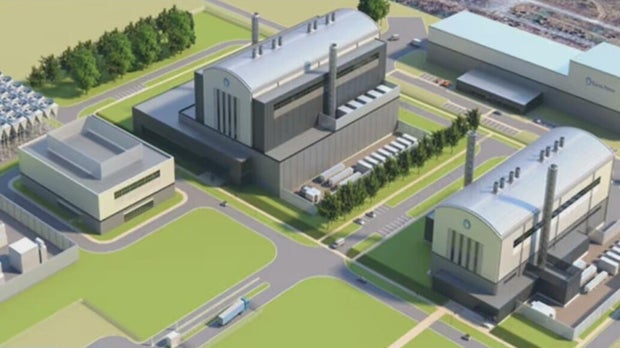
The TVA is the largest public power company in the United States and was created by the U.S. Congress in 1933 as a federal corporate agency.
Hermes 2 is scheduled to come online in just four years. Kairos Engineers will run the plant. The TVA will buy energy from Kairos and then route it to two Google data cancers now operating in Tennessee and Alabama.
The Hermes 2 reactor is part of a landmark deal with Google to develop a U.S. fleet of advanced nuclear reactors to power their data centers.
Laufer at Kairos hopes the power will go further.
"Not just for data center customers but also for utilities and the general population here in the United States," he said.
Once the fuel is spent, the nuclear waste must be maintained and stored.


