Panama struck by 2 powerful earthquakes, U.S. Geological Survey says
A powerful magnitude 7.7 earthquake struck near Panama's southern tip on Friday morning, shaking buildings more than 100 miles away in the capital and prompting evacuations, according to the U.S. Geological Survey. A second powerful 6.6 magnitude earthquake struck the country later in the day following a series of aftershocks.
The initial quake was centered about 7 miles southwest of the remote community of Pitaloza Arriba and struck at a depth of about 7 miles, the USGS said. The 6.6 magnitude quake came about two and a half hours later, with its epicenter about 8 miles west of Río Grande on Panama's Pacific coast and a depth of about 6 miles.
The U.S. Pacific Tsunami Warning Center had initially warned about the possibility of tsunami waves hitting Panama's coast, but later said the threat had passed.
Tremors were felt in Panama City, where buildings shook and people evacuated into the streets. Visibly shaken residents gathered outside as they waited for news.
"We felt it very strongly. It knocked things over in the kitchen, but we're OK, though we're very scared," Rosendo Domínguez, 60, who is from Herrera province, where the earthquake struck, told The Associated Press by phone. "Everyone is outside, scared."
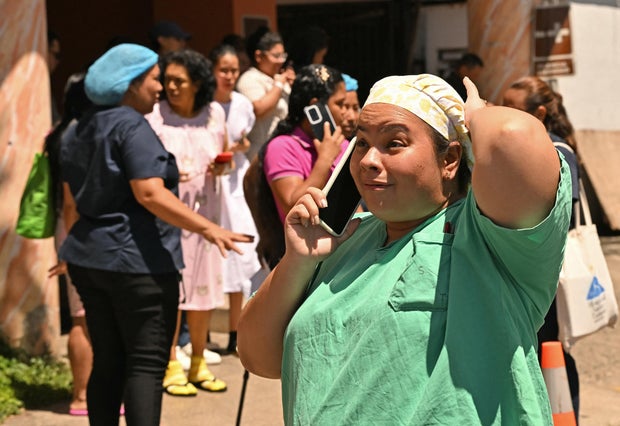
Multiple aftershocks continued to rattle Panama, including several measuring magnitude 5.8, 5.5 and 5.2. Seismologists at the University of Panama recorded more than 45 aftershocks, though many were too weak to be felt.
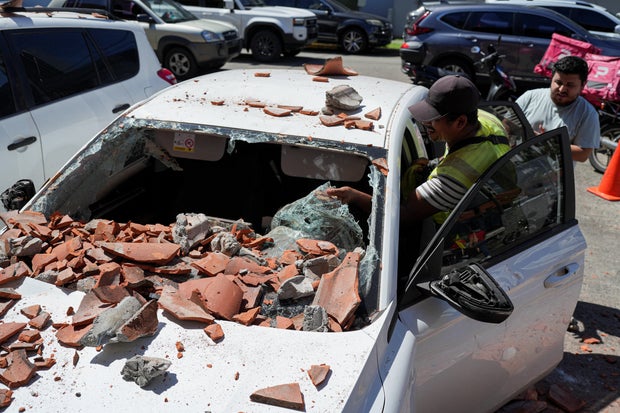
Images of crumbling buildings and deep fissures slicing through roads added to fears across a region battered by a series of devastating earthquakes in recent months.
Two back-to-back 7.2 and 7.5 magnitude earthquakes roiled Venezuela's La Guaira state in June, killing more than 6,500 people and leaving 17,000 homeless. In August, a 7.4 magnitude earthquake in Colombia killed at least 289 people.
Panamanian President José Raúl Mulino called for calm on Friday, writing on social media: "What happened should not be used to cause alarm or disorder."
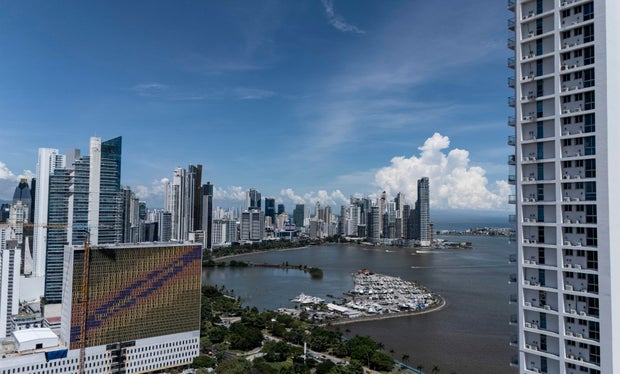
Omar Smith of the National Civil Protection Service said on the Telemetro Reporta news channel that damage was concentrated in the central provinces of Veraguas, Herrera and Los Santos. He said there were no reports of damage in the capital, which is known for its hundreds of skyscrapers.
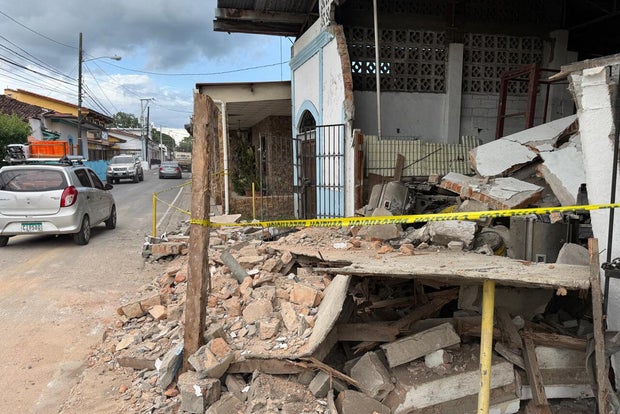
Smith said several injuries have been reported, including one person struck by debris from a partially collapsed structure in the city of Penonomé, around 93 miles from the capital. He confirmed a partial collapse and cracks at the cathedral in the district's main square, as well as damage in the governor's office building and the Dos Continentes hotel. No casualties were immediately reported.
Local news outlets also reported that the Church of San Atanasio, a colonial-style Catholic church in Panama's Los Santos province, had collapsed. The church was declared a National Historic Heritage Site in 1938. Elsewhere, including in Veraguas province, large fissures ran along roadways.
Tocumen International Airport in Panama City, one of the region's busiest airports with more than 20 million passengers in 2025, temporarily suspended operations after the first quake but said Friday afternoon that it was reopening.
The Panama Canal Authority said operations were continuing normally along the key global trade route. It said its priority was the safety of employees, vessels and crews and that specialized technical teams were inspecting facilities for possible damage.
The last major earthquake to cause widespread damage in Panama struck in 1991. A magnitude 7.4 quake centered in nearby Costa Rica killed 23 people, injured 559, and left thousands of people homeless in the border Bocas del Toro region.
Earthquakes are common, especially along Panama's border with Costa Rica and its Pacific coast, because of the interaction of several tectonic plates, including Cocos, Nazca and Caribbean plates.
Panama lies along the "Ring of Fire," a 25,000-mile arc of volcanoes and fault lines around the Pacific Basin, where most of the world's earthquakes occur.
Nearby countries sent messages of support Friday afternoon. Colombian President Abelardo de la Espriella expressed his solidarity with the Panamanian people and their government during what he called "difficult times."
"Panama is not alone! You can count on Colombia's support and our full willingness to provide whatever assistance is needed," he wrote on social media.
The U.S. Embassy in Panama said it was "closely monitoring" the aftermath of the quake and accounting for the welfare of its citizens in Panama, a well-known retirement destination for Americans.


