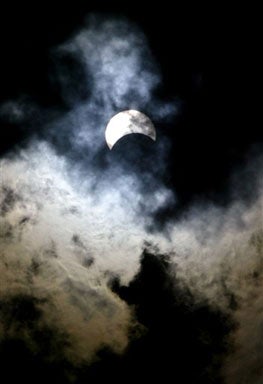
AP Photo/Visar Kryeziu
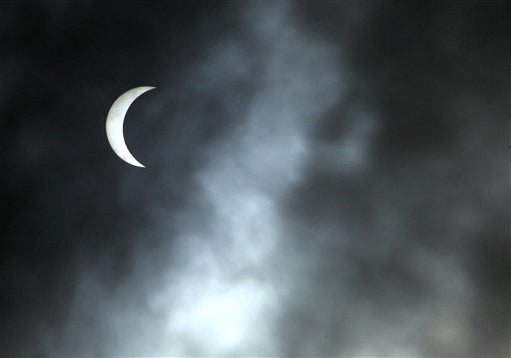
The moon partially covers the sun behind the clouds during a partial solar eclipse seen in Vucitrn, Kosovo, Wednesday, March 29, 2006. The moon began blocking out the sun in the morning in Brazil before the path of greatest blockage migrated to Africa, then on to Turkey and up into Mongolia, where it will fade out with the sunset.
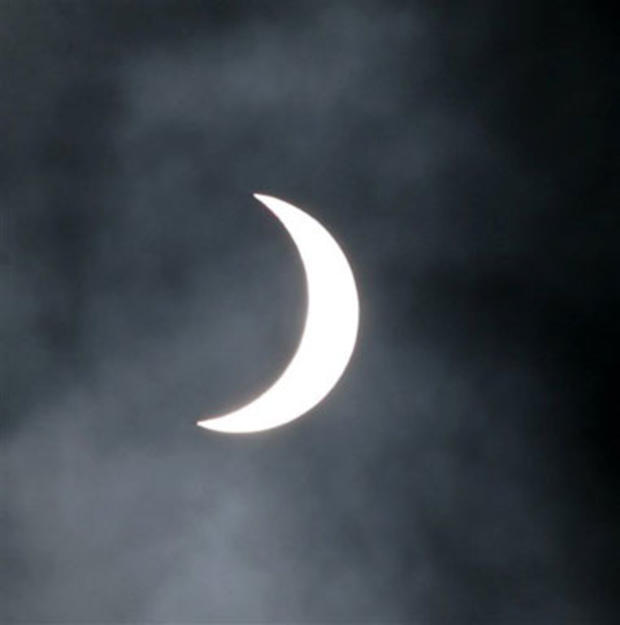
AP Photo/Nader Daoud
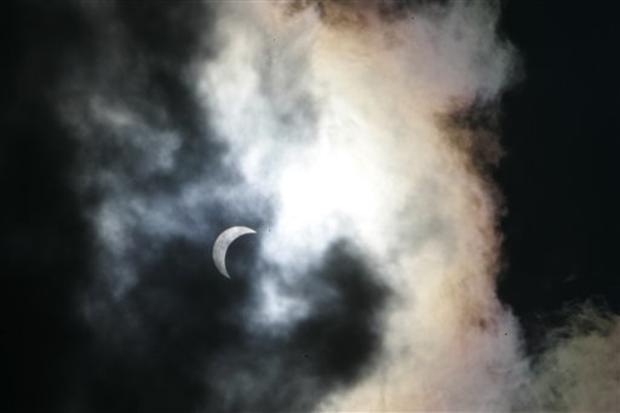
The moon partially covers the sun during a solar eclipse seen in Amman, Jordan, March 29, 2006. The moon began blocking out the sun in the morning in Brazil before the path of greatest blockage migrated to Africa, then on to Turkey and up into Mongolia, where it faded out with the sunset.
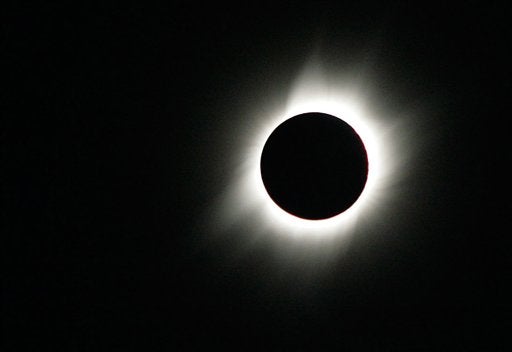
AP Photo/Olivier Asselin
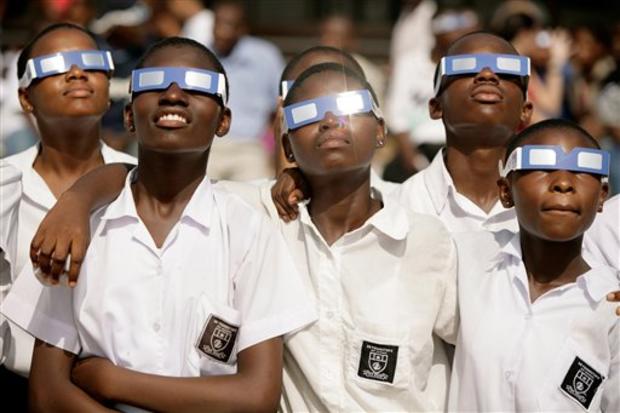
A solar eclipse as seen in Accra, Ghana, March 29, 2006. Schoolchildren cheered as the eclipse plunged Ghana into daytime darkness, an eagerly awaited solar show that swept northeast from Brazil to Mongolia.
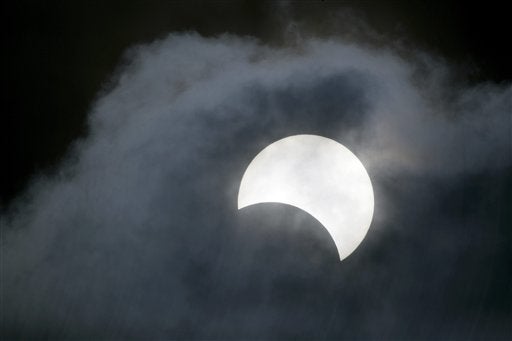
AP/Keystone, Alessandro Della Bella
The moon partially covers the sun during a partial solar eclipse seen in Zurich, Switzerland, March 29, 2006.
AP Photo/Nasser Nouri
The eclipse seen in Salloum, Egypt, March 29, 2006. Folklore troupes played popular Egyptian music in the town of Salloum on the Libyan border as some 8,000 tourists watched the phenomenon.
AP Photo/Lefteris Pitarakis
The moon partially covers the sun over Jerusalem's Old City on March 29, 2006.
AP Photo/Lefteris Pitarakis
Here is another shot of the partial solar eclipse over Jerusalem's Old City on March 29, 2006.
AP Photo/NASA
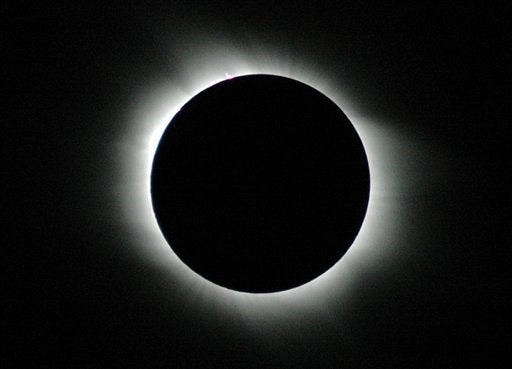
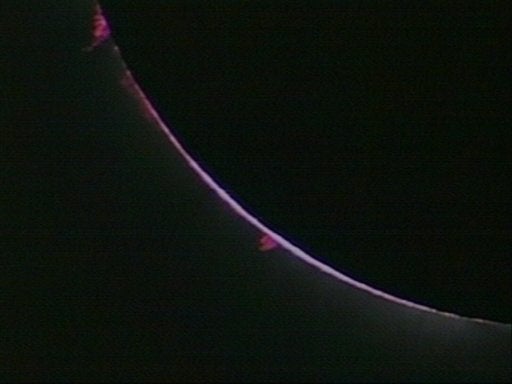
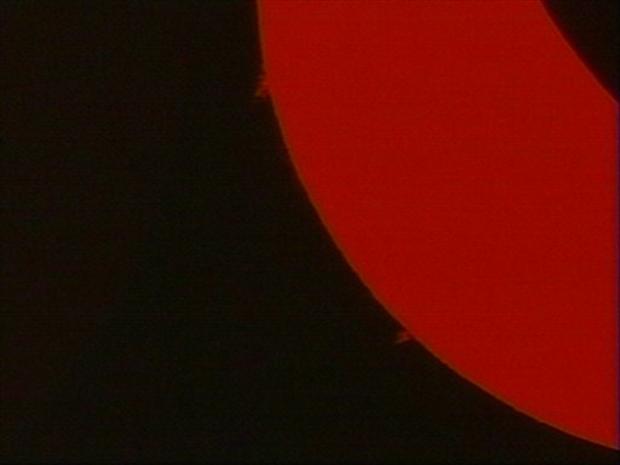
This TV image provided by NASA from March 29, 2006, shows two solar flares seen during the total solar eclipse captured in Turkey's Mediterranean town of Side. The last such eclipse in November 2003 was best viewed from Antarctica, said Alex Young, a NASA scientist involved in solar research.
AP Photo/NASA
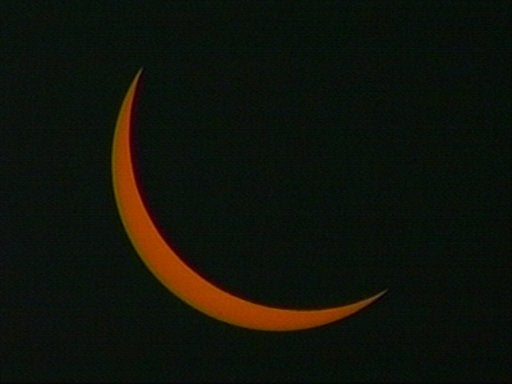
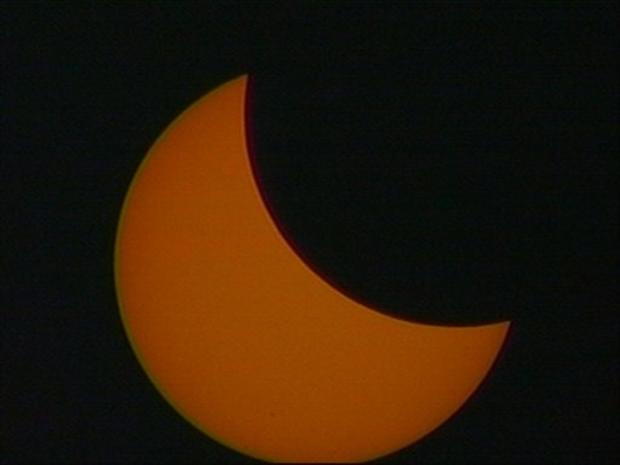
The eclipse before the total solar eclipse is shown in another TV image provided by NASA March 29, 2006. Total eclipses are rare because they require the tilted orbits of the sun, moon and earth to line up exactly so that the moon obscures the sun completely. The next total eclipse will occur in 2008.
AP Photo/NASA
Here is another TV image provided by NASA, showing two solar flares during the total solar eclipse March 29, 2006. The image was captured in Turkey's Mediterranean town of Side.
AP Photo/NASA
The beginning of the total eclipse March 29, 2006, is shown in this TV image provided by NASA.
AP Photo/Burhan Ozbilici
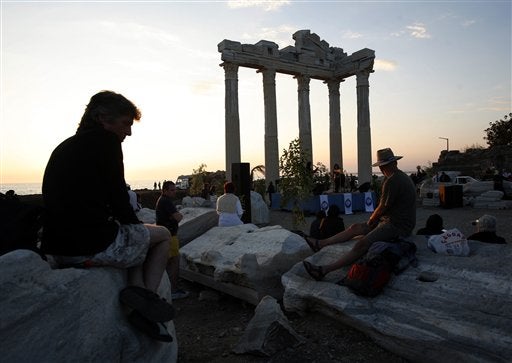
Two Turkish musicians play and sing traditional jazz in front of the Apollo Temple as thousands of tourists gather along the Turkish Mediterranean coastal resort of Side, Turkey, March 28, 2006, to view the total solar eclipse.
AP Photo/Srdjan Ilic
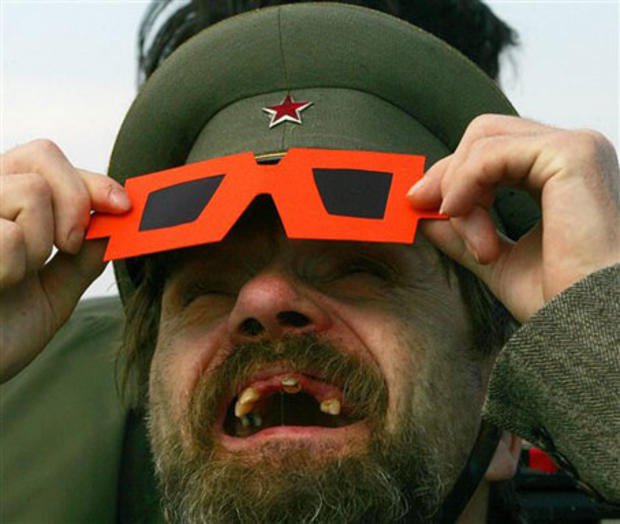
A man wears old Yugoslav army cap as he watches the solar eclipse March 29, 2006, in Belgrade's observatory.
AP Photo/Nasser Nouri
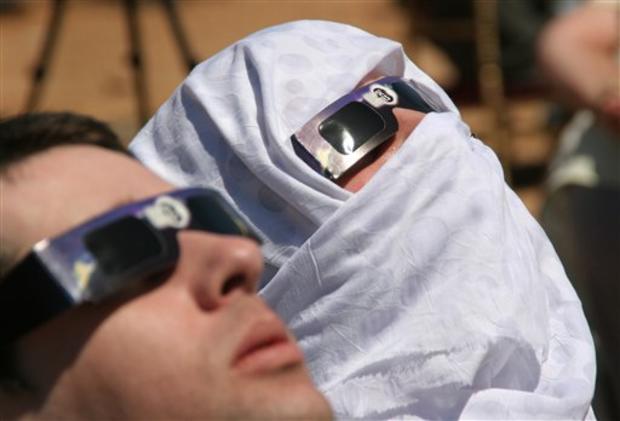
Two foreign tourists, one wearing a headscarf, watch a solar eclipse in Salloum, Egypt, March 29, 2006.
AP Photo/Bassem Tellawi
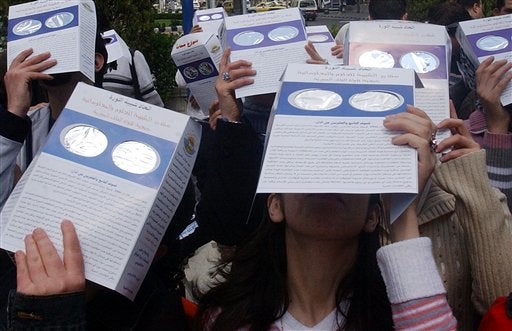
Syrians in Damascus view the solar eclipse through filters March 29, 2006. The Syrian Health Ministry warned citizens not to look at the sun during the eclipse to avoid eye damage that could be as severe at total blindness.
AP Photo/Olivier Asselin
A group of school children look at the solar eclipse in Accra, Ghana, March 29, 2006.
AP Photo/Lefteris Pitarakis
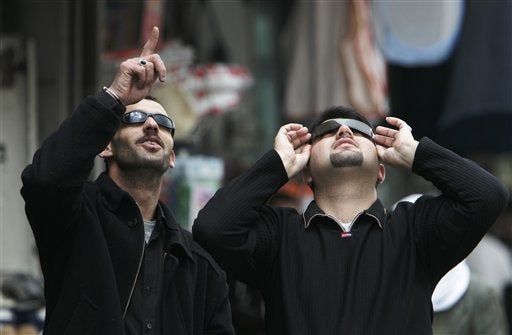
A Palestinian points as another uses a piece of 35mm photographic film to watch the moon cover the sun during a partial solar eclipse outside Jerusalem's Old City on March 29, 2006.
AP Photo/Lefteris Pitarakis
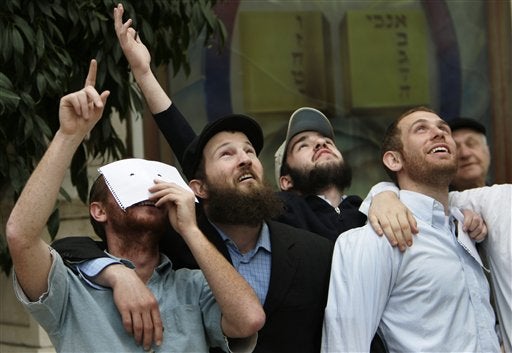
Orthodox Jewish students watch as the moon covers the sun during a partial solar eclipse, in Jerusalem's Mea Sharim neighborhood March 29, 2006.
AP Photo/Erick Christian Ahounou
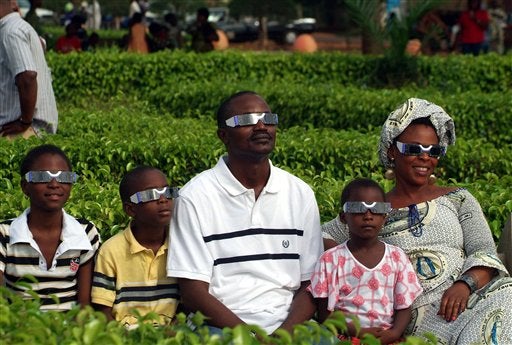
A family views the eclipse from the town of Abomey, Benin, March 29, 2006. The last such total solar eclipse, in November 2003, was best viewed from Antarctica. But Wednesday's eclipse blocked the sun in highly populated areas, including West Africa.
AP Photo/Efrem Lukatsky
A Ukrainian girl watches a partial solar eclipse through a CD in Kiev, Ukraine, March 29, 2006.