What May's strong jobs report means for interest rates
After a tepid start in 2015, the U.S. economy is revving back up as job gains reaccelerate.
Payrolls jumped by 280,000 in May vs. the 225,000 analysts were expecting. That's up from the 119,000 gain in March and 221,000 in April, and marks a return to the pace of job creation seen at the end of 2014. The unemployment rate bumped up to 5.5 percent as more job-seekers entered the workforce in a show of confidence.
All of this has increased the odds the Federal Reserve will raise interest rates this year, possibly as soon as June 18 but more likely sometime later in the year.
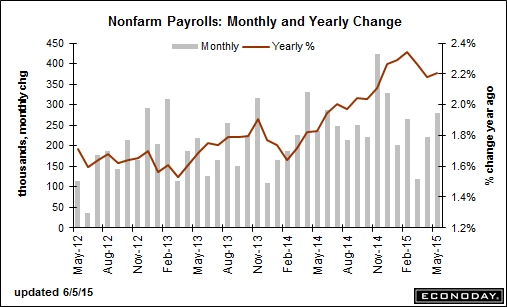
Earlier this week, the International Monetary Fund pleaded for the Fed to delay a rate hike until 2016 after the IMF marked down its U.S. GDP growth forecasts. But in the wake of Friday's jobs numbers, the futures market increasingly believes Fed chair Janet Yellen won't be able to wait that long, and traders are bringing forward their rate hike estimates as a result. Current pricing suggests an increase in September or October followed by another early next year.
While GDP growth and other measures of economic activity have been weak lately, the job market is actually performing better than it should be -- suggesting structural frictions as businesses have a harder time finding qualified workers. Consider that the jobless rate among those aged 25 years or more with a four-year college degree or more stands at just 2.7%.
Philippa Dunne and Doug Henwood at the Liscio Report noted that based on historical data, a 2 percent GDP growth rate should correspond to about 100,000 new jobs a month. We're well ahead of that, considering the economy contracted at a 0.7 percent seasonally adjusted annual rate in the first quarter and that the Atlanta's Fed's GDPNow tracking estimate for second-quarter growth stands at just 1.1 percent.
Further evidence that the Fed risks falling behind a tighter-than-it-looks job market is the accelerating drop in labor productivity. That's a sign businesses have to load up on a growing number of workers to expand output by a set amount. Yes, the economy still has 550,000 fewer full-time jobs than it did before the recession started. But for a variety of reasons -- demographics, shifts in the mix of jobs, etc. -- the pool of available workers has already started to dry up.
The next phase in all this should see an upward acceleration in wage inflation, the long-delayed deliverance working-class Americans have been waiting for in this recovery. Early signs show it's happening: Average hourly earnings grew 0.3 percent in May vs. 0.1 percent in April. Efforts to raise pay for entry-level workers are having an impact: On an annual basis, wages in retail are growing at a 2.5 percent clip, while those in leisure and hospitality are growing 3.6 percent.
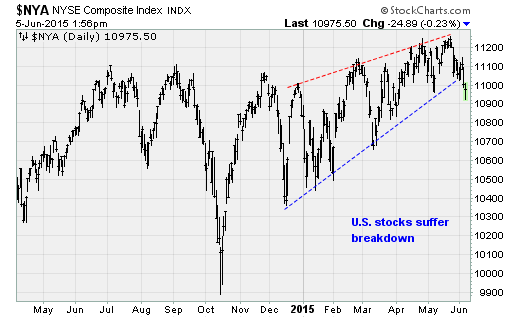
The specter of higher interest rates and the potential for disorderly losses in the long-term bond market have weighed on stocks this week, with the NYSE Composite falling down and out of a multimonth uptrend support. That suggests risky assets could come under increasing pressure in the weeks ahead as we get closer to the end of the zero interest rate policy the Fed started in late 2008.