Three Strategy Books for the New Economy
In Fast Competition and Flat Denial, Phil Rosenzweig attacks the bulk of strategy books published each year:
few of them are fundamentally persuasive or insightful. Most are long on admonition and exhortation -- Be innovative! Be bold! -- but short on critical thought. Many suffer from a fatal flaw: They feature companies that have achieved remarkable perforÂmance -- whether great success or colossal failure -- and then explain those outcomes using simplistic ex post facto rationalizations. In doing so, they fail to appreciate the real uncertainties facing managers as they make decisions. And they ignore the fact that it is just as easy to select a handful of successful companies and conclude that they prevailed through dogged persistence and focus as it is to pick a set of companies whose success seems to be based on their willingness to scrap the conventional and do something radically different. After the fact, it's always possible to tell one story or the other.He looks at three books from last year that look directly at how to make decisions in the face of daunting
 competition. His favorite is "The Red Queen Among Organizations: How Competitiveness Evolves," by William J. Barnett. The "Red Queen" plays off the idea that competition raises every company in a sector -- "performance is relative to competition, not absolute. A company can run faster and fall farther behind at the same time," Rosenzweig writes. That's especially true if companies fall into a 'competency trap,' where its excellence in a certain kind of market causes it to miss the next one.
What will save them from falling behind will not fit a formula. Rosenzweig isn't happy with all of Barnett's answers for managers, and he notes that Barnett's book is more theoretical than practical, which will make it hard for managers to act on it. Still, Rosenzweig calls "The Red Queen" "the best treatment on the subject of global strategy to appear for quite some time, and a much-needed antidote to the simplistic treatments of flat-world management that are currently in vogue."
It's unfortunate that he does not compare Barnett's "Red Queen" to Clay Christensen's "The Innovator's Dilemma," which seems to cover similar ground and draw similar conclusions. That, however, is a quibble about a fine overview. And Rosenzweig turns next to a real-life example of a Red Queen battle.
In "Sony vs. Samsung," by Sea-Jin Chang, Rosenzweig sees the problem of the competency trap playing out, as Sony's excellence in the analog world cannot be sustained in the digital era. Chang, the author, sees other factors at work, like Sony's management infighting. Rosenzweig acknowledges this, but says
It may be that Sony's inability to adapt its organizational processes is not unusual, but indeed almost predictable. Organizations often change more slowly than their environments, meaning that in time most organizations become unfitted to their new contexts. That is, of course, very much the notion of the competency trap described by Barnett in The Red Queen among Organizations, and raises the question of whether success in one context tends to lead to failure in another.
Overall, he praises the unusual access that Chang had to leaders at both Sony and Samsung, and his ability to look at both companies over the long haul.
Finally, Rosenzweig examines a book on the force that built and then buffeted Sony, globalization.
Or rather, semi-globalization, as Pankaj Ghemawat calls it in "Redefining Global Strategy."
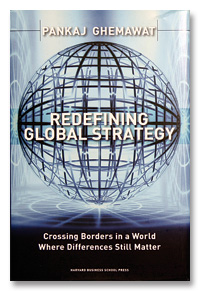
The key to understanding why the world isn't actually flat, Ghemawat says, is this:
National differences, he says, exist along four dimensions: cultural, administrative, geographic, and economic. Further, the importance of these dimensions can differ by industry. For example, geography and culture may matter little in the semiconductor industry, but for the food industry the implications of these two dimensions are massive. Once these national differences as they exist in a given industry are understood, firms can identify ways to add value through the dispersion and coordination of global activities, whether by adding revenues, decreasing costs, managing risk, or leveraging expertise.
Rosenzweig says the book "is the best treatment on the subject of global strategy to appear for quite some time, and is a much-needed antidote to the simplistic treatments of flat-world management that are currently in vogue."