Syrian President Praises Obama, Slams Israel
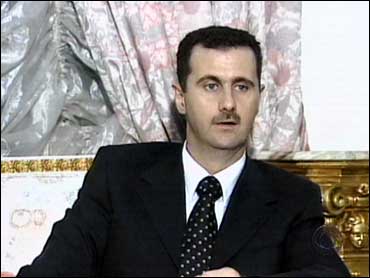
Syrian President Bashar Al-Assad heaped praise on U.S. President Barack Obama's quest for reaching a settlement in the Middle East, but told visiting U.S. Senator John Kerry on Monday following talks that Israel was not seeking peace at all.
Sen. Kerry, chairman of the Senate's Foreign Relations Committee and a proponent of engagement with Damascus, is fast becoming the U.S. administration's key interlocutor with Syria; it was his third visit to the country this year and his sixth as a senator. He is the administration's official emissary for special missions there.
Sen. Kerry has consistently said that while the United States has serious, long-standing disagreements with Syria--in particular its support for Hizbullah and other terrorist groups--this Arab Republic can play a critical role in bringing peace and stability if it makes the strategic decision to do so.
The Politics Behind Misunderstanding Islam
US Says Syria, Iran, Hezbollah Endanger Lebanon
Hariri Court President Appeals For Acceptance
In a presidential press release following the talks, Pres. Assad lauded Obama's desire in achieving peace in the region and renewed Syria's willingness and pursuit for a just and comprehensive peace. The release went on to say that the real problem was on the Israeli side, which rejects peace.
"(Sen.) Kerry highlighted the need for Syria's engagement for consolidating security, stability and maintaining peace in the region," the release stated after the talks.
The statement said that both discussed latest development in the region, in particular Iraq and Lebanon, but gave no further details.
Sen. Kerry, who came in after a short stop in Lebanon, refused to speak to reporters. He said in Beirut, however, that Lebanon is powerless to stop a U.N.-backed probe into the murder of ex-premier Rafiq Hariri, despite a campaign by Hezbollah to torpedo the court.
The Obama administration expressed a continued commitment to reappointing a U.S. ambassador to Syria, in order to be able to relay messages from the American administration more directly to the Syrian regime.
Obama named Robert Ford as the ambassador to Syria in February, the appointment has yet to be voted on.
Former U.S. President George W. Bush recalled the American ambassador following the murder of former Lebanese Prime Minister Rafik Hariri in Beirut in 2005. Republicans object to the appointment of an ambassador to Syria, viewing it as a reward to Damascus.
The Obama administration and its Arab allies are hopeful that re-engagement with Syria may encourage its leaders to distance themselves from Iran, an economic and strategic alliance that Syria has fostered for decades.
Kerry's meeting with Assad was held not long after an exchange of hard words between Damascus and Assistant Secretary of State for Near East Affairs Jeffery Feltman.
On Thursday, Syria slammed advice given by the senior U.S. diplomat as to how the Middle Eastern nation should manage relations with its neighbors and internal political groups, saying Feltman was suffering "illusions."
Sec. Feltman told the Washington Post in an interview published last week that Syria should pressure Iran and the Islamic militant group Hezbollah to curb their activities in Lebanon if it wants to rebuild its relations with Washington. Sen. Kerry's visit was the latest in a flurry of diplomatic efforts aimed at containing a growing political crisis in Lebanon over the Special Tribunal for Lebanon (STL), a U.N.-backed probe into the 2005 assassination of Hariri and 22 others.
According to unconfirmed reports, the STL is set to implicate high-ranking Hezbollah figures in connection with Hariri's murder. The reports have sparked the ire of the Shiite party, which has called for a boycott of the STL and accused the United States of using it as its "last pawn" in Lebanon.
Last week, Washington announced a new 10-million-dollar contribution to the tribunal. Hassan Nasrallah, the chief of Hezbollah which has two ministers in Lebanon's unity government, has openly warned all Lebanese against further cooperation with the tribunal. But Saad Hariri, Rafik Hariri's son and the current prime minister of Lebanon, has vowed to see the investigation through.