Supreme Court poised to weigh legal battle over federal gun ban for drug users
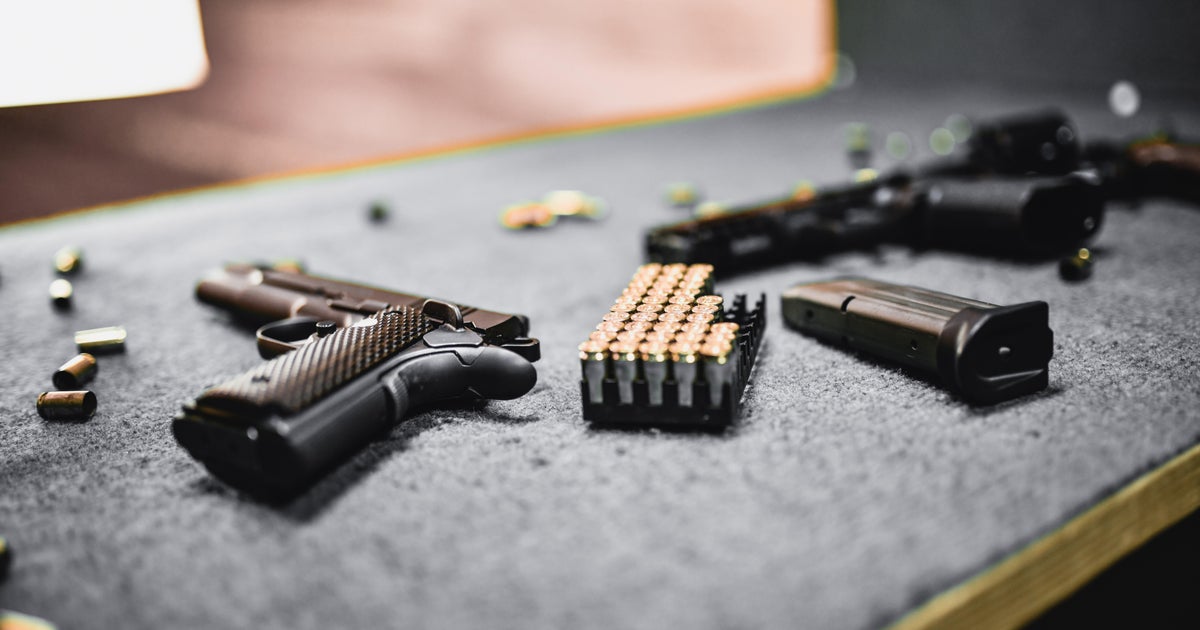
Washington — The Supreme Court is set to hear arguments Monday in a Second Amendment dispute over a federal law that bars unlawful drug users from possessing firearms.
The case, United States v. Hemani, is the second involving gun rights that the high court is hearing in its current term, joining a legal battle over a Hawaii law that restricts where concealed-carry license holders can bring their firearms. The Supreme Court heard arguments in that case in January and seemed skeptical about the constitutionality of the measure.
But the court fight is also the latest to land before the Supreme Court in the wake of its landmark 2022 decision that recognized the right to carry guns in public and laid out a new test for determining whether a firearms restriction violates the Second Amendment. Under that framework, the government must show that a gun law is consistent with the nation's historical tradition of firearm regulation.
The gun law
The statute at issue was enacted by Congress in 1968 as part of the Gun Control Act and forbids an unlawful drug user from having a firearm. A violation of the law is a felony punishable by up to 15 years in prison. The Justice Department estimates roughly 300 people are charged with the offense each year.
Perhaps the most high-profile offender was Hunter Biden, the son of former President Joe Biden who was found guilty in 2024 of possessing a gun while he was addicted to crack cocaine. He was pardoned before Biden's presidency ended last January.
The defendant in this case, Ali Hemani, was charged with illegally possessing a firearm as an unlawful drug user after the FBI found a Glock 9mm pistol, 60 grams of marijuana and a small amount of cocaine during a search of his family's home in Texas. Hemani informed agents of the gun and surrendered it to them, according to court papers. He also admitted to using marijuana a few times a week.
The prosecution centered solely on his marijuana use. Hemani moved to dismiss the charge, arguing that the drug-user-in-possession law violates the Second Amendment. His effort was successful. The U.S. Court of Appeals for the 5th Circuit ruled in similar cases in 2023 and 2024 that the law is unconstitutional when applied to a drug user who was not proven to be under the influence while he had the firearm.
The legal arguments
President Trump has taken steps to shore up Second Amendment rights, but in this case, the Justice Department is urging the Supreme Court to uphold the law. In court filings, Solicitor General D. John Sauer said that the Second Amendment allows Congress to restrict gun possession by habitual drug users.
Hemani's lawyers, on the other hand, argue that the question before the court is a narrow one: whether the government can deprive an occasional marijuana user of the right to keep a handgun in the home.
"I think what the court is being asked to decide, and I would imagine the reason it took the case, is to give some more guidance about what kinds of people can be disarmed without violating the Second Amendment," Joseph Blocher, co-founder of the Duke Center for Firearms Law, told CBS News. "Fundamentally, that's what this case is about."
In filings, Sauer argued the law covers habitual users of controlled substances like marijuana, and said the restriction is "temporary and limited" since a person regains the ability to have guns once he stops habitually using illegal drugs. He argued there is robust evidence in the nation's historical record demonstrating that people who pose a clear threat of violence to others can be disarmed, but only temporarily.
Sauer pointed to founding-era measures that restricted the rights of habitual drunkards, which he said are closely analogous to habitual drug users. He argued that legislatures can restrict gun possession by "unusually dangerous people." Those limits, however, cannot be so broad that they cover most ordinary citizens, he said.
"For as long as America has had a drug problem, jurisdictions have restricted drug users' access to firearms," he wrote, adding that Congress was justified in determining that armed habitual drug users jeopardize public safety.
Sauer noted that 43 states and the District of Columbia all have laws that restrict drug users and addicts from having guns, and warned that the 5th Circuit's decision, if upheld, would throw those laws into question.
Still, if there are constitutional concerns about the law in marginal cases, Sauer noted that the Justice Department under Mr. Trump has revived the process for a disarmed person to petition the attorney general to have their gun rights restored.
The case is "significant because it's the first real test at the Supreme Court of the legislature's prerogative to disarm categories of people," Blocher said.
History and tradition
The Supreme Court's June 2022 decision in the case New York State Rifle and Pistol Association v. Bruen was significant in that it marked the first expansion of gun rights since the high court's 2008 and 2010 rulings involving the individual right to gun ownership. But it also changed the way courts evaluate the constitutionality of gun laws, placing the burden on the government to show that a restriction is rooted in the nation's historical tradition of firearms regulation.
Since then, lower courts have struggled to apply that standard, and in some places, longstanding federal firearms restrictions have been invalidated for failing the history-and-tradition test. In a 2024 decision in the case United States v. Rahimi, the Supreme Court provided some clarity for how courts should examine gun regulations under its new framework when it upheld a federal law that bars people subject to domestic violence restraining orders from having guns.
But that case involved a determination by a court that an individual posed a threat to the safety of others and therefore could be disarmed temporarily.
Blocher said Hemani's case is different in that it involves a determination by Congress about which groups of people are considered dangerous and subject to disarmament.
"I would like to see an affirmation that legislatures have some power to declare certain categories of people subject to disarmament," he said. "That doesn't mean that those determinations are unreviewable. It doesn't mean that the legislature just gets to decide whatever it thinks in terms of people being disarmed. There still has to be, after Bruen and after Rahimi, a historical principle to underlie that determination."
The case has created some odd alliances, with gun violence prevention groups joining the Trump administration in urging the Supreme Court to uphold the law. On the other side, the American Civil Liberties Union has signed on as co-counsel to represent Hemani. The ACLU and gun rights groups like the National Rifle Association argue the restriction should be invalidated.
In a Supreme Court brief, Hemani's lawyers argue that there is no historical tradition of stripping anyone who consumes an "intoxicant" a few times a week of their gun rights. They argue the law is unconstitutional on two different grounds. First, they say it is too vague, since Congress didn't define "unlawful user" or specify how frequent, recent or substantial the drug use must be in order for someone to be stripped of their gun rights. Second, they say the law violates the Second Amendment.
"We see this as a critical civil rights question," Brandon Buskey, director of the ACLU's Criminal Law Reform Project, told CBS News. "As an initial matter, the heart of the government's case against our client, Mr. Hemani, is that he can be prosecuted and subject to a prison term of up to 15 years simply by virtue of admitting to regular marijuana use and having a gun that was safely secured in his home. For us, that in and of itself constitutes a major question of constitutional and also civil rights for all Americans."
Buskey argued that as to the Second Amendment question, history and tradition do not support treating recreational marijuana users as categorically dangerous.
Hemani's lawyers also reject the government's attempt to liken laws disarming habitual drunkards to the law disarming drug users, arguing that those early restrictions covered only people who regularly abused alcohol, not all those who drink. They warned that if the Supreme Court accepts the government's position, millions of Americans who use an "intoxicating substance" with some frequency could be deprived of a constitutional right.
They also noted that 40 states have legalized marijuana use to some degree in recent years, so the federal ban poses a "constant threat" to a portion of the population who lives in those states and owns guns.
"It's not our position that marijuana is a completely innocuous and harmless substance. We also want to make clear that we think there are genuine concerns in this country with gun violence," Buskey said. "Our position is merely that this law does not serve public safety and that there are many other and narrower ways for the government to address the very real problem of gun violence, beyond simply assuming that every individual who uses marijuana on some basis is a public-safety risk."
The Supreme Court has also been asked to weigh in on a different provision of the Gun Control Act that prohibits people convicted of felonies from having firearms. Dozens of petitions have been filed with the court asking it to decide whether the law violates the Second Amendment as applied to people convicted of nonviolent felonies.
While the Supreme Court turned away many of these appeals, it has not yet acted on a petition filed by a Utah woman convicted of felony bank fraud for passing a fraudulent check at a grocery store more than 15 years ago.