Prediction market user made $436,000 betting on Maduro capture
A trader made more than $436,000 on a prediction market by appearing to anticipate former Venezuelan President Nicolás Maduro's capture by U.S. forces last weekend, raising questions about the timing of the bet and the integrity of such online futures trading platforms.
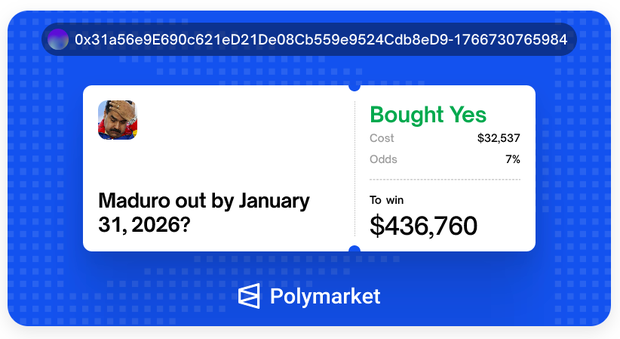
An anonymous user on Polymarket won the payout after placing a roughly $32,000 wager on Maduro's removal — just before President Trump announced the U.S. had ousted the former leader.
The longshot wager raises questions about the anonymous bettor's identity and potential access to inside information ahead of the U.S. operation to seize Maduro and his wife, legal and financial experts told CBS News.
Polymarket, a New York-based cryptocurrency prediction market that recently secured a $2 billion investment from stock exchange operator Intercontinental Exchange, is currently pursuing regulatory approval in the U.S.
Suspicious timing?
A Polymarket account holder, who appeared to join the trading platform in December, bet $32,537 on the likelihood that Maduro would be "out by January 31, 2026." The speculative investment was placed shortly before Mr. Trump announced Maduro's arrest at 4:21 a.m. Saturday on Truth Social.
Experts said several indicators suggest the bettor could have had access to classified information regarding the U.S. operation to capture Maduro.
"It clearly suggests that the bettor did have access to inside information," said Dennis Kelleher, cofounder and CEO of Better Markets, a nonpartisan advocacy group focused on financial reform. "This particular bet has all the hallmarks of a trade based on inside information. It happened very late, right before the very event they were betting on happened; it was a relatively large amount of money; and it happened in a market that is not really regulated and where there is no transparency."
Three additional bets were made via the same Polymarket account: a $1,000 wager on the U.S. invading Venezuela by January 31; a $250 wager that Mr. Trump would invoke the War Powers Act against Venezuela by January 31; and a $146 wager that U.S. forces would land in Venezuela by the end of the month.
"It was a new account only betting on issues around the Venezuelan president's potential removal from office — there are a lot of telltale signs that make it seem like insider trading," Stephen Piepgrass, a regulatory attorney at Troutman Pepper Locke who specializes in futures trading, told CBS News.
Polymarket did not respond to a request for comment on the Maduro-related bets. Last fall, company CEO Shayne Coplan told CBS News that insiders "having an edge to the market is a good thing."
"Obviously, you need to curate them and you need to be really clear and stringent on where the line is drawn and, like, sort of ethics, and we spend a lot of time on that. But it's sort of an inevitability that this will happen, and there's a lot of benefits from it. And, you know, people will adapt," he told 60 Minutes' Anderson Cooper.
Uneven playing field?
The Commodity Futures Trading Commission (CFTC) is the government agency tasked with regulating prediction markets such as Polymarket and Kalshi, another online betting platform that lets consumers bet on a range of news, sports and other events.
But Kelleher contends that the commission's oversight of prediction markets is weak.
"These kinds of gambling markets are almost entirely unregulated. The CFTC is supposed to regulate, but it doesn't have the money, personnel or expertise to do it," he said. "This isn't a case of light-touch regulation — it's a case of no-touch regulation."
The CFTC did not immediately respond to a request for comment.
The Polymarket wager could violate the Commodity Exchange Act (CEA), a federal law regulating futures and options trading, experts told CBS News. Specifically, the CEA prohibits gambling on events related to assassination, terrorism and war.
Kelleher also said the incident highlights the potential risks for other prediction market users.
"Consumers and investors should know that these are totally unregulated, non-transparent markets and that the odds of losing money are incredibly high," he said.
Piepgrass told CBS News that the Maduro bet marks a "flashpoint" in the debate around what he characterized as inadequate regulation of such markets. Enabling insiders with access to confidential information to place bets on the trading forums would disadvantage other customers, he said.
"It's about fundamental fairness," Piepgrass said. "Do you want to be placing bets in an area where some people have information directly relevant to winning that bet, but you do not? If you are a consumer, you have to really question, is that a market you want to participate in."