Picking the Right Transition Strategy
The Idea in Brief
Are you moving into a new leadership position? If you don't correctly diagnose the situation you'll be facing in that role, you risk overrelying on strategies that worked for you in the past. That'll backfire if your new situation requires fresh approaches.
To succeed in your new role, Watkins recommends these steps:
- Diagnose the situation. Are you leading a startup? A turnaround? Realigning a faltering company? Managing a rapidly expanding business?
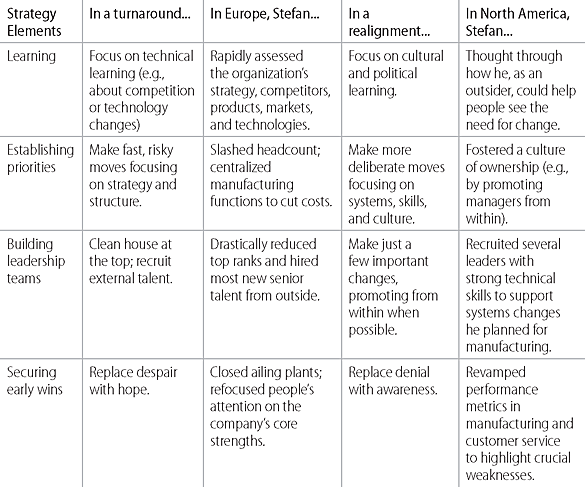
- Select the right organizational strategies. For instance, turnarounds require faster, riskier changes than realignments and call for technical learning (strategies, markets, technologies). Realignments demand mastery of cultural and political nuances.
- Adopt the right leadership style. For example, in turnarounds, people are hungry for hope, vision, and direction. You'll need a heroic style--charging against the enemy, sword flashing. Realignments require stewardship: diplomatic building of consensus around the need for change.
The Idea in Practice
Diagnosing Your Situation
First determine what kind of transition your organization faces. Watkins focuses on two transition types — turnarounds and realignments — to illustrate his recommended process.
In a turnaround, you must save a business recognized as in crisis. Challenges include:
- Reinspiring demoralized stakeholders
- Making effective decisions under pressure
- Going deep enough with painful cuts
In a realignment, you must reenergize a previously successful organization. Challenges include:
- Convincing stakeholders that change is needed
- Restructuring the top team and refocusing the organization
Selecting the Right Transition Strategy
The table illustrates how Stefan, an executive for a U.S.-based consumer-products firm, adapted his transition strategy to two different situations. Stefan first led a turnaround of the company's European manufacturing operations. Then he was asked to realign the company's North American operations.
Adopting the Right Leadership Style
Turnarounds call for heroic leadership. You need to give people a sense of hope, a compelling vision, and clear direction. In Europe, Stefan immediately took charge and made some very painful calls. Because the outlook was bleak, people acted on his directives without resistance.
Realignments require stewardship. You must set aside your ego and patiently build consensus around the need for change. In North America, Stefan resisted the urge to step in and issue directives. Instead, he provided data and let people form their own conclusions. They took ownership of problems and of the change initiatives required to solve them.
Further Reading
Articles
The Ways Chief Executive Officers Lead
Harvard Business Review
October 2004
by Charles M. Farkas and Suzy Wetlaufer
CEOs inspire sentiments from awe to wrath, but there is little debate over their importance in the business world. Their decisions change companies and lives. But what do CEOs do all day? Where do they go? Charles Farkas and Suzy Wetlaufer analyzed interviews with 160 chief executives around the world and examined the attitudes, activities, and behaviors that shape the answers to these questions. At the outset, the authors thought they might find 160 approaches to leadership. Instead, they identified only five, each with a singular focus: strategy, people, expertise, controls, or change.
Harvard Business Review
January 2009
by Mark E. Van Buren and Todd Safferstone
Today's business leaders increasingly rely on coaches for help in understanding how to act in a demanding and volatile world. These confidants and advisers can earn up to $2,000 per hour. To understand what they do to merit that money, HBR conducted a survey of 140 leading coaches and invited five experts to comment on the findings.
Commentators and coaches agreed that the reasons for engaging coaches have evolved over the past decade. Ten years ago, most companies hired a coach to help fix toxic behavior at the top. Today, most coaching is about developing the capabilities of high-potential performers or acting as a sounding board. As a result of this broader mission, there's a lot more fuzziness around coaching engagements, including how coaches define the scope of engagements, how they measure and report on progress, and what credentials a company should look for when selecting a coach.
Do companies and executives get value from their coaches? When coaches were asked to explain the healthy growth of their industry, they said that clients keep coming back because "coaching works." Yet the survey results also suggest that the industry is fraught with conflicts of interest, blurry lines between what is best handled by coaches and what should be left to mental health professionals, and sketchy mechanisms for monitoring the effectiveness of a coaching engagement. The bottom line: Coaching as a business tool continues to gain legitimacy, but the fundamentals of the industry are still very much in flux. In this market, as in so many others today, the old saw still applies: Buyer beware!
- Purchase the full-length Harvard Business Review article here.
- Visit Harvard Business Online.
- See more on Leadership and Managing People at Harvard Business Online.
Copyright (c) 2008 Harvard Business School Publishing Corporation. All rights reserved.