Path forward in Libya still hazy after summit
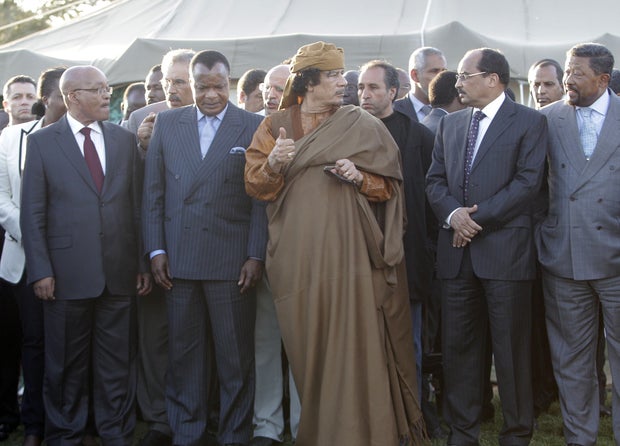
The African Union delegation didn't even have to meet with rebel leaders here to get the message that their peace mission wasn't going to end in total success.
Their official cars had to run a gauntlet of thousands of demonstrators chanting "Libya free, Qaddafi go away" just to reach the entrance to the hotel where talks on the "road map" to end the conflict here were to be held.
One of the four provisions already accepted last night by Libyan leader Colonel Muammar Qaddafi calls for negotiations with him and his regime to create a new political dispensation.
The reception in Benghazi pretty much mirrored the overall situation. The scattered motorcade of notables was nearly swamped in the street outside the once-luxury hotel. And when the luminaries, who are more used to adoration than approbation, arrived at the front entrance, neither the local security men nor the black-suited - and in one case black body-armored - personal security detail for the African leaders could do more than squeeze their charges through a gaggle of journalists.
Complete coverage: Anger in the Arab World
AU says Qaddafi accepts roadmap to cease-fire
More deference was shown to rebel delegates, several of whom arrived in the front seats of dusty, four-wheel drive pickup trucks, the kind favored by rebel fighters.
A ceasefire between them and Qaddafi's forces is one path of the "road map" that might have half a chance. The rebels often retreat as soon as their enemy fights back with rockets or artillery, and have been unable to hold ground they take. Over the weekend, the fighting along the coastal road reached the city of Ajdabiya, a mere 100 miles from Benghazi. Qaddafi's forces outmaneuvered the rebels by making a flanking movement across the desert.
They were prevented from completely swamping the now deserted town of 140,000 residents by NATO airstrikes, and by Monday morning they had retreated.
NATO said planes enforcing the no-fly zone took out up to twenty-five Libyan government tanks around Ajdabiya and the oil port of Brega.
NATO also said it forced a Mig23 that took off from Benina airfield near Benghazi on Saturday to turn back. But the man who says he flew it, and who for security reasons asked to be identified only as Colonel Khalid, told CBS News he not only took off, he fired 128 rounds and took out a fuel truck and two other vehicles near Ajdabiya.
Colonel Khalid, who said he had been in the Libyan air force for 32 years before defecting to the rebels, insisted several times, in English and in Arabic, that he would not have taken off without NATO permission..
"We fly normal and we come back," he said. "I had permission for take-off and for landing."
A military air traffic controller at Benina, Ali El-Shamekh, said the rebel military council asked NATO for flight permission, and it was granted. The stated mission, he said was "to shoot Qaddafi forces."
But NATO disputed the rebel's account. A spokesman said an AWACS plane detected the Mig when it took off and called in two fighter planes, which forced the Mig to return to base.
There are two Mig23 fighters based at the Benghazi airbase.
There used to be a Russian-made Hind 35 helicopter there too, but it went on a mission over the weekend and was hit by fire from the Qaddafi forces. Sources at the airbase here said it had made what they described as "a hard landing".
The African Union peacemakers will probably have a good understanding of that. Before they left Tripoli, the delegation leader, South African president Jacob Zuma indicated that Qaddafi might be ready to make a deal. "The brother leader delegation has accepted the road map as presented by us," Zuma said. "We have to give ceasefire a chance."
If nothing else, his depiction of Qaddafi ruled out any chance Zuma's delegation had of convincing the people in the streets where the revolt began that a deal that would suit them was going to be brokered any time soon.