9 states are cutting individual income taxes in 2026. See if yours is one of them.
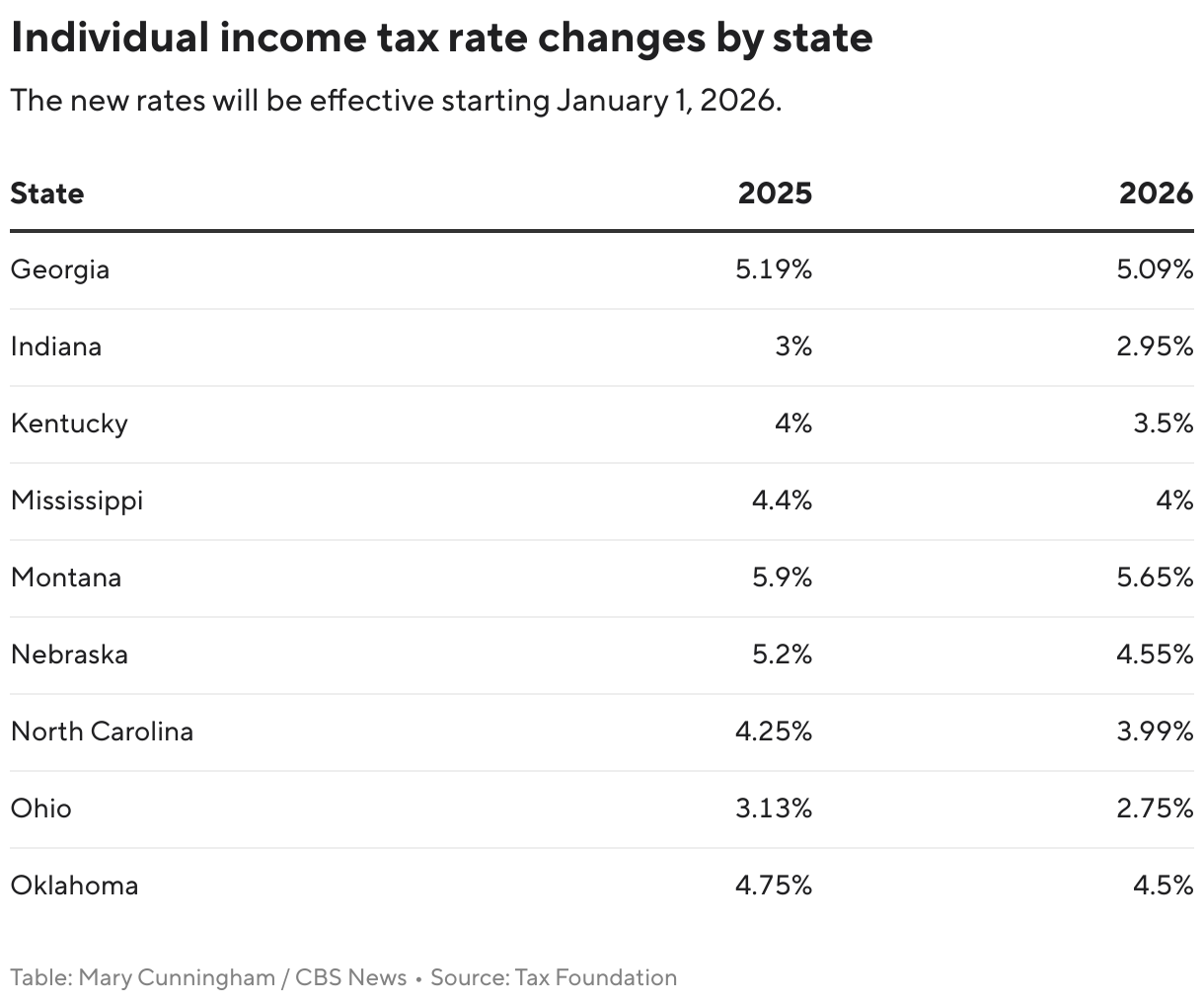
Nine U.S. states are lowering income taxes on Jan. 1, according to a recent Tax Foundation analysis — a move that could give some taxpayers additional financial breathing room as they head into the new year.
The cuts are part of an ongoing effort that began during the pandemic, when many states' budgets ballooned due to federal aid, providing them with an extra incentive to trim state income taxes.
Proponents of the cuts argue that they can spur economic growth and make their states more competitive.
At the same time, groups like the nonpartisan Center on Budget and Policy Priorities have warned that reducing or eliminating state income taxes could stymie investments in public services such as education.
As of October, nine states levied no income tax at all, according to the Tax Foundation.
Read on to learn about the nine states where individual income taxes will be lower starting on Jan. 1, 2026, according to the Tax Foundation.
Georgia
Georgia, where the Republican Party controls both chambers of the state legislature as well as the governor's office, will trim its income tax rate to 5.09% in 2026, down from 5.19% in 2025.
The state is set to decrease its income tax by 0.10% every year until the rate reaches 4.99%, according to WABE, NPR's member station in Atlanta. Some lawmakers have advocated eliminating the state income tax, the outlet reported.
Indiana
In Republican-led Indiana, the state's flat-rate individual income tax — a single rate applied to all taxpayers regardless of income — will fall to 2.95% from 3% at the start of next year, under a budget measure passed by the state legislature in 2023. The rate is slated to drop another 0.05 percentage point to 2.9% in 2027.
Kentucky
Kentucky's individual income tax rate will be cut to 3.5% on Jan. 1, down from its current 4%. The change stems from a 2022 bill that includes a trigger mechanism to incrementally reduce the state's income tax each year, as long as revenue, spending and the budget reserve trust fund meet certain thresholds, according to Louisville Public Media.
Kentucky has a Republican majority in its state legislature and a Democratic governor.
Mississippi
The individual income tax in Mississippi will decrease from 4.4% in 2025 to 4% as of Jan. 1, 2026, in what the Tax Foundation said is the final round of a multi-year scheduled reduction.
New legislation signed by Gov. Tate Reeves, a Republican, in March will reduce the individual income tax rate to 3% by 2030, and allow the state to continue cutting it annually until it reaches 0%.
Montana
A bill passed in the Montana state legislature this year lowers its top marginal rate — the rate applied to the highest portion of a person's income — from 5.9% to 5.65% in 2026, then down to 5.4% in 2027. The new law also expands the number of people eligible for the lowest tax bracket.
Montana has a Republican trifecta, meaning the party controls the governor's office and holds a majority in both chambers of the state legislature.
Nebraska
The individual income tax rate in Republican-led Nebraska will dip to 4.55% starting Jan. 1 from 5.2% currently. The decrease is part of an ongoing reduction that will lower the rate to 3.99% by 2027, the Tax Foundation said in its analysis.
In 2023, the state had a budget of $1.9 billion but now faces a $432 million shortfall, according to the Center on Budget and Policy Priorities (CBPP). Some lawmakers have called on the state to pause the next phase of income tax cuts to shore up the state's budget.
North Carolina
In North Carolina, where the governor is a Democrat and the state legislature is controlled by Republicans, the individual income tax rate will be reduced from 4.25% to 3.99% in 2026.
North Carolina has a flat income tax rate, meaning the same rate applies to all state residents regardless of their incomes.
Ohio
The state's main budget bill this year paved the way for its individual income tax to decline to a flat rate of 2.75% for all nonbusiness income over $26,050, down from 3.125% currrently, according to the Tax Foundation.
After the budget plan was approved, the Ohio House of Representatives said in a release that the move to a flat tax rate "makes Ohio more competitive with surrounding states, simplifies the tax code and spurs revenue."
The Republican party holds the offices of governor, secretary of state, attorney general and both chambers of the state legislature.
Oklahoma
In Republican-led Oklahoma, the top marginal income tax rate will decrease from 4.75% to 4.5% beginning Jan. 1. A tax reform measure signed into law earlier this year also consolidated the state's six individual income tax brackets into three.
Additional savings
Americans could see additional tax savings next year as a result of the Republicans' "big, beautiful bill" act passed this year, which introduced a slate of new tax changes, including lifting the cap on the state and local tax deduction (SALT) from $10,000 to $40,000.
Piper Sandler estimates taxpayers' refunds will be about one-third larger than usual, translating to an average of roughly $1,000 more per filer. The financial services company expects middle- and upper-middle-income households to benefit the most.