National Guard troops patrol New Orleans on New Year's a year after Bourbon Street attack
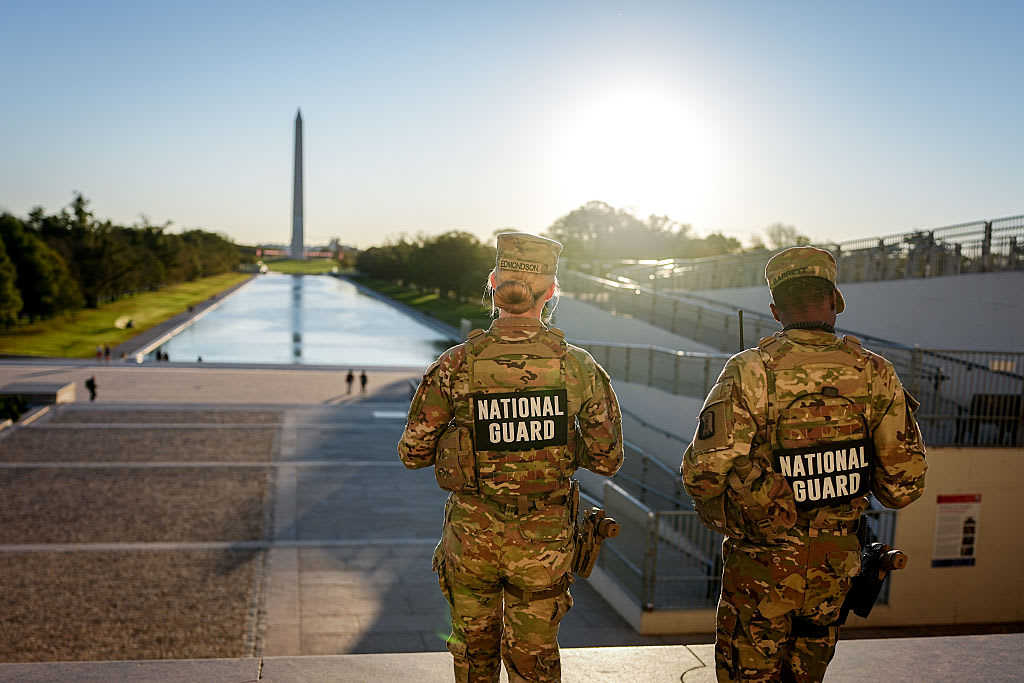
Hundreds of National Guard troops are patrolling the streets of the iconic French Quarter in New Orleans this New Year's Eve, one year after a terror attack killed 14 people and injured dozens of others.
A caravan of National Guard Humvees advanced down Bourbon Street Tuesday night to block off entrances to the street that were not protected by barriers capable of blocking vehicles – marking the start of the Guard's two-month deployment in New Orleans.
Their arrival was met with mixed reactions from people on Bourbon Street.
"There's National Guard everywhere, and they need to get outta here," said one local resident, Phillip, who declined to give his last name. "This is a city where you just live life, live life to the fullest. However, you want National Guard looking over my shoulder? Don't like it."
City leaders say the National Guard's help is a partnership, not an invasion.
"People need people, and they've answered the call to serve in this magnitude, and we should all be grateful," said Mayor LaToya Cantrell.
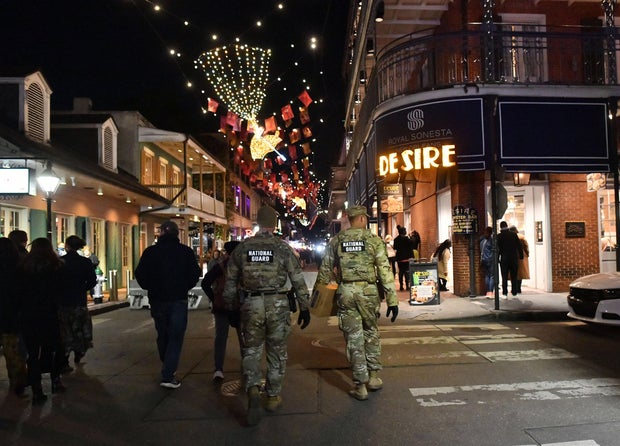
One local resident who works security at a bar on Bourbon Street said the federal support makes him feel safer.
"It doesn't hurt to have the National Guard out here," said the resident, Chris Wolfe.
"Somebody did it once, doesn't mean they won't do it again," he said, referring to last year's attack, when an ISIS-inspired U.S. Army veteran barreled down three crowded blocks in the early morning hours of New Year's Day, attempting to hit as many pedestrians as possible.
Dr. Dwight McKenna, the New Orleans coroner, described the scene as a "nightmare" that still haunts him to this day. He responded with his team of only two other people to conduct forensics.
"When I got the call, I thought it was a mistake," McKenna said. "What I saw was a nightmare, bodies strewn everywhere, body parts here, body parts there, blood everywhere. Young people obviously had been killed, even the perpetrator was down on the ground, and it was, it was a scene I'll never forget … This one still wakes me up at night sometimes."
Many are still seeking justice. Eighty people who were affected by the attack – including loved ones of people killed, attack survivors who were injured, and people who witnessed the attack and now live with anxiety and trauma – claim in a lawsuit against the city that it was a preventable tragedy.
In the lawsuit, filed in October, they allege that some of the barriers that were in place were not working properly at the time. Other barriers for the sidewalk, called archers, were in storage and were not being used.
"It cannot be overstated that the city had the tools at their disposal on New Year's Eve to prevent this attack from occurring, or at the very least stopping it before it became far worse, and they failed to do so," said attorney Michael Ceresa, a partner at Romanucci and Blandin in Chicago, Illinois, which is representing the 80 people named as plaintiffs in the suit against the city.
"Back in 2016, the City of New Orleans undertook a comprehensive review of the security in the French Quarter, determined to find a way to prevent an attack from occurring on Bourbon Street or in the French Quarter, and they put a lot of resources towards implementing security protocols," Ceresa said. "What we know is that that initial plan was failed from the start."
Asked how the city has responded to the lawsuit, Ceresa said "the city has been relatively quiet."
"They have not… made any overtures towards doing right by the victims to this point," he said. "The bottom line is, the city has made no steps to take any accountability for what happened to date."
The City of New Orleans declined to comment due to pending litigation, and pointed CBS News to a press conference about security plans for New Year's celebrations and Sugar Bowl festivities.
In a news release issued Monday about their security plan for New Year's, city officials wrote, "the City of New Orleans is grateful for the federal resources and coordination dedicated to support these events and appreciates the continued partnership. Local, state, and federal partners will continue to work closely to ensure appropriate preparedness, coordination, and situational awareness throughout the event period."
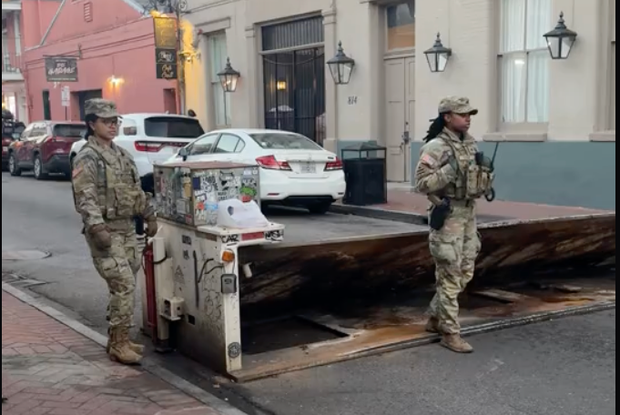
Since the attack, the city has made several improvements to its network of metal barriers along Bourbon Street, to block vehicle traffic during high pedestrian traffic hours. But some people feel it's far from adequate.
"I still think there's a lot of questions that need to be answered that haven't been answered yet," said Christian Pendleton, who manages a restaurant in the French Quarter and serves on the board of the French Quarter Management District.
So far, only one gate that can withstand speeds above 40 miles per hour has been installed – located at the intersection of Canal Street and Bourbon Street, where the attacker first began his rampage.
Pendleton wants stronger gates at many more intersections in the French Quarter.
The city plans to vote on a measure to install more barriers once a newly-elected mayor takes office in January.
"I think it would be fair to say most people expected this conversation to happen months ago," Pendleton said.
Tuesday night before New Year's Eve, as state and federal agents were taking their posts on every block of Bourbon Street, CBS News spotted several vehicles still weaving around crowds of pedestrians in the street.
Meanwhile, Louisiana Attorney General Liz Murrill announced Monday she has completed her investigation into the city's security plan, but said she is not releasing her findings yet due to their sensitive nature. The investigation began after the attack.
Other locals demand a permanent solution beyond federal support and barriers. This week, the city announced that Bourbon Street will be a pedestrian-only zone from sunset on Dec. 31 to sunrise on Jan. 1. Some would like to see it permanently become a pedestrian-only zone, during the daytime, too.
It's a contentious topic, since businesses rely on vehicle access to receive regular shipments of goods.
Brooke Gauthreaux, of nearby Gretna, Louisiana, believes that turning parts of the French Quarter into a permanent pedestrian zone is an important move that could help protect people. Her brother, 21-year-old Hubert Gauthreaux, was one of the 14 people killed in the New Year's Day attack.
"He was so thoughtful" and a "loving human being," Brooke Gauthreaux said. "It's so cliche to say, but he was just the kindest, most beautiful person ever. One of my best friends, truly."
She remembers the night her brother left to go out for New Year's Eve celebrations with friends.
"The second to last thing I told him, other than 'I love you' … I wanted him to stay home so bad," she recalled. "I really just wanted to hang out with him, and I was trying to guilt him into staying home and I said, 'You're gonna be sad when you can't hang out with me and mom when we're dead,' and then he walked out the door and never came home."
She said she doesn't think the city has done enough to improve security since the attack. She hopes other cities will learn from what happened in New Orleans, and craft a security plan and execute it.
"I would love to see a re-working of the city plan," she said. "Because, it would break my heart to think that it could happen again."