NASA hauls Artemis II moon rocket to launch pad for February flight
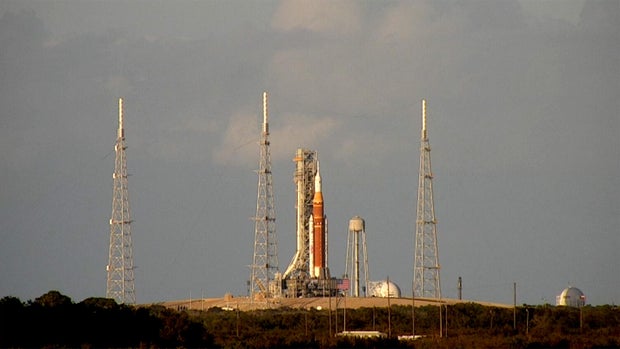
After months of meticulous preparation, NASA's 32-story-tall Space Launch System rocket, the most powerful operational booster in the world, was hauled to its seaside launch pad Saturday in Florida, setting the stage for a long-awaited flight next month to send four astronauts on a trip around the moon.
The 5.7-million-pound rocket, carried by an upgraded Apollo-era crawler-transporter tipping the scales at some six million pounds, began the trip to pad 39B just after 7 a.m. local time, creeping out of NASA's cavernous Vehicle Assembly Building at a top speed of just under 1 mile per hour.
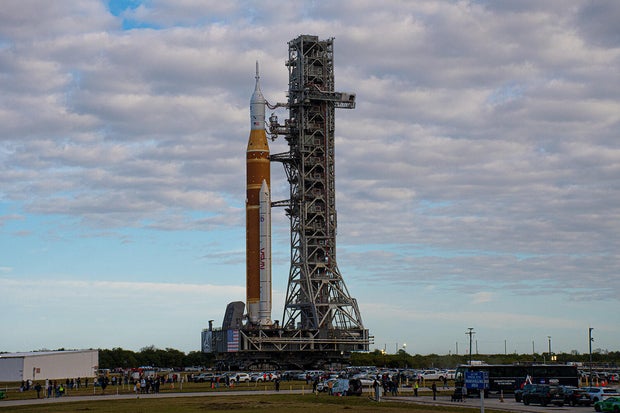
Hundreds of space center workers, family members and guests gathered near the VAB and along the crawlerway to take in the sight, posing for selfies and enjoying a chilly Saturday morning as the towering moon rocket slowly rolled past.
New NASA Administrator Jared Isaacman and the Artemis II astronauts — Cmdr. Reid Wiseman, Victor Glover, Christina Koch and Canadian astronaut Jeremy Hansen — were also on hand to witness the milestone.
"Wow. LETS GO!!!" Wiseman posted on the social media platform X with a photo of the SLS rocket moving out of the VAB. In another post, he called the SLS and its Orion crew capsule "engineering art."
Generating some 8.8 million pounds of thrust at liftoff, the SLS is the most powerful rocket ever operated by NASA, including the agency's legendary Saturn 5 moon rocket. It has a little more than half the thrust of SpaceX's Super Heavy-Starship rocket, but after a successful unpiloted test flight in 2022 — Artemis I — NASA deemed it safe enough to put astronauts aboard.
The SpaceX rocket is still in the test phase, and it's not known when it might make its first flight with people on board.
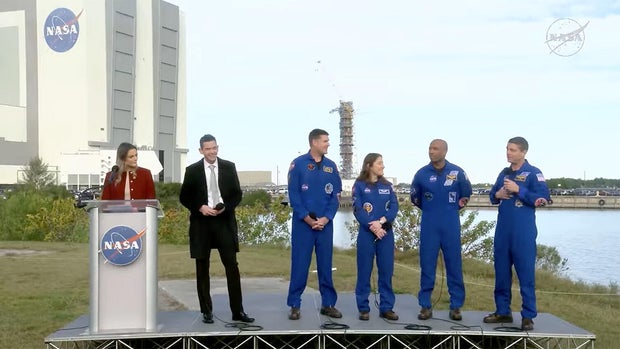
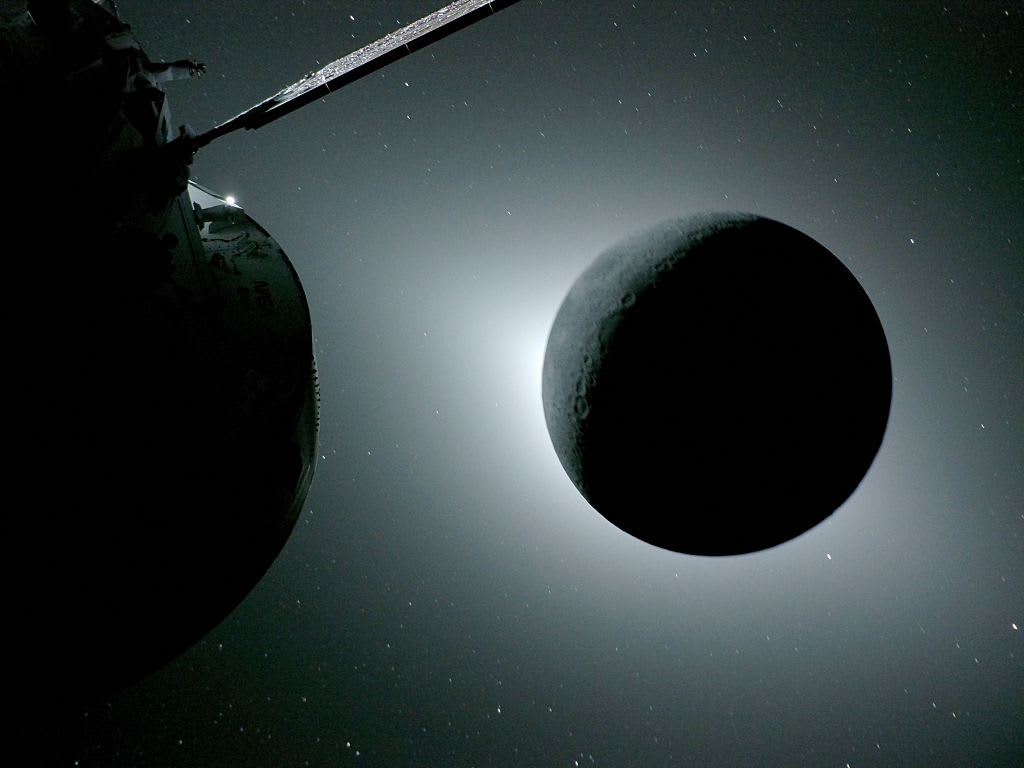
The Artemis II crew plans to blast off in early February to test drive their Orion crew capsule in Earth orbit before heading into deep space on a flight around the moon that will carry them farther from Earth than any astronauts have ever ventured. In the process, they will get a chance to observe the far side of the moon in some detail.
"I think one of the most magical things for me in this experience is when I looked out a few mornings ago, there was a beautiful crescent (moon) in the morning sunrise, and I truly just see the far side," Wiseman told reporters during the SLS rollout. "It was a waning crescent here, so it's a waxing gibbous on the far side."
He added: "And you just think about all the landmarks we've been studying on that far side, and how amazing that will look, and seeing Earth rise, those sorts of things, just flipping the moon over and seeing it from the other perspective is what I think when I look out (at the moon) right now."
The trip to launch pad 39B took about eight hours, kicking off a busy few weeks of tightly scripted tests and checkouts before a critical fueling test around Feb. 2 when nearly 800,000 gallons of super cold liquid hydrogen and oxygen will be pumped aboard for a "wet" dress rehearsal countdown.
"One of the first things that happens after we get to the pad, we get connected ... all the validations, getting tied back to the firing room, getting ready to power up the individual elements," said launch director Charlie Blackwell-Thompson. "We will get into our crew module work (and) we're going to power everything up."
Blackwell-Thompson added: "We have incrementally tested all of this offline or in the integrated environment of the VAB and now it's just getting out to the pad and testing those pad interfaces. ... Wet dress is the big test at the pad. That's the one to keep an eye on, I guess, that's the driver to launch."
The maiden flight of the SLS rocket in 2022 was delayed multiple times by propellant loading problems and persistent hydrogen leaks. For the rocket's second flight, NASA and its contractor team have implemented multiple upgrades and procedural changes to minimize or eliminate any such problems the second time around.
"Artemis I was a test flight, and we learned a lot during that campaign getting to launch," said Blackwell-Thompson. "And the things that we learned relative to how to go load this vehicle, how to load (liquid oxygen), how to load hydrogen, have all been rolled into the way in which we intend to load the Artemis II vehicle."
Because of the relative positions of the Earth and moon, along with the trajectory NASA plans to use for Artemis II, the agency only has five launch opportunities in February: Feb. 6, 7, 8, 10 and 11. Because rollout came a few days later than planned, pushing the fueling test into early February, it would appear only the final three opportunities are still available.
But a leak-free fueling test, in the absence of any other major issues, will clear the way for a launch attempt on one or two of those days. If not, the next set of launch windows opens in March.
A wild card in the mission planning is the launch of a fresh crew to the International Space Station to replace four crew members who returned to Earth ahead of schedule Thursday because of a medical issue affecting one of the astronauts. That launch originally was scheduled for Feb. 15, but NASA managers are looking into moving it up by several days to minimize the gap between crews.
NASA flight controllers want to avoid flying two piloted spacecraft at the same time. If the space station crew replacement flight stays on track, or if problems are found during the SLS fueling test, agency managers might be forced to delay the Artemis II launch to the next set of opportunities in March.
But Isaacman is keeping NASA's options open.
"We have, I think, zero intention of communicating an actual launch date until we get through wet dress," he said. "But look, that's our first window, and if everything is tracking accordingly, I know the teams are prepared, I know this crew is prepared. We'll take it."