Kilmar Abrego Garcia leaves ICE detention after federal judge ordered his release


Washington — Kilmar Abrego Garcia returned to his Maryland home Thursday night, after a judge ordered the immediate release of the Salvadoran national who was mistakenly deported to his home country earlier this year.
Abrego Garcia's attorney, Simon Sandoval-Moshenberg, told CBS News on Thursday that he was officially out of Immigration and Customs Enforcement custody in Pennsylvania. Hours later, he was spotted arriving at his home in Maryland.
Abrego Garcia was instructed to check in at an ICE field office in Baltimore at 8 a.m. Friday, his legal team told CBS News. When he was given similar instructions over the summer, following his release from pretrial detention, he was taken into ICE custody, and there are concerns he could be rearrested Friday on different legal grounds.
Overnight, his lawyers asked U.S. District Judge Paula Xinis, who has been presiding over his case, to issue an emergency order blocking immigration officials from re-detaining Abrego Garcia after an immigration judge "unlawfully issued a purported removal order" Thursday night, they said in a filing.
Xinis granted that request on Friday morning, prohibiting the Trump administration from taking Abrego Garcia into custody once again. She ordered his lawyers and the Justice Department to submit additional filings.
"If, as Abrego Garcia suspects, [immigration officials] will take him into custody this morning, then his liberty will be restricted once again. It is beyond dispute that unlawful detention visits irreparable harm," she wrote in a brief order.
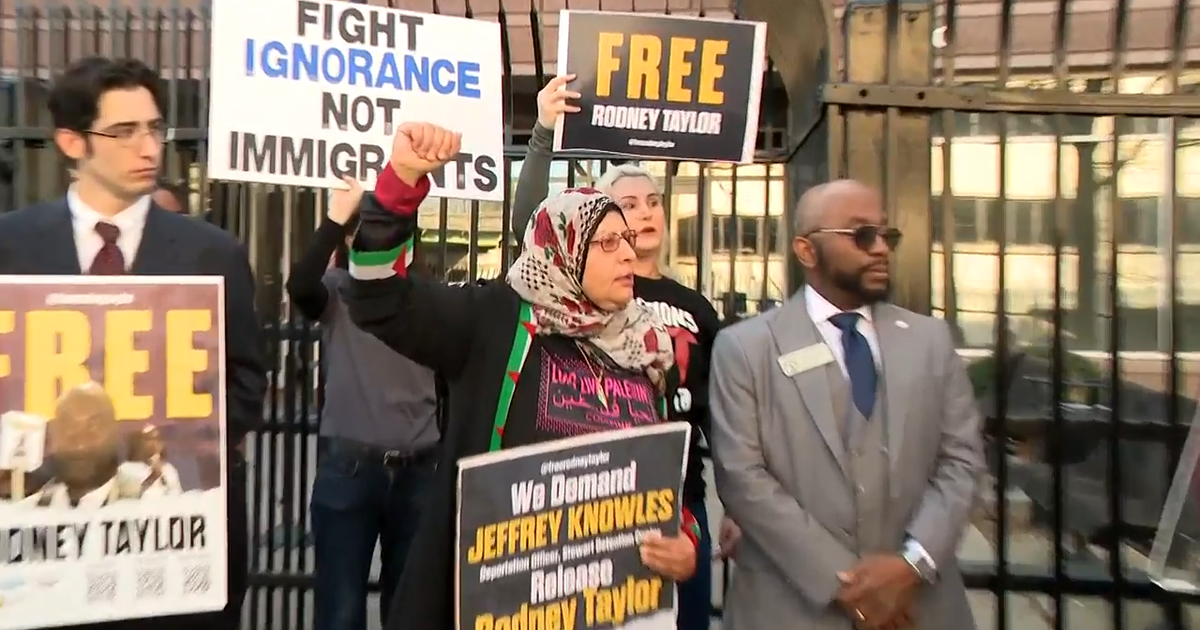
Sandoval-Moshenberg said during a rally outside the ICE field office Friday that because of the judge's latest order, Abrego Garcia would remain free.
The overnight court action came after Xinis granted Abrego Garcia's habeas corpus petition seeking release from custody Thursday morning. It's a significant victory for Abrego Garcia, whose immigration case became a major flashpoint in President Trump's mass-deportation campaign when he was removed to El Salvador earlier this year. An earlier order had prohibited the U.S. from removing him to his native country because of possible persecution by local gangs.
Xinis, in her order, found that there was no final order of removal from the government to deport Abrego Garcia from the United States, despite the Trump administration's repeated attempts to remove him.
"Because respondents have no statutory authority to remove Abrego Garcia to a third country absent a removal order, his removal cannot be considered reasonably foreseeable, imminent, or consistent with due process," Xinis wrote in Thursday's order.
"Although respondents may eventually get it right, they have not as of today," the judge continued. "Thus, Abrego Garcia's detention for the stated purpose of third country removal cannot continue. Respondents' conduct over the past months belie that his detention has been for the basic purpose of effectuating removal, lending further support that Abrego Garcia should be held no longer."
Assistant Department of Homeland Security Secretary Tricia McLaughlin called the judge's decision "naked judicial activism by an Obama-appointed judge."
"This order lacks any valid legal basis and we will continue to fight this tooth and nail in the courts," McLaughlin said.
The Trump administration has been attempting to re-deport Abrego Garcia to the African nations of Uganda, Eswatini or Ghana, but none of the countries have agreed to accept him.
In October, however, the administration informed the court that Liberia had agreed to take Abrego Garcia and was making "final necessary arrangements" for his deportation there.
Sandoval-Moshenbergsaid at the time that unless Liberia guaranteed it would not send Abrego Garcia to El Salvador, deporting him to the West African nation "is no less unlawful than sending him directly" to his home country again.
In November, the Trump administration argued that Abrego Garcia had received significant due process in the U.S. In a court filing, the Justice Department said a U.S. government asylum officer had interviewed Abrego Garcia, who has been in federal immigration detention since late August, and determined he had failed to prove he would face persecution or torture in Liberia.
Xinis heard testimony in October from John Schultz, an ICE official, about the Trump administration's efforts to remove Abrego Garcia. Schultz said the administration remains in active discussions with Eswatini about removing him there, though the east African country rejected a request to take him.
Schultz said that once the administration has been informed that a third country is willing to accept Abrego Garcia, it could deport him within 72 hours if allowed by the court.
Abrego Garcia has said he is willing to go to Costa Rica and designated the country as his preferred country of removal, and Costa Rica has indicated it would provide him refugee status or residency. But during the hearing Oct. 10, a Justice Department lawyer said there had not been discussions about deporting him there.
Lawyers for Abrego Garcia accused the Trump administration of gamesmanship and deliberately seeking to remove him to countries where he could raise claims of reasonable fear of persecution, with the goal of keeping him detained for longer.
Abrego Garcia came to the U.S. from El Salvador in 2011 and has lived in Maryland with his wife and children. But he was arrested by immigration authorities in March and deported there, though he'd been granted the legal status in 2019 that should have prevented his removal to that country.
As part of a civil case Abrego Garcia and his wife brought against the Trump administration, Xinis ordered DHS to facilitate his return to the U.S. But immigration officials resisted doing so for months. Abrego Garcia was brought back to the U.S. in June, but only after a federal grand jury in Tennessee indicted him on two charges of human smuggling, stemming from a November 2022 traffic stop.
Abrego Garcia pleaded not guilty, and a judge in Tennessee ordered him to be released on bail ahead of a criminal trial set to begin in January. But he remained in criminal confinement for several more weeks because of concerns from his lawyers that immigration authorities would arrest him upon his release and deport him from the U.S.
He was released from jail in Tennessee in August and returned to Maryland. But days later, he was taken into custody by immigration authorities after being summoned for an interview at an Immigration and Customs Enforcement office in Baltimore. The Trump administration notified Abrego Garcia's lawyers he could be deported to Uganda, though Abrego Garcia expressed fear of persecution and torture, as well as a concern that the Ugandan government would send him back to El Salvador.
Abrego Garcia also filed a new legal challenge to his confinement and the Trump administration's efforts to deport him for a second time, which Xinis is presiding over. She has blocked immigration officials from removing Abrego Garcia from the U.S., and he had since remained in detention at a facility in Pennsylvania.
At the heart of Abrego Garcia's challenge is a 2001 Supreme Court case, in which the high court said the government cannot indefinitely detain a person in the U.S. illegally if there is no significant likelihood of removal in the "reasonably foreseeable future."
Abrego Garcia's lawyers argued that he has been in near-continuous confinement since March, when he was deported to El Salvador and held in prisons there. His only period of freedom was for a weekend in August, in between his release from criminal custody in Tennessee and his arrest by immigration authorities in Maryland.