Jessica Dovey and the MLK misquote trend: How one Facebook status changed everything
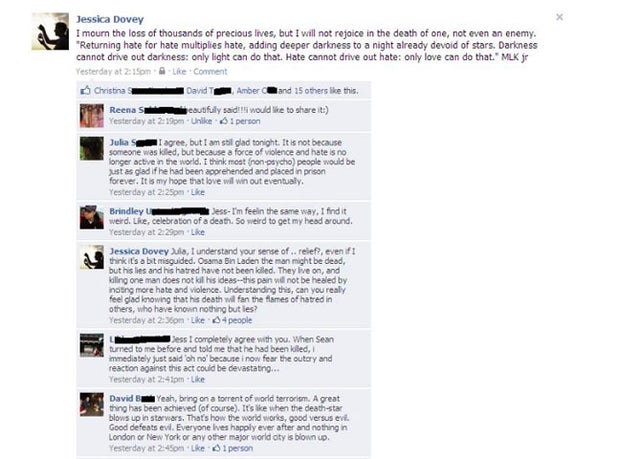
This morning, I linked to an article written by Megan McArdle of The Atlantic, in which she established that the Martin Luther King Jr. quotation trending on Twitter was misattributed. She also asked the question that launched (almost) a thousand comments: Assuming the misquote was intentional, why would someone fake an #MLK quotation?
Like the tweet she wrote about, McArdle's article soon attracted attention. Hundreds of people responded to the article and soon the comment section hosted a variety of arguments and tangents. Many people worked to locate the source of the quote, and many others criticized McArdle for not getting to the bottom of it herself.
I will mourn the loss of thousands of precious lives, but I will not rejoice in the death of one, not even an enemy. "Returning hate for hate multiplies hate, adding deeper darkness to a night already devoid of stars. Darkness cannot drive out darkness; only light can do that. Hate cannot drive out hate, only love can do that." MLK Jr.
The development of this story is noteworthy for a couple of reasons. First, it shows how crowd sourced fact checking has become an essential part of the journalistic process. When many people saw holes in the story presented to them, they took it into their own hands to rewrite the story.
Second, the misquote is important in itself. Dovey's words resonated with people so much so that when the source was called into question -- potentially discrediting the quotation -- people passionately sought for the truth. Her words expressed a feeling that was lacking in the zealous celebrations over the murder of Osama Bin Laden, and therefore, they became news.