How Mobile Apps Are Revolutionizing Advertising.
When Steve Jobs announced that Apple has sold 30 million iPhones worldwide, Madison Avenue's ears must have been ringing.
Just as Apple's game-changing phone upended the way we use mobile — giving us powerful pocket computers for emailing, Web surfing, and Twittering our every move — it's now upending the world of advertising.
Take a look at the iPhone app store, which now contains 75,000 choices (and counting). A new brand seems to emerge with every refresh of the screen. What was once a funky garage where techheads dropped their latest gizmos is now a mash up of supermarkets, auto dealerships, and strip malls. Right this way on aisles A through G, you'll find Audi, Coke, Gap, and Gillette. Further along it's IBM, Kraft Foods, Nestl , and Target. All of them pioneers in a growing marketplace.
In the past six months or so, chief marketing officers have been walking into meetings with ad giants like OgilvyOne Worldwide and not just listening to pitches on building apps, but insisting on hearing about them.
The reason is largely personal. "Marketing officers now go home, pull out their iPhones and check out new music with Shazam or cruise the Internet while sitting on the couch," says Brian Fetherstonhaugh, chairman and CEO of OgilvyOne, the interactive unit of Ogilvy & Mather. "It's making this medium relevant in their hands, hearts, and minds."
While spending in the U.S. ad industry shrank 15 percent in the first half of this year, mobile — from text alerts and banner ads to Web sponsorship and apps — was on the rise. Globally, it's expected to grow from a slim $913 million this year to as much as $13.3 billion in 2013, as mobile phone users continue migrating to smart phones and flat-rate data plans come down in price, according to research firm Gartner.
For the uninitiated, apps are software applications like those that we all use on our computers, except they're designed for smart phones. A couple of quick taps on the screen, for example, and your iPhone can create a personalized radio station or turn into a GPS device that guides you to the top-rated wine bar in the neighborhood.
The appeal of apps is obvious to anyone with an iPhone, or even one of the runner-up smart phones. Most of the popular smart phones – RIM's Blackberry, Google's Androids, and Nokia's—are linked with apps stores, or will be soon. Microsoft says it plans to roll out its app store this fall. Unlike text or visual ads, which fight for your attention, apps offer a rich and welcome experience. Even better, they are the experience.
The Live Event App
When IBM wanted to impress tennis fans at this year’s US Open in New York, it made an app for that. Big Blue, the longtime chief sponsor and score tabulator for the tournament, uses the Open to foster its image as a cutting-edge innovator that can find solutions — in the argot of its marketing — for a smarter planet.
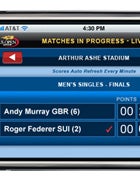
IBM's US Open app
Its app gave fans a virtual front-row seat, and plenty more. IBM pushed out real-time scores, player stats, and its radar-gun readings, which measured, among other things, Andy Roddick’s 145-mph serve. Add to that live radio broadcasts, video feeds, and Twitter dispatches from the likes of Roddick and pre-meltdown Serena Williams, and suddenly last year’s mobile phone seemed like a wooden tennis racket.
The execs at IBM were ecstatic. About 100,000 fans downloaded its free app in the first few days it was available. For a live-event promotion, that’s a big success. But the folks at IBM say the numbers aren’t even the point. Rather, they’re looking at the power of the medium and the new possibilities it offers.
Check out what IBM did in June at Wimbledon, another Grand Slam tournament it sponsors. IBM built an Android app that used sensors to let fans interact with the happenings at the complex. Spectators pointed their phone’s camera lens at a spot on center court to get scores and players’ stats in real-time. And they aimed at another marker to get an instant read on which line was shortest for souvenirs or strawberries and cream.
“Five years ago we were doing Web sites on mobile phones that were very text based and not popular at all,” says John Kent, the program manager for IBM’s sponsorship marketing team. “Apps deliver form and function, and users stay on them.”
The Get-Them-Hooked App
Make an app useful, the thinking goes, and you will create loyal customers. That’s the advice of Eric Bader, who is the president of mobile marketing firm Brand in Hand, which counts Procter & Gamble among its clients.
Bader encourages marketers to invest plenty of time up-front figuring out just what they want their app to do. Remember, he says, this is neither a cell phone nor a computer; it’s a handheld computer, and as such it should incorporate functions for people on the move. The features can be simple, Bader points out, so long as they’re useful.
Two of his personal favorites: A Starwood Hotels app that makes it a snap for him to book rooms and then find his hotel with an interactive map, and it automatically keeps track of his reward points — features that make him seek out Starwood when he travels. And an American Airlines Web-based app, which lets him present his boarding pass as a bar code directly on his iPhone, creating a true paperless way to go through airport security and board the plane. “These are rich, intelligent, and they create a relationship with the brand,” says Bader, who didn’t work with either company on their products.
In that same vein, Nestlé built an app for a super-attentive group: expectant moms. Its app, which so far is only available in France, offers advice on vitamins, morning sickness, diet, and choosing a name; it also provides an easy way to connect expectant moms to one another.

Zipcar's soon-to-be released app
“Moms have their cell phones on them all day,” says Maria Mandel, an executive director of digital innovation at OgilvyOne, which built this app and the one IBM used for the US Open. “They open their phone and they see Nestlé. It’s very powerful.”
The features keep getting more impressive. The car-sharing service Zipcar, for instance, is about to release an iPhone app that, using GPS technology, lets customers locate and book a car. Then, when users arrive at the parking lot, they tap on the phone and the car’s horn honks so they can find it. Naturally, they unlock the car by tapping on the phone as well.
The Goofy Brand-Builder App
TV ads have long incorporated humor to create a playful or hip image around a brand, and marketers are using apps to do the same thing.

Gillette’s uART iPhone app
Look at Procter & Gamble’s Gillette’s uART iPhone app, for example; aimed at young men, it attempts to make Gillette fun and personal. Users upload or snap a picture of themselves or friends, then use a finger to “shave in” facial hairstyles — a hipster goatee, perhaps, or biker lamb chops.
“It’s pure silliness,” says Bader, who didn’t work on the app. “It’s not going to make products fly off the shelf. But it’s effective at getting attention and brand notice.”
Making Your App Stand Out
- Five Strategies for Making a Smart App
- How to Innovate Like Apple
- The 5 Inviolable Rules of Branding
Getting your app noticed is another matter entirely, and that in itself has become an enormous challenge as the number of apps in the iTunes store climbs toward 100,000.
Apple says you can’t buy your way to a front-page display. It might, however, feature a marketer’s app on its site, or even in one of its print or TV ads. But that’s entirely up to Apple, which wouldn’t talk about its methodology. Remember, too, that Apple’s motivation is to use the appeal of someone else’s app to sell iPhones.
To try to push themselves to the front of the line, many marketers are making their apps free. Sure, they eat the development costs, which according to Forrester Research, run from $20,000 to $150,000. But in return, they get far more downloads, and, if they really score, they might land a spot in the app store’s “what’s hot” category.
Naturally, companies are also heavily promoting their apps on their own Web sites. And they’re working the viral angle, trying to build “app buzz” via Facebook and Twitter, and hoping their app is offbeat or creative enough to attract traditional media attention.
But powerful behind-the-scenes technological tricks are helping out as well. One of the most effective methods, according to Mandel, delivers ads directly to iPhone users when they are using their iPhones to visit a Web site. The destination site, whether it’s CNN, The New York Times, or MSNBC, sniffs out that you are using an iPhone and shows you a banner ad for an app.
“The technology is really driving things here because it allows you to specifically target 100 percent of your audience,” says Mandel, who also chairs the Mobile Marketing Association in the U.S. “When you’re on that Web site, I know you’re an iPhone user, and I can offer you this app that I know works on your iPhone.”
Steve Jobs also accomplished something he did not intend: Not only is the iPhone creating an entirely new form of advertising, but it could become the device that actually makes the long-maligned banner ad useful, at least on cell phones.
More on BNET: