Floodwaters plaguing Northeast start to recede
WILKES-BARRE, Pa. - Stretches of the swollen Susquehanna River in New York and Pennsylvania were receding Friday morning after days of rainfall from what had been Tropical Storm Lee flooded communities around the Northeast, sweeping homes off their foundations and forcing nearly 100,000 people to seek higher ground. At least 11 deaths have been blamed on Lee and its remnants.
The damage was concentrated along the Susquehanna in Wilkes-Barre and dozens of miles up the river in Binghamton, N.Y., as well as other communities along the river. The National Weather Service said the Susquehanna crested above 38 feet Thursday night in Wilkes-Barre — below the top of the levee system protecting residents in northeastern Pennsylvania.
CBS News correspondent Elaine Quijano, reporting from Wilkes-Barre., said that the force of the cresting Susquehanna actually pushed a bridge more than a foot.
The flood waters that inundated the city of Binghamton and surrounding communities were receding Friday morning, but there was no indication yet when some of the 20,000 evacuees could expect to return to their homes.
Broome County Deputy Emergency Manager Raymond Serowik told The Associated Press that the Susquehanna was receding slowly and that authorities were just beginning to gain access to some areas to assess the damage from Thursday's record flooding.
The mayor of Binghamton said the flooding was the worst in more than 60 years.
Lee's impact was felt widely in already waterlogged Pennsylvania, as authorities closed countless roadways, including some heavily traveled interstates, and evacuation shelters were opened to serve the many displaced people. Similar scenarios played out in Maryland and New York, but the fading storm's wrath was also felt from Connecticut to Virginia.
President Barack Obama declared states of emergency in Pennsylvania and New York early Friday, clearing the way for federal aid.
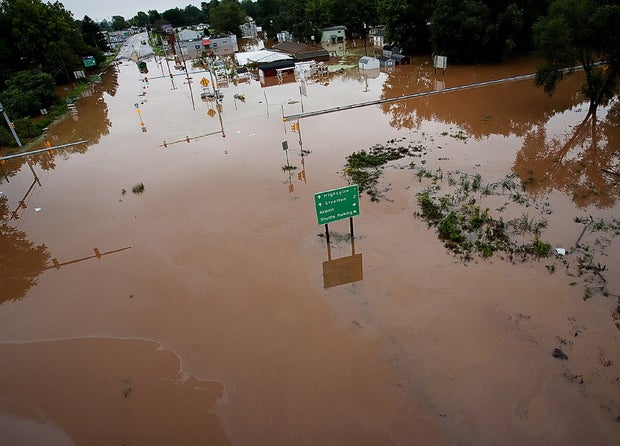
Rose Simko was among some 75,000 residents of Wilkes-Barre and neighboring communities who left Thursday under a mandatory evacuation order. As she packed her belongings into a car and prepared to drive away from her home, which sits about 150 feet from Wilkes-Barre's levee, she said she knew she had to get out.
"Everything is replaceable," she said, "but my life is not."
Evacuees were told to expect to stay at least until Sunday or Monday, and it will be some time before officials get a handle on the damage that included a partial bridge collapse in northern Pennsylvania, vehicles and other property swept away, and failed sewage treatment plants.
"We're going to have some damage, but you won't know until it's over," said Wilkes-Barre Mayor Tom Leighton.
The flooding was fed by drenching rains from Tropical Storm Lee that continued for days, and followed a little more than a week the dousing that Hurricane Irene gave the East Coast. In some areas of Pennsylvania the rainfall totals hit 9 inches or more, on top of what was already a relatively wet summer.
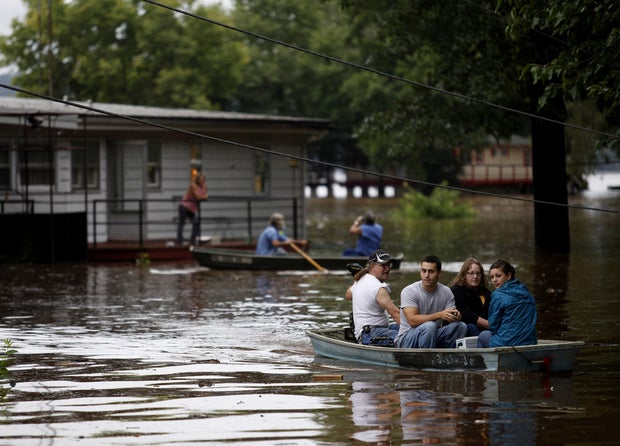
People in many small towns and rural areas in central Pennsylvania scrambled to get their families and their belongings out of harm's way as waters sometimes rose with frightening speed.
In West Pittston, which is near Wilkes-Barre but unprotected by the levees, several hundred homes were under water — many to the second floor, said former Mayor Bill Goldsworthy. Goldsworthy's own home was among those inundated.
It was the same story downriver in Plymouth Township, where floodwater swamped about 80 businesses and houses.
Further down the Susquehanna River in Bloomsburg, flood waters topped the height reached by Hurricane Agnes in 1972 and were expected to crest just short of the record set by a 1904 flood.
Harrisburg evacuated 6,000 to 10,000 residents in low-lying areas, while in Luzerne County, Pa., which includes Wilkes-Barre, the evacuation order covered all communities along the Susquehanna River that were flooded in the historic Hurricane Agnes deluge of 1972.
About 75 people and five pets were staying at a Red Cross shelter at Solomon-Plains Elementary School in Plains Township, outside Wilkes-Barre, many clustered around a big-screen TV to watch news coverage of the flooding.
Christina Holmes, 38, came with her fiancDe and three children. Before leaving their apartment in Wilkes-Barre, they unplugged appliances and picked up items off the floor. Holmes said she's been told to expect to stay at the shelter at least through Sunday.
"I'm trying to make the best of it," she said. "I brought the (playing) cards. I brought the games for the kids."
She said it's been a long time since they've seen sunny, blue skies.
"We've had rain for about five straight days and it's like, as soon as it's done, it picks back up," Holmes said.
Late Thursday, Wilkes-Barre city crews scrambled to plug holes in the city's elaborate flood control system with sandbags. The river's dramatic rise began to slow, giving hope that the walls and earthen mounds would hold.
In nearby places unprotected by the levee system, however, emergency officials expected catastrophic flooding of 800 to 900 structures, as the river was likely to crest above some rooftops.
At least 11 deaths have been blamed on Lee and its aftermath: four in Pennsylvania; two in Virginia; one in Maryland; and four others killed when it came ashore on the Gulf Coast last week.
The heavy rains also shut down parts of the Capital Beltway in Fairfax County, Va.; some portions have reopened. As many as 10 inches of rain have fallen in some places in the area around Washington since Wednesday.
In northeast Maryland, most of the 1,000 residents of Port Deposit were told to evacuate after the massive Conowingo Dam, upstream on the Susquehanna, opened its spill gates, and hundreds more were told to leave their homes in Havre de Grace, where the river meets the Chesapeake Bay. Shelters were opened in Perryville and Aberdeen, with river levels projected to be their highest since Hurricane Agnes.
There were also mandatory evacuations in a neighborhood along the Housatonic River in Shelton, Conn., just as residents were mopping up from the mess Hurricane Irene left behind.
"I even have fish swimming in my garage, that's a first," Brian Johnson told the Connecticut Post. "There's minnows swimming in there."