How California quietly adds hundreds in hidden fees to drive up traffic tickets

Getting a traffic ticket is a terrible feeling that is made even worse when you find out how much it's going to cost you.
What you may not realize is that buried in the dollar amount you're told to pay is a long list of hidden fees, some that have nothing to do with traffic. CBS News California Investigates looked at what you're paying for and why.
A red light camera recorded Kris Kahrs as she drove through an intersection in April 2025.
"As I was pulling, approaching this light, which was starting to turn yellow, there was no chance to stop at that point," she said.
The citation came in the mail soon after with a bail amount of $486, Kahrs noted. But here is the catch: Her citation was just $100.
So why did she have to pay more than four times that? That is due to hidden fees, which are technically illegal under California law, unless you're a state agency.
It turns out lawmakers have been tacking on nearly a dozen different hidden fees to traffic tickets over the years. Some of those fees, like the Fish and Game Preservation Fund, have absolutely nothing to do with traffic violations.
"It feels like they're trying to hide something," Kahrs said.
California lawmakers have been quietly using traffic violations as a revenue generator for the state, or at least they've been trying. But as the state faces a multi-billion-dollar deficit, state data reveal revenue has been decreasing year after year.
Nearly a decade ago, California's Joint Legislative Audit Committee commissioned a state audit, which was paid for by your tax dollars. The auditor found the "seemingly arbitrary" fees and fines "not directly connected to the offense" or clearly "based on program needs."
The auditor urged lawmakers to "reconsider the entire penalty and fee structure."
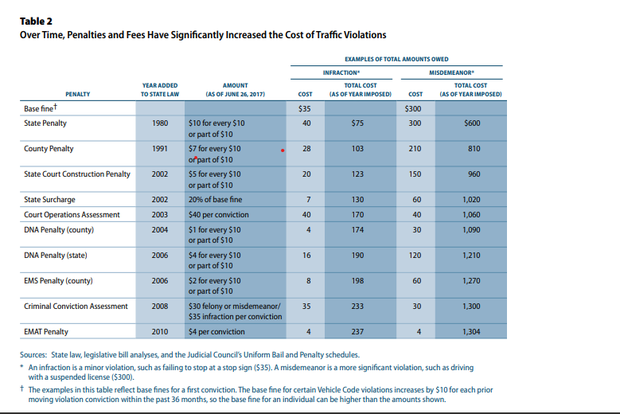
Eight years later, the auditor said he is still waiting for lawmakers to take action.
"It's not very effective because it's inefficient. People can't pay what they don't have.
Brandon Greene with the Western Center on Law and Poverty points to the auditor finding that "traffic fines have gone unpaid partially because they are a significant financial burden," a disproportionate financial burden for low‑income drivers.
"We have to be honest about who is being impacted," Greene said.
He said he believes lawmakers would rather continue struggling to collect than risk upsetting powerful interest groups or vocal voters by imposing new taxes.
"The people we're talking about are not the people who can send an email or call a legislative office," Greene said.
So for now, despite a decade's worth of data showing declining revenue and clear recommendations from an audit you paid for, Kahrs says "people are struggling."
It appears lawmakers will continue to do the same thing and hope for a different result.
"I don't think that's fair, and I don't think that it'll work for us anymore," Kahrs said.
Kahrs got around paying the fines by hiring Ticket Snipers, one of a growing number of companies that specialize in helping drivers fight tickets in court. The price for the service was $179.
CBS News California asked Gov. Gavin Newsom's office whether it has plans to address these hidden fees. His team didn't answer that question directly, but a spokesperson from the California State Transportation Agency released the following statement.
"The state believes traffic-related fees should be appropriate, transparent, and encourage safe and responsible driving. Every Californian deserves safe roads and a fair system of accountability," said Kimberly Erickson, with the CSTA. "We continue to work with the legislature, courts, and local partners to ensure penalties advance public safety while maintaining affordable access to transportation for all Californians."
However, the head of the Assembly Transportation Committee tells CBS News California Investigates that she was unaware of the issue until we brough it to her attention.