Court upholds Prop 50, allowing California to use its newly redrawn congressional maps
A federal three-judge panel for the U.S. Central District Court of California upheld Prop 50, ruling that Democrats can proceed in using their newly redrawn congressional maps in the state for the 2026 midterm elections.
The court found "that the evidence presented reflects that Proposition 50 was exactly what it was billed as: a political gerrymander designed to flip five Republican-held seats to the Democrats."
The judges rejected Republican plaintiffs' claims that the maps had been drawn to favor Latino voters over other voting groups. The opinion was written by Judge Josephine Stanton, with Judge Kenneth Lee dissenting in the 2-1 decision.
The Trump administration and California Republicans sued Gov. Gavin Newsom and California Secretary of State Shirley Weber, claiming the recently approved congressional maps were drawn to favor Hispanic voters over other racial groups. Republicans argued race was a predominant factor in drawing the district boundaries, in violation of the 14th and 15th Amendments.
Republicans had asked the court for a preliminary injunction that would block the maps from being used in 2026.
In a statement after the ruling, California Gov. Gavin Newsom said, "Republicans' weak attempt to silence voters failed. California voters overwhelmingly supported Prop 50 — to respond to Trump's rigging in Texas — and that is exactly what this court concluded."
Rob Bonta, the state's attorney general, pointed out that there have so far been no successful challenges to the measure.
"Today's decision upholds the will of the people. It also means that, to date, every single challenge against Proposition 50 has failed," Bonta said in a statement.
In November, California voters backed the new maps through the ballot measure known as Proposition 50, voting to amend their state's constitution so that the new map could be used from 2026 to 2030. The new map shifts five of California's Republican U.S. House seats to be more favorable to Democrats in the midterm elections this year.
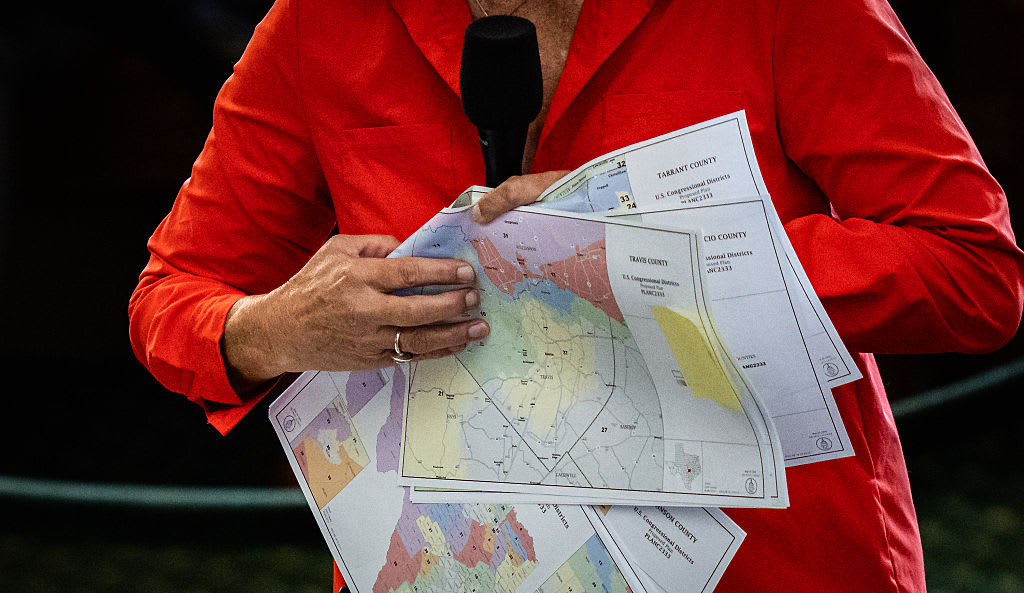
California Democrats argued in court that the new congressional maps were drawn for partisan reasons and to shore up support for vulnerable Democratic congressional candidates. They said they were retaliating against Texas' redistricting legislation, signed into law in August, which aims to help Republicans secure five additional House seats.
In December, the Supreme Court allowed Texas to keep its redrawn maps. In its ruling, the Supreme Court said that "Texas adopted the first new map, then California responded with its own map for the stated purpose of counteracting what Texas had done."
In a concurring opinion, Justice Samuel Alito, who was joined by Justices Clarence Thomas and Neil Gorsuch, wrote that "it is indisputable – that the impetus for the adoption of the Texas map (like the map subsequently adopted in California) was partisan advantage pure and simple."
Ahead of Wednesday's ruling, legal sources familiar with California's case contended that Republicans would face an uphill battle in court, given the Supreme Court's go-ahead ruling on the Texas case, and would likely not be able to meet the burden of showing that race was the predominant factor in redistricting.
At the core of Republicans' case in court were public statements made by Paul Mitchell, head of the consulting firm tasked to draw the congressional maps for California. Mitchell told outside groups he intended to bolster Latino voters in the 13th Congressional District.
After the closing arguments in December, Bill Essayli, the U.S. attorney for the Central District of California, told CBS News that Mitchell's intent in using race as a factor was clear from his statements.
"In this case, we do have an admission from Paul Mitchell that that was his intent, and that was his purpose," Essayli said.
During the closing hearing, U.S. District Judge Josephine L. Staton pushed back on the federal government's argument, raising California voters's support for the ballot measure.
Mitchell did not testify in court during the three-day hearing, despite Republicans' attempts to call him as a witness.
The case has been closely watched as the race for control of the U.S. House in next year's midterm elections gets underway. Along with California and Texas, several other states have also engaged in gerrymandering efforts.
Read the full opinion here: