Bondi Beach suspects reportedly trained in the Philippines, where there's a decades-old Islamist insurgency
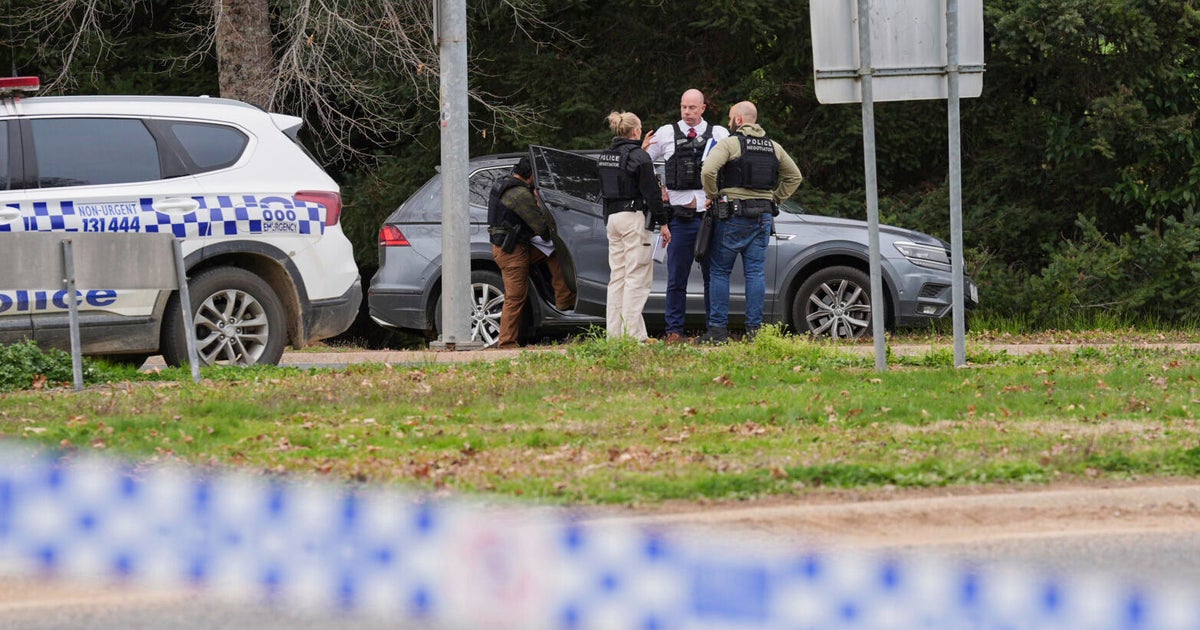
The father and son suspects in the terror attack on Jewish people gathered for a Hanukkah event in Bondi Beach, Australia, spent most of November in the Philippines, police said Tuesday. Australia's Prime Minister Anthony Albanese said, meanwhile, that the attack was "motivated by ISIS ideology."
New South Wales Police Commissioner Mal Lanyon told reporters that investigators were still looking into the reasons for the trip and where exactly the men went between Nov. 1 and 28. The Philippines Bureau of Immigration said Sajid Akram, 50, who was killed during the attack, and his 24-year-old son, identified widely by Australian media as Naveed Akram, had listed the southern city of Davao as their final destination on the trip.
Australian public broadcaster ABC reported the men had undergone "military-style training" in the Asian nation, citing security sources.
Philippine officials denied it. Presidential spokesperson Claire Castro, quoting a National Security Council statement, said "there is no validated report or confirmation that individuals involved in the Bondi Beach incident received any form of training in the Philippines," according to French news agency AFP.
The government "strongly rejects the sweeping statement and the misleading characterization of the Philippines as the ISIS training hotspot," Castro said.
"People have traveled and networked amongst these groups, but very, very rarely," Tom Smith, the academic director of the Royal Air Force College who studies security and terrorism in the Philippines and Southeast Asia, told CBS News. "And this is often overblown."
The Philippines' history with Islamist insurgency
Islamist separatists have operated in the southern Philippines for decades — it's "an insurgency which is almost 100 years in the making," according to Smith.
He said two longstanding militant groups — the Moro Islamic Liberation Front, known as the MILF, and the Moro National Liberation Front, or MNLF — have been "sort of the grandfather, old rebellious groups of the Islamist movement" in the Philippines.
But, Smith said, "when you have two rather, sort of beefy militant groups, people get disgruntled. And so there's loads of other fringe, much smaller militant groups" in the region, including one called Abu Sayyaf, which is affiliated with ISIS.
Smith said these groups are "much smaller in number, but probably more vicious in their attacks against civilians and government officials."
"Analysts now describe Abu Sayyaf as fragmented remnants with residual ideological affinity to Islamic State (ISIS), but little evidence of real operational direction or sustained funding" from ISIS, Lucas Webber, a senior research fellow at the New York-based Soufan Center think tank, told CBS News.
Based in the Philippines' remote Sulu archipelago, Abu Sayyaf's main business is kidnapping for ransom, Smith said.
They "wrapped themselves in the ISIS flag, or the al Qaeda banner in years gone by, because they want to inflate their sense of danger. Because, quite frankly, there's an economic incentive to that. Because it means that they will get a higher ransom paid more efficiently, and these guys don't play," he said. "They will actually behead people."
That is a view shared by the U.S. government, which designated Abu Sayyaf as a terrorist organization in 1997, not long after it emerged as an offshoot of the larger Islamist groups in the country.
According to the U.S. State Department's most recent assessment from 2023, it is "one of the most violent terrorist groups in the Philippines."
"Some Abu Sayyaf Group factions have been reported to interact and coordinate with ISIS-P [ISIS-Philippines], including by participating in attacks that are claimed by ISIS in the Sulu Archipelago," the U.S. government assessment said, adding that it had "committed bombings, ambushes of security personnel, public beheadings, assassinations, extortion, and kidnappings for ransom."
But both Smith and Webber told CBS News that Abu Sayyaf, and other regional factions, had been dealt a serious blow in recent years.
"Years of military pressure [with U.S. support], better local governance in Bangsamoro, and amnesty/reintegration programs have broken up many networks, led to mass surrenders, and sharply reduced the frequency and scale of attacks," Webber said. "At the same time, small pockets of militants and ex‑fighters with IS ideology remain in parts of Mindanao and the Sulu archipelago, and individuals can still be radicalized online or through personal ties. The main risk today is less a large 'IS province' on Philippine soil, and more the possibility that residual cells or sympathizers could attempt sporadic attacks or link up with transnational plots if local conditions deteriorate or security efforts are neglected."
Terror training camps?
The Associated Press cited Philippine military and police officials on Tuesday as saying there has been no recent indication of any foreign militants operating in the south of the country.
Smith said to travel to receive weapons training with Abu Sayyaf militants would be very difficult for foreigners in the Philippines, especially without any local language skills.
"They would stick out like a sore thumb," Smith said. "When I go there, you know, I'm there with military support. I have a Ph.D. in the area, and even I stick out like a sore thumb."
He said there are "plenty of armed people in Mindanao, in the Philippines, for them to go and practice, you know, firing rifles and what have you. But it's a long way to say that that equals a terrorist camp."
Referring to the suspects in the Bondi Beach attack, Smith said it was "much more likely that they could have got some ex-rebels and gone somewhere in the jungle for a couple of weeks and been shown how to fire and clean their rifles and stuff like that."
The two larger militant groups, the Moro Islamic Liberation Front and the Moro National Liberation Front — which are not affiliated with ISIS — do "have the training camps. They're left alone to their territories. But it would be very unusual if the Bondi Beach attackers got orientated with them, because I just can't imagine that the MILF or the MNLF would have countenanced that. So it is really unusual," Smith said.