Lula wins 4h term as Brazil's president, beating Flávio Bolsonaro in runoff, but Bolsonaro rejects results
Brazil's President Luiz Inácio Lula da Silva, a vocal critic of President Trump, was reelected Sunday in a result that provides relief to critics of Mr. Trump and keeps some distance between Latin America's biggest economy and Washington.
With 100% of the vote counted, Brazil's electoral court announced that the soon to be 81-year-old Lula had a lead of nearly 4.4 million votes over opponent Flávio Bolsonaro, giving him 51.8% of the total vote. Bolsonaro quickly refused to concede defeat and asked for the election results to be annulled after an evening of chaos at some polling places that followed a last-minute decision to extend voting by two hours. That decision by a Supreme Court justice may trigger legal action by Bolsonaro.
Bolsonaro is the son of former President Jair Bolsonaro, whom Lula defeated to take the presidency in 2022.
Lula's triumph bucks a trend in Latin America, where increasing numbers of right-of-center presidential candidates allied with Mr. Trump have been winning, further extending the United States' influence in the region.
Lula's victory leaves Mexico and Brazil, Latin America's two most populous nations, with left-of-center leaders. It also means the nation with Latin America's largest economy, with a GDP of $2.6 trillion per year, will likely continue defying Mr. Trump's demands, despite the pressure of increased tariffs he imposed.
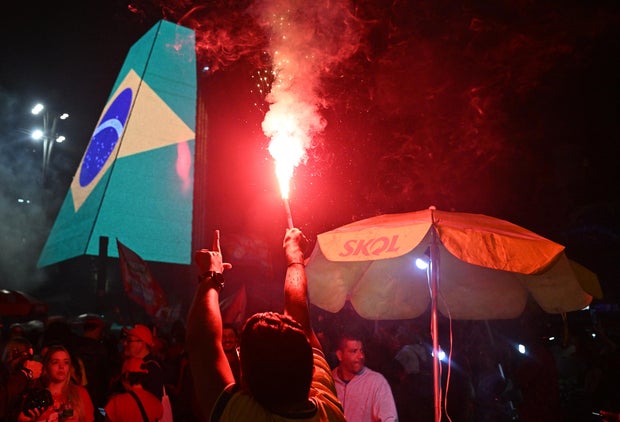
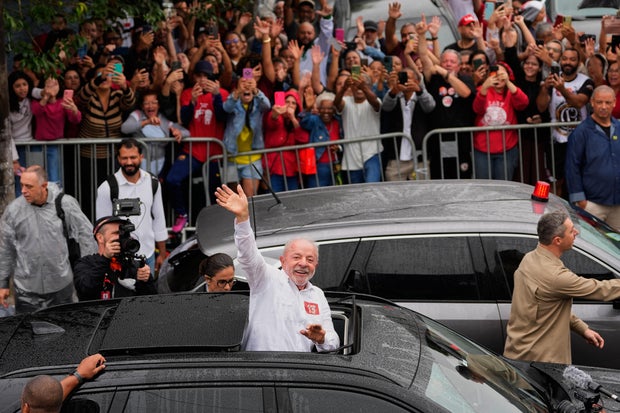
The announcement kicked off a celebration of supporters in and out of the Sao Paulo hotel where Lula watched the count with first lady Rosângela da Silva, allies, and friends.
Lula's victory, if confirmed by electoral authorities, will give him his non-consecutive fourth term as president. The next term begins on Jan. 5, 2027.
It is the first time since Brazil's military dictatorship ended in 1985 that the second-highest vote-getter in the first-round elections won the presidency. Bolsonaro had 47% of the vote in the first round to Lula's 45%, a difference of 2.2 million votes. However, more than 33 million voters out of nearly 160 million did not turn out in the first round.
A video published by Lula's campaign shows the veteran leader celebrating with first lady Rosângela da Silva and allies after his runoff victory was confirmed by Brazil's electoral court. Wearing star-shaped red glasses, he kissed his wife. Hundreds of his supporters began gathering on São Paulo's main artery to celebrate the victory.
In addressing supporters, Lula expressed his gratitude to the Brazilian people, and pledged to respect all Brazilians, regardless of gender or religion. He also attacked Bolsonaro."
"This was a defeat for denialism and lies. I must confess that every time I attended a debate, I felt embarrassed," he said.
He also doubled down on his commitment to Brazil's sovereignty.
"Either the homeland remains free, or we die for Brazil," he said. "This country will not accept being anyone's backyard."
In Rio de Janiero, cars beeped their horns and a woman dressed in red — the color of Lula supporters — shouted "You lost! Cry harder!" to four men in yellow and green sipping beers, Bolsonaro's signature colors. A huge roar echoed in the street as the result was confirmed.
Rodrigo Valentim, a 51-year-old businessman and supporter of Bolsonaro, said that another Lula government would harm the economy. He pointed to financial markets' positive reaction to the result of the first round, when Bolsonaro bested Lula.
"I don't understand how people can vote for Lula," he said. "The country is collapsing."
Sunday's victory will likely be the last of the veteran leader's political career. Lula began his political career in the 1970s as a union leader. He then helped found the Workers' Party, which he represented as a presidential candidate three times until he finally won it in 2002. He was reelected four years later and was succeeded by one of his cabinet ministers, Dilma Rousseff, in 2010. She was reelected in 2014.
Rousseff was impeached for accounting maneuvering in 2016 amid a sprawling corruption probe, which also ensnared Lula. He tried to run for president again in 2018 but was jailed in March after being convicted.
Lula was released from prison after 580 days and saw Brazil's Supreme Court annul his sentence after police found messages that showed the judge who convicted him was biased. He quickly became one of former President Jair Bolsonaro's biggest critics and narrowly beat him in 2022.
Lula admitted in 2024, two years into the job, that his administration had done little to earn the support of his voters.
Since he lost the first round, Lula reorganized his campaign, appealed to young voters, put millions of Brazilians on the streets to defend democratic values and his legacy, raised fears of another Bolsonaro administration and boosted several government initiatives.
Lula also defended Brazil's sovereignty and insisted that a Bolsonaro presidency would allow the U.S. to exert control over Brazil.
He joins Mr. Trump and Nicaragua's president, Daniel Ortega — all age 80 — as the oldest presidents in the Americas.
Judge ruled to extend voting by 2 hours
The electoral court's announcement ended an evening of confusion at polling places after Brazilian Supreme Court Justice Cristiano Zanin ruled three minutes before the scheduled end of voting to keep polls open for two more hours, following requests by both candidates. Lula's request came after issues with buses that provide transportation to polls in Sao Paulo and Salvador, two cities that tend to favor the incumbent. Bolsonaro's request was due to heavy rains in Brazil's south, where he was favored.
In Brasilia, volunteers who oversaw the vote count at a school debated whether they needed to stay after the announcement to extend voting, but most left 15 to 20 minutes after polls closed and they had given count information to electoral authorities. At a polling station in Rio de Janeiro, the voting machines had already been switched off minutes after polls were set to close and couldn't be turned back on.
The decision delayed tallying the votes by two hours. It was unclear how many polling stations stayed open after the scheduled closing time.
Bolsonaro ally Nikolas Ferreira noted that Zanin, who made the decision, is Lula's former lawyer.
Security and cost-of-living concerns
Lula, who first governed Brazil between 2003 and 2010, faced a tough reelection battle because of concerns about the cost of living and security. Bolsonaro made a tough-on-crime approach the cornerstone of his campaign and pledged to bring down food costs.
Both had been hit by corruption suspicions involving family members and allies, with Bolsonaro implicated in a sprawling scandal rocking Brazil. Lula previously spent more than a year in prison on corruption convictions that were eventually annulled.
Bolsonaro's admission that he accepted about $12 million from disgraced former banker Daniel Vorcaro to produce a film on his father's life has cast a shadow over his campaign. He is under investigation for corruption, money laundering and tax evasion in connection with the case.
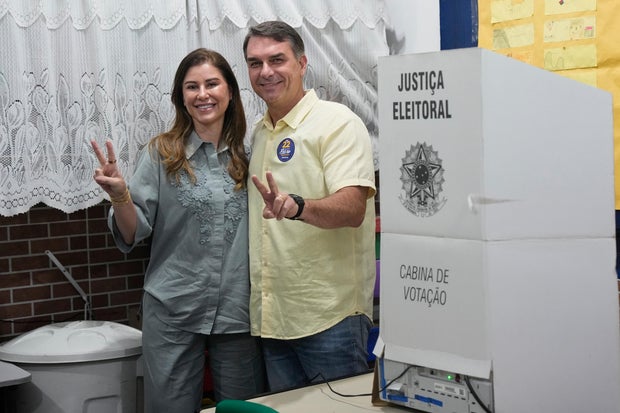
As Bolsonaro voted at a school in Rio de Janeiro, his supporters shouted "Lula, thief, your place is in prison" while Lula's supporters chanted in his support.
"The time of real change has arrived," Bolsonaro said. "Brazil can't go on for another four years on its current trajectory."
In the lead-up to the vote, Lula frequently portrayed Bolsonaro, whose father is under house arrest for attempting a coup, as a threat to democracy. Bolsonaro has promised to seek an amnesty for his father if elected.
Lula, trying to lure undecided voters, has invested in costly incentives. His government endorsed a debt relief program for small businesses and promised free public transportation on weekends. A major win then came when the Senate backed a popular proposal to end the six-day workweek.
Lula thanked his voters for an outpouring of support while casting his ballot in the city of Sao Bernardo do Campo, where he began his political career as a union leader in the 1960s. "It is a lot of generosity, a lot of care, a lot of love. I will be forever grateful," Lula said.
Lula voters respect his past; Bolsonaro voters want change
Lula voters turned out Sunday driven by his history of supporting marginalized people and working to lift Brazilians out of poverty.
"Lula is a man of the people and he knows what it's like to be poor," Luzia da Souza, who runs a bar in Rio de Janeiro, said. "I find it impossible not to vote for him."
Anderson Falcão, a 43-year-old journalist in Brasilia who sported a red shirt in support of Lula, said he worried about Bolsonaro's long-term political vision, which he called "exclusionary."
"It's a project that harms the less fortunate, harms the worker, women, the forest, the Amazon," he said.
Bolsonaro voters, many of whom wore yellow and green Brazil jerseys in support of the senator, said they wanted change.
"Things are really expensive and taxes are too high," Fabianne Borges Santoro, a 45-year-old physiotherapist in Rio de Janeiro, said. She added that she once voted for Lula's party but now associates it with corruption.
Issues with public transportation affect the vote
In Bahia state, a stronghold for Lula, whose voters tend to live in areas that depend more heavily on buses, at least 75 public buses were prevented from leaving municipal garages during the presidential runoff vote, according to a state electoral judge. He ordered the arrest of the mobility secretary of the capital, Salvador, Pablo Souza, in relation to the case.
Mayor Bruno Reis, a Bolsonaro ally, blamed trade unionists for illegally sticking Workers' Party materials onto transit vehicles for the measure.
President of Brazil's Superior Electoral Court, Kassio Nunes Marques, confirmed that electoral authorities received a report on problems with buses in Bahia that is being analyzed. He did not confirm if voting would be extended, which Lula requested in Salvador and Sao Paulo, where issues with public transportation were also reported in the city with a mayor allied with Bolsonaro.
"We will not be robbed by mayors, governors or businessmen," Lula told the press. "These people need to respect democracy."
Bolsonaro did not immediately comment on the issue.
International observers earlier in the day said that voting was occurring peacefully and with transparency and did not immediately comment on the incident.
The Trump administration looms large
Lula criticized the U.S. president before Brazil's election, speaking about the risks of U.S. intervention in Brazilian elections after the Trump administration imposed high tariffs against Brazilian exports and classified drug-trafficking groups as foreign terrorist organizations. Experts say the moves may have been intended to make Lula look soft on crime.
Bolsonaro has touted his proximity to the White House and insisted that Brazil needs to strike better deals with the Trump administration, including in the rare minerals economy. Brazil estimates that its deposits hold up to 21 million tons, second only to China. He denies he's being helped by the U.S. government.
Mr. Trump said Sunday that he was watching the election but declined to endorse a candidate.


