Black-owned Venice beach boutique hotel is also a museum

The Redline Venice isn't just accommodation; it's also a museum experience that takes guests on a deep dive into the Black pioneers who helped make Venice, Venice.
Following the success of Venice, the Redline Group is looking to expand the concept to other cities nationwide, starting with New Orleans and Miami.
The Hooper family from Chicago regularly visits their son in Venice. "We've been here several times and rented places, but this was so different," Brenda Hooper said.
Instead of their usual Airbnb, they chose The Redline Venice this time, a boutique museum hotel just steps from the Venice boardwalk.
"This is what we call cultural tourism," Kamau Coleman, Redline Hotel Group co-founder and CEO, said.
When Coleman and Michael Clinton bought the beachfront property during the pandemic, they planned to convert it into apartments. But after learning about contributions made by African Americans in the area, they changed their concept.
"You know the Abbot Kinney area, and I didn't know the history at all about it," Chicago resident Jennifer Weisner said.
In the early 1900s, developer Abbott Kinney wanted to build a Venice of America resort, 12 miles west of downtown. Executing his vision were his lead decorator, Arthur Reese, and confidant, Irvin Tabot.
In the Redline Venice, a suite pays homage to the Black and Brown laborers who dug the canals and developed the area but weren't allowed to call it home.
Venice was one of the communities that was redlined from the 1930s to the late 60s, where Black families were denied mortgages, insurance, and home loans in the area.
Art in the Redline Venice, created by the hotel's creative director Sophea Samreth, shows a group of elitists playing shuffleboard over a color-lined map of LA, representing the game of life for people of color back then.
"In this game, there were winners and losers. But the losers didn't know that the game was rigged," Redline Hotel Group Brand Manager, Destinee Sales, said.
After the short-lived oil boom came a period of neglect. In the 1950s, Venice became known as the "slum by the sea," an enclave for the beatnik generation.
Another suite pays homage to Black surf and skate pioneers, such as John Quincy Tabor Jr., who became the first Black Mexican American lifeguard in LA.
"In some ways, we are reclaiming the discriminatory practice of redlining, and infusing it with something that was positive and inspirational," Clinton said.
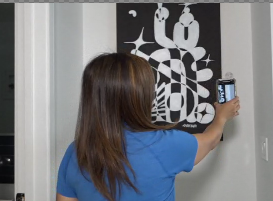
The museum portion of the experience comes from the QR codes on the walls. Guests can scan them with their phones to learn a bit more about the history or the artist, depending on the piece.