Woodlawn Central development plan, on agenda for Chicago Plan Commission, seeks to "regenerate" a community

As the Obama Presidential Center transforms a piece of Jackson Park, developers planning to transform and revitalize a section of the Woodlawn neighborhood with a $300 million plan.
The Woodlawn Central project is the brainchild of Apostolic Church of God Senior Pastor Dr. Byron T. Brazier and his son, project executive J. Byron Brazier. It involves transforming the parking lots around the church, at 63rd Street and Dorchester Avenue, into a vibrant community complex.
The first phase of the development will involve two 14-story towers to be constructed in the parking lot space bounded by 63rd Street on the north, 64th Street on the south, the Metra Electric tracks on the east, and Dorchester Avenue on the west. One of the towers will house a boutique-style hotel with 150 keys, while the other will house 94 residential units, J. Byron Brazier said.
A second part of the first phase will also involve additional residential units in a building on the other side of 63rd Street and Kenwood Avenue.
The long-planned development is advancing in June, as the plans for the two 14-story towers are on the agenda for Chicago Plan Commission meeting on June 25.
Hearings before the City Council Committee on Zoning, Landmarks and Building Standards and the full City Council are set for July.
"We should have our certification by September. We should have everything kind of sewn up by September, and we'll do something ceremonious this year — maybe October, November, for some groundbreaking," said J. Byron Brazier.
Construction for that first phase is expected to get under way in earnest in the spring of 2027, he said. Afterward, other phases of the development will follow, in an effort to create a development focused on building and preserving community.
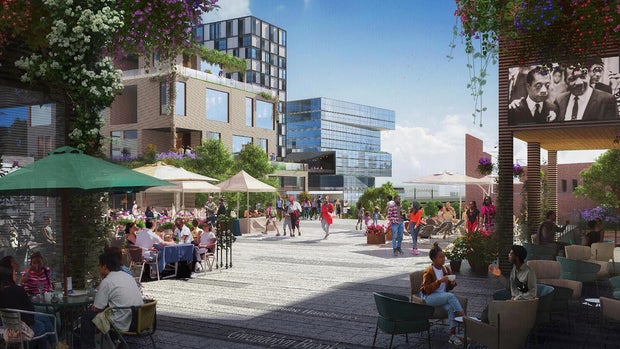
Altogether, Woodlawn Central is set to comprise 870 residential units — including workforce housing, market rate, luxury, senior housing, and theater lofts.
The plans call for multigenerational housing that keeps families in the community, a business incubator to support Black entrepreneurs, and festival streets and performance venues to showcase the arts and culture, among other features.
The development also calls for 215,000 square feet of office and retail space; a Black Box Theater for stage performances, film screenings, and cultural events; a new head house at the 63rd Street Metra Electric station, a 530,000 cubic-foot vertical greenhouse, a clean-energy micro-grid facility, and a new shared parking garage to replace the surface lots for the church.
J. Byron Brazier said it is too soon to estimate how long it will be before the entire Woodlawn Central development is complete and up and running, but such developments are likely to take eight years to complete.
Restoring vibrancy, creating jobs and investment
Brazier said the vision for Woodlawn Central is inspired by his grandfather, Bishop Arthur Brazier, who served as pastor of the Apostolic Church of God from 1960 until his retirement in 2008, Bishop Brazier is a renowned civil rights leader and community advocate, known in particular for fighting displacement and advocating for Black homeowners as head of The Woodlawn Organization.
"I think this is a generational iteration of his work," J. Byron Brazier said.
Brazier added that he believes the church has a responsibility to its community, and the Woodlawn Central development honors that mission for the Apostolic Church of God.
"I believe that the church, the modern church, is setting a precedent for external community development," Brazier said. "Churches tend to be very insular. They kind of focus on their own mission, vision and objectives. But I think in particular in the Black community, the church being one of the longest standing organizations, has a responsibility to support economic development in a number of ways — not just building buildings, but also creating jobs."
Brazier also emphasized that Chicago does not have a specific cultural destination for Black Americans similar to the roles communities such as Chinatown and Ukrainian Village serve for their respective ethnic groups.
"The unfortunate part about our community is that we have not been able to establish that," Brazier said. "And so I hope that Woodlawn Central sets that precedent for creating those cultural destinations."
Brazier said the goal is that Woodlawn Central will bring jobs to the community and raise median income, which in turn will remove barriers to market-rate investment and bring in other developers to invest in Woodlawn.
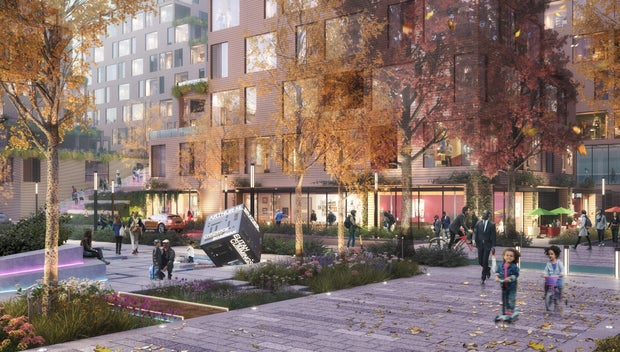
Woodlawn Central also seeks to restore the density and vibrancy that the Woodlawn community once boasted but isn't always acknowledged.
Speaking to CBS News Chicago for a story on the Chicago Urban Heritage Project, which uses state-of-the-art technology to document the history of buildings and development in Chicago neighborhoods, UChicago executive director of Chicago Studies & Experimental Learning Chris Skrable said the city initially pushed back on whether a high-density development could be supported in Woodlawn, as data going back 20 to 30 years showed a sparser population for the area.
"We were able to bring data to them that said, well, up until 1970, you know, there was this headquarters for the Illinois Central Railroad that was right here on one of those parking lots. There was a huge hotel right across the street from it," Skrable said in March. "There were a whole series of movie and theater venues that ran down that stretch."
Restoring that vibrancy is very much part of the mission for Woodlawn Central.
"I like to use the word regeneration, because we're really regenerating what was there previously," said Brazier. "As you mention, Woodlawn had a population of 95,000 at one point, and right now, we're at 25,000. So there is plenty of room to grow just within that spectrum of what once was to where we are now."
Brazier added that he expects a synergy between Woodlawn Central and the Obama Presidential Center, with visitors coming to the area to visit the presidential center staying and visiting in the revitalized community.
"I think, you know, Woodlawn has always been an organized community, and I think the Presidential Center has given a boost to those particular opportunities as well," he said. "So I do envision some great synergy between what the Obama Center is doing and what Woodlawn Central will be doing."
A long-term goal of a broader revitalization of Woodlawn
The Woodlawn Central development plan as it now stands focuses just on the footprints of the parking lots around the Apostolic Church of God. But Brazier has goals that extend well beyond, with a long-term vision of redevelopment in Woodlawn all the way to State Street.
Brazier said the goal is a walkable, vibrant community throughout Woodlawn, not just isolated within the Woodlawn Central development.
Brazier noted that everything closest to Lake Michigan in Chicago — which includes the sites for the current Woodlawn Central plan — is the most viable and valuable for investment and development. But he said the west side of Woodlawn should not be left out, and should be able to borrow from the success of what happens at Woodlawn Central.
"We have to make sure that we're not just looking at housing, again, but that we're looking at cultural destinations," he said, adding that adaptive reuses of vacant buildings in Woodlawn are also part of the broader long-term goal.
Brazier said "we're really looking at a 2060 plan" for the broader community redevelopment that would involve revitalization of the Woodlawn community west to State Street.


