University of Chicago scientists create "artificial leaf" that could be used for wireless implants

What University of Chicago scientists call an artificial leaf that mimics photosynthesis could be useful for wireless medical implants and other technologies.
The team from the U of C's Pritzker School of Molecular Engineering and Department of Chemistry said the nanoplasmonic leaf can stimulate nerves and pace heartbeats in an animal model, and could also be used as a computer-like sensing platform where people can interact with the screen using visible light and transmit information.
The research was published in the journal Nature Photonics, and was led by the lab of UChicago chemistry professor Bozhi Tian.
Why is it called an artificial leaf? The device converts sunlight into energy in a manner similar to photosynthesis in plants.
As it is, scientists and engineers have a hard time making electronic devices convert light into energy like plants do. Solar cells use semiconductor materials to turn sunlight into energy, but the laws of physics limit their efficiency, UChicago explained.
Nanoplasmonics might be more efficient, scientists said.
They are made from noble metals — that is, metals that do not react easily with oxygen, water, and many acids and thus are resistant to oxidation — such as gold. The noble metal is combined with titanium dioxide into minuscule structures called nanostructures that measure about 15 nanometers in size, the U of C said.
A nanometer is one-billionth of a meter.
The nanostructures absorb light and serve as light-powered energy converters, the university explained.
The light excites ripples of electrons called plasmons in the nanostructures. The plasmons decay into electrons and holes, also called hot carriers, that allow researchers to manipulate electrical and chemical processes, UChicago said.
In layman's terms, the devices provide electrical energy without the need to be plugged into anything.
But researchers need to figure out how to create nanoplasmonics to amplify their electrical current. UChicago Pritzker School of Molecular Engineering grad student Pengju Li found a way — a gold nanoparticle surrounded by a hemisphere of titanium dioxide with a gold film at the bottom. The structure absorbs light, while the gold film acts as a mirror to increase the energy's intensity, the university said.
"If you don't have that gold layer, the light just passes through," Yuze Zheng, a co-first author of the research and a grad student in Tian's lab, said in a news release. "But having the film amplifies the performance of the material to make it useful for devices."
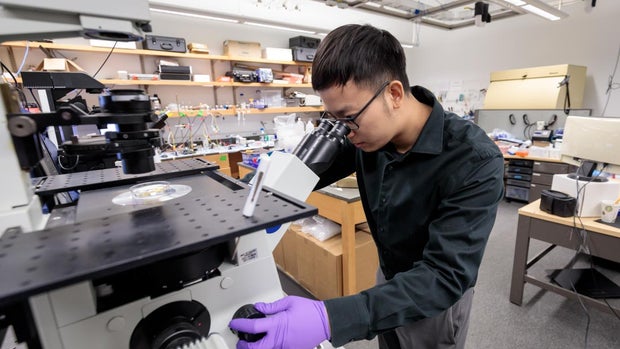
The team created their new artificial leaf with its gold film at the U of C's Pritzker Nanofabrication Facility. They then tested on a rat, placing a patch of the material on the rat's heart, the university said.
It turned out that using the device, researchers could control the pace of the rat's heart by shining light onto it, the university said. They also stimulated the sciatic nerve by placing the device and shining light, in what could be a therapy for nerve pain in the future, the university said.
Also using the artificial leaf, the team developed an optosensing platform — similar to a touchscreen, but using light instead of a finger. Researchers interacted with the screen with a laser pointer, and then used an AI program to reconstruct the patterns onto which they had shone light, the university said.
"A device like this could change the way people interact with computers," Li said in the release. "Instead of using touch, you can use light to input certain information. And the light can be invisible, which would improve security. AI can then be used to decode what you wrote. This opens up new directions for our material."
The team is next planning to use the technology to develop a fully implantable device that could be used for biostimulation for a year or more, the university said.


