University of Chicago-led team discovers new species of dinosaur in Sahara

A team led by the University of Chicago said it has discovered a new species of dinosaur — a fish-eating giant, and the first new species of its kind discovered in a century.
In 2019, a team led by celebrity UChicago paleontologist Paul Sereno led a 20-person group on an expedition to the central Sahara in the West African country of Niger. They found a bone in the shape of a scimitar — a sword with a curved blade — but they didn't recognize it for what it was right away, the university said.
Further research determined that it was the head crest of a new species of dinosaur called Spinosaurus mirabilis, or hell heron. It took a return visit in 2022, two more head crests, and a 3D digital skull assembly powered by solar panels in the desert before the researchers figured out what it was.
"The gravity of this, you have to understand, is really the first time that Spinosaurus skull material has been found in over a century," Sereno said.
Sereno and his team were inspired by a discovery by a French geologist referenced in a monograph from the 1950s. At the turn of the last century, the geologist had found one saber-shaped fossilized tooth that appeared like those of the giant predator Carcharodontosaurus, UChicago said.
In 2019, Sereno's team headed to the Sahara and met a local Tuareg man who took them to the area in Niger where what turned out to be Spinosaurus mirabilis bones were found, UChicago said.
Sereno and his team returned and found more bones in 2022. Back in Chicago, Sereno and his team cleaned and conducted a CT scan on the teeth and bones of the Spinosaurus mirabilis to create a digital skull rendering, UChicago said.
Sereno then worked with paleoartist Dani Navarro in Madrid to create an action scene involving Spinosaurus mirabilis.
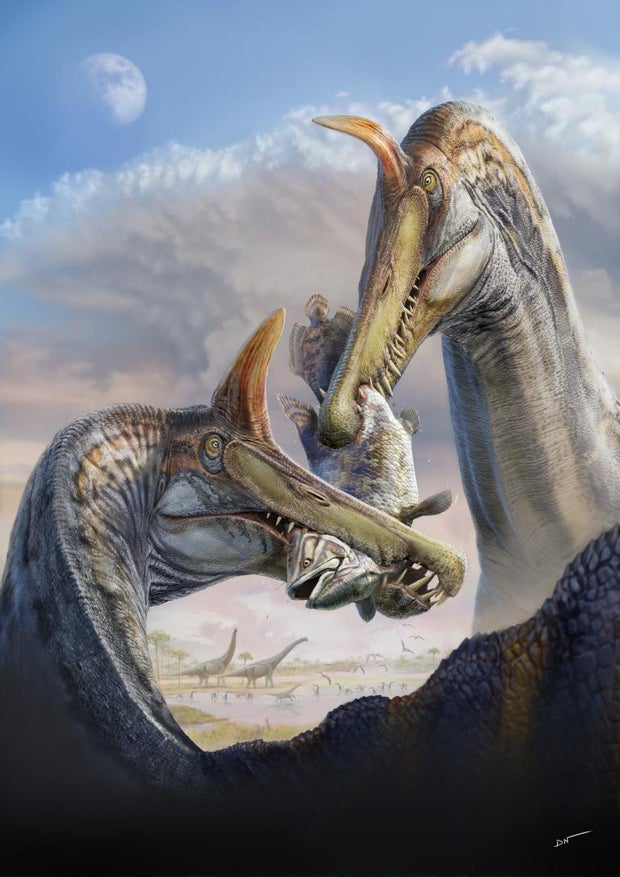
The discovery of Spinosaurus mirabilis also sheds light on the evolution of the Spinosaurus genus, UChicago said. Based on the texture and interior vascular canals of the head crest, experts believe it was sheathed in keratin and brightly colored, "curving toward the sky as a blade-shaped beacon," UChicago said.
Spinosaurus mirabilis also has a skull with interlocking teeth. The teeth on the lower jaw protrude and interlock between those on the upper jaw, making for a deadly fish trap, UChicago said.
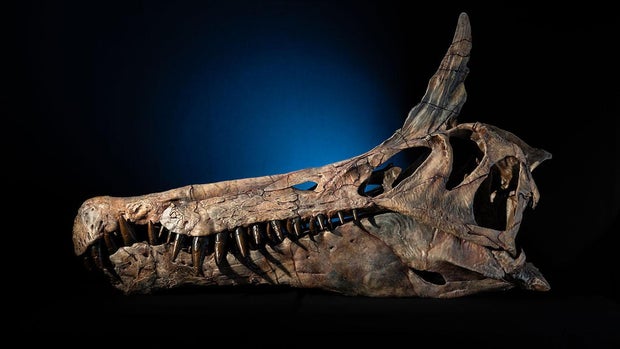
Spinosaurid bones had previously been found in coastal deposits close to the ocean, leading some to believe they had been fully aquatic and had gone after fish underwater, UChicago said. But the new discovery of Spinosaurus mirabilis indicates that they lived inland too, and given their proximity to the partial skeletons of long-necked dinosaurs in river sediments, it is believed Spinosaurus mirabilis lived in areas with rivers, the university said.
Two replicas of Spinosaurus mirabilis will join the Dinosaur Expedition exhibit at the Chicago Children's Museum.


