Why does Trump want Greenland to be part of the U.S.?
Why does the United States want Greenland? President Trump has made it clear that he thinks the U.S. needs control of the island to ensure the security of America and its NATO allies, a point those allies — and Greenland — vehemently disagree on.
The president now says a "long-term deal" is in the works. Here's why Mr. Trump has been so focused on the semi-autonomous Danish territory, and why NATO allies and Greenland say the U.S. could achieve its aims without a takeover.
Greenland's strategic location
- Greenland is located strategically between the U.S., Russia and Europe.
- Climate change means new shipping routes will open up through the Arctic.
- Greenland is the location of the northernmost U.S. military base.
Greenland spans about 836,000 square miles, much of it inside the Arctic Circle and covered by the Greenland Ice Sheet. It's home to only around 60,000 people.
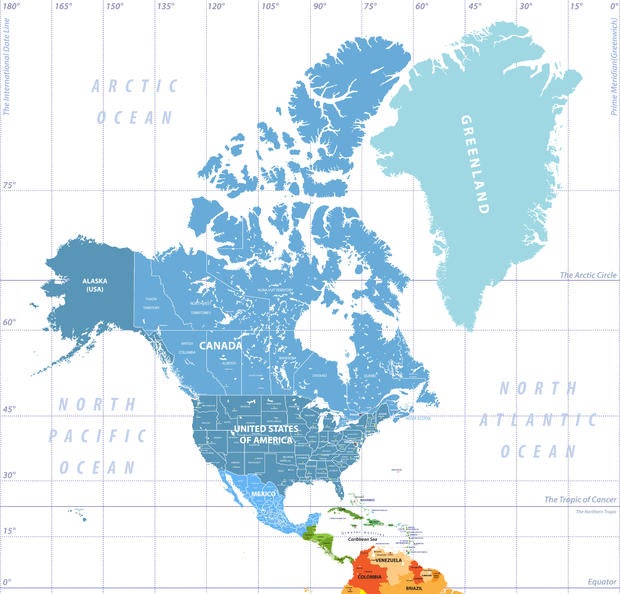
Greenland is a semi-autonomous territory of the Kingdom of Denmark with its own elected government.
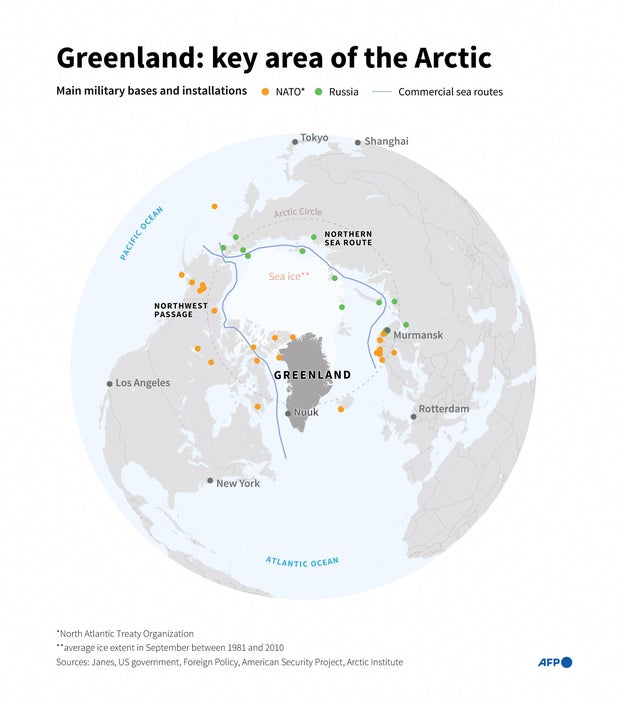
Its location between the U.S., Russia and Europe makes it strategic for both economic and defense purposes — especially as melting sea ice has opened up new shipping routes through the Arctic.

Greenland is also the location of the northernmost U.S. military base — the Pituffik Space Base, which was established during World War II.
National security
- President Trump has said Chinese and Russian activity around Greenland is a security threat to the United States.
- The threat of Chinese and Russian ships around Greenland is disputed.
- Danish politicians have said the U.S. could put additional troops or equipment on Greenland just by asking.
Mr. Trump has repeatedly claimed the U.S. needs Greenland for national security purposes.
"It's so strategic right now," he told reporters on Jan. 4, claiming "Greenland is covered with Russian and Chinese ships all over the place. ... We need Greenland from the standpoint of national security, and Denmark is not going to be able to do it."
Mikkel Olesen, a Danish foreign policy and diplomacy researcher, told CBS News earlier this month that there aren't Russian and Chinese ships all over the Arctic, but there are Russian planes, and there has historically been a lack of situational awareness in the region.
"This is something that the U.S. used to do itself. I mean, throughout the Cold War, the U.S. had a line of radar stations across Greenland and the U.S. chose to close down those radar stations because the Cold War ended," Olesen said. "Now, that's not to say that Denmark as an ally isn't obligated to try to help the U.S. handling that problem, not at all. I'm just saying that the status quo before Donald Trump was that the U.S was very happy about being able to just have a free hand in Greenland to handle those issues."
The Danish government has made it clear that the U.S. is welcome to expand its military presence in Greenland, and that protecting the island from any potential adversaries should be the joint responsibility of the NATO alliance.
"Put up warning systems, missile systems, soldiers, etc. Just by asking, you can," Danish lawmaker Lars Christian Brask, vice-chair of the Danish Parliament's Foreign Policy Committee, told CBS News earlier this month. "It's not you [the U.S.] running the country, but you have the options, the possibility, of having troops, material ... equipment in Greenland. You just have to ask."
Members of the U.S. Congress have openly questioned Mr. Trump's claim of a Russian or Chinese security threat to Greenland, including Senate Intelligence Committee deputy chair Mark Warner, a Democrat from Virginia, who said, "The only country that is, frankly, benefiting the most from this chaos are both Russia and China."
Former U.S. Ambassador to Denmark Rufus Gifford also disputed Mr. Trump's claim of a threat to the island from the U.S. adversaries.
When asked earlier this month what specifically the United States would gain in terms of national security by taking control of Greenland, given all that the U.S. is able to do already, White House press secretary Karoline Leavitt said: "More control over the Arctic region and ensuring that China and Russia and our adversaries cannot continue their aggression in this very important and strategic region. And there would be many other benefits as well that, again, the president and his national security team are currently talking about."
Control over a new, valuable route for shipping
- Melting sea ice around Greenland has created more opportunity to use northern sea passages.
- The Northwest Passage, which comes close to Greenland, is not currently viable for the entire year.
Melting sea ice around Greenland has created more opportunity to use northern sea passages that enable shippers to save time and millions of dollars in fuel by taking shorter routes between Europe and Asia that were long only passable in warmer months.
There are a couple primary routes through the Arctic becoming more viable. The Northern Sea Route, which follows Russia's long northern border, doesn't bring ships too close to Greenland, and Russia and China agreed to jointly develop that path and have been making greater use of it in recent years.
A Russian commercial vessel, aided by an icebreaker, first traversed the Northern Sea Route in the winter in February 2021.
The other route, called the Northwest Passage, comes close to Greenland's coastal waters and is more likely of concern to the Trump administration.
Before those two routes started becoming viable during the winter, the only way to move goods from ports in Russia or the manufacturing powerhouses of East Asia was to go south. But those paths are about 3,000 miles longer, and thus much more expensive.
Greenland's natural resources
- Greenland has reserves of oil, natural gas and highly sought after mineral resources.
- It would be very expensive to explore and develop those resources.
- Greenland has long said it's open for business if American companies are interested in exploring.
Those mineral resources, which include rare earth elements, "have only been lightly explored and developed," Jose W. Fernandez, the U.S. Department of State's undersecretary for economic growth, energy and the environment, said at a Minerals Security Partnership event in Greenland in November 2024.
Greenland may have significant reserves of up to 31 different minerals, including lithium and graphite, according to a 2023 report assessing the island's resources. Both minerals are needed to produce batteries for electric vehicles and a wide array of other technologies.
Currently, lithium production is dominated by Australia, Chile and China, while China produces about 65% of the world's graphite, the report noted.
Greenland also has the potential to provide a significant amount of rare earth minerals such as neodymium, which is used to make the magnets used in electric motors, the 2023 report said.
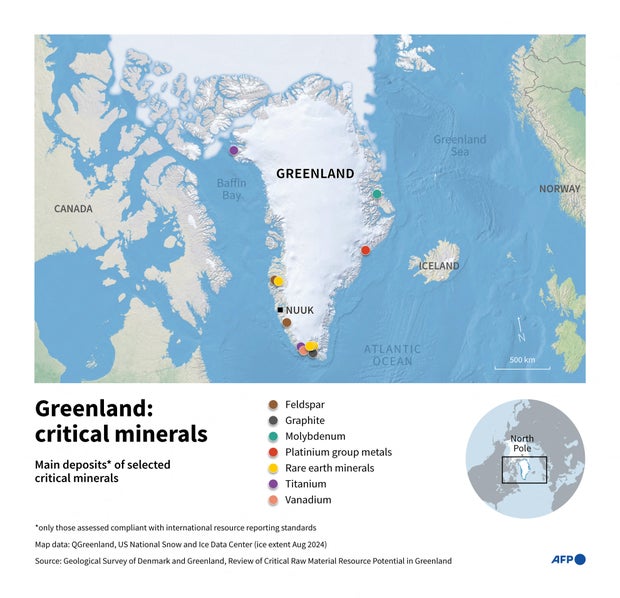
China produces about 70% of rare earth elements, and demand for them continues to grow with technological advances and the rapid spread of consumer devices.
There are, however, significant hurdles to mining in Greenland, including environmental and cost issues.
The U.S. "can explore, of course if you live up to environmental regulations, etc., all the rare earths and minerals that you want in Greenland on a commercial basis. There won't be any hold back on that," Danish lawmaker Brask told CBS News earlier this month.
Olesen, the Danish foreign policy researcher, said these minerals are still very expensive to extract, so it hasn't so far made economic sense for private companies to go after them.
"The position of the Greenland government has been for a long time that Greenland is open for business, and with few exceptions, the main reason for why not much has happened has been that there hasn't been a business case for American companies," Olesen said, adding, "nothing has prevented U.S. companies from going in for a long time."
Would Trump use military force to take Greenland?
- Mr. Trump said on Jan. 21, "I don't want to use force, I won't use force" to take Greenland.
- He had previously declined to take the option off the table, saying the U.S. could do it "the easy way" or "the hard way."
President Trump, for the first time, ruled out using force to acquire Greenland in his speech at the 2026 World Economic Forum in Davos, Switzerland.
"We probably won't get anything unless I decide to use excessive strength and force where we would be, frankly, unstoppable. But, I won't do that. Okay?" he said in his address on Jan. 21. "Now everyone's saying 'oh, good.' That's probably the biggest statement I made, because people thought I would use force. I don't have to use force, I don't want to use force, I won't use force. All the United States is asking for is a place called Greenland."
Mr. Trump said he was "seeking immediate negotiations" — and then announced, after a meeting with the NATO secretary general, that a deal has been reached.
Previously, the president and White House officials had suggested military force was among the options being considered.
"If we don't do it the easy way, we're going to do it the hard way," Mr. Trump said on Jan. 9, without explaining what that could involve. The White House stated that a range of options, including the use of military force, were under consideration.
"I'd love to make a deal with them. It's easier. But one way or the other, we're going to have Greenland," he said Jan. 11.
Most Greenlanders don't want to be American
- Most Greenlanders say they do not want to be a part of the United States.
- Greenland's leaders say they want good relations and cooperation.
Greenland's Prime Minister Jens-Frederik Nielsen says his country wants good relations with the U.S. He said he did not "think that there might be a takeover of the country overnight, and that is why we are insisting that we want good cooperation."
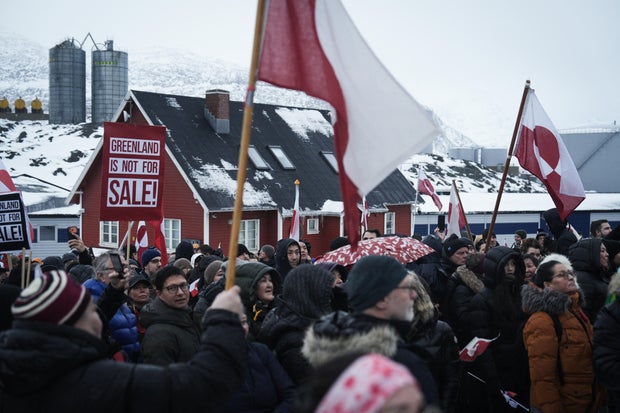
A poll conducted a year ago showed that 85% of Greenlanders did not want to be part of the United States.
"He can't just take it like that," Daniel Rosing, a trainee electrician who said he was proud of being a Greenlander, told CBS News ahead of a visit last year to the island by Vice President JD Vance and his wife.
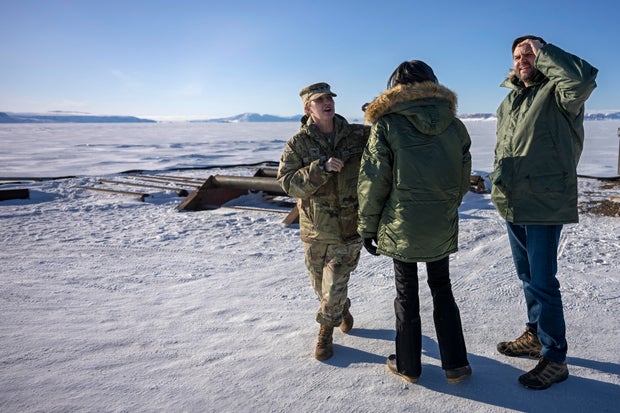
As Mr. Trump doubled down on his vows to take control of Greenland one way or another, and threatened eight of America's closest allies with tariffs if they refuse to bow to his demand, thousands of residents of the island marched in its capital Nuuk to reject his rhetoric.
Nielsen said in a Facebook post that the tariff threats would not change the Greenlandic people's views.
"We will not be pressured," he said.