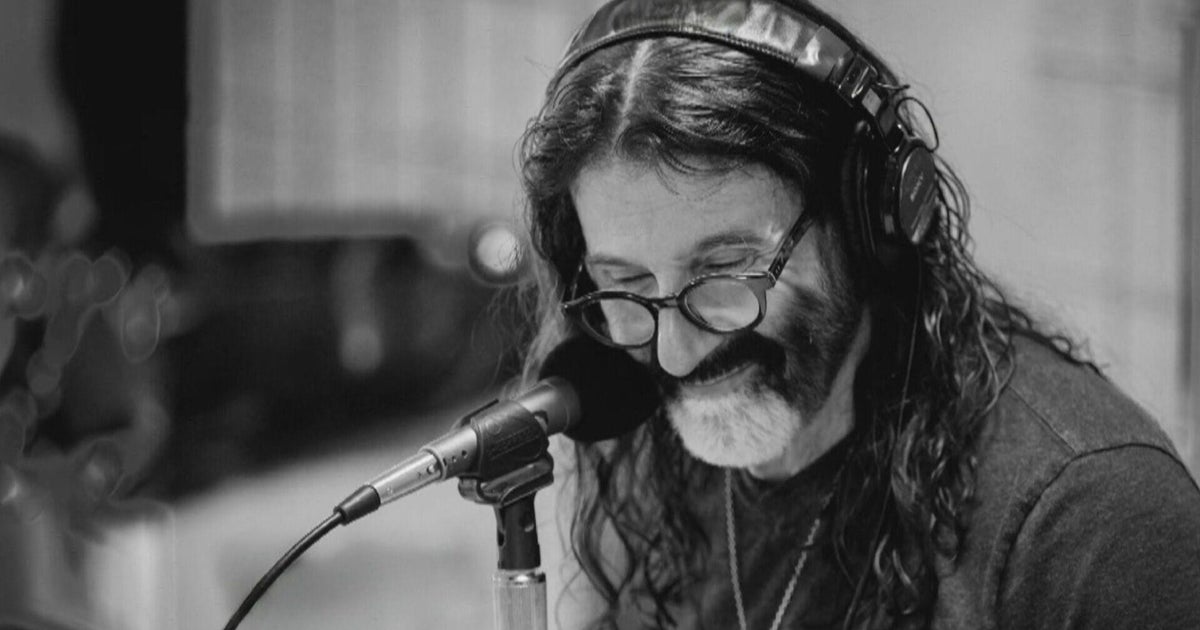
Tony Fitzpatrick, esteemed Chicago artist, writer and actor, dies at 66
Tony Fitzpatrick, an esteemed Chicago artist, writer, actor, and jack of many other trades, died this weekend.
A friend, author and Eckhartz Press cofounder Rick Kaempfer, announced Fitzpatrick's death on Facebook on Saturday. Fitzpatrick was 66.
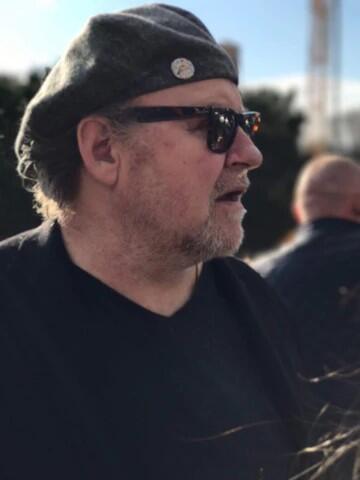
The Chicago-based artist was best known for his multimedia collages, as well as prints, paintings, and drawings. Over the course of his life, Fitzpatrick also worked as a radio host, bartender, bouncer, boxer, and construction worker, as well as a film and stage actor, according to a biography posted on his website.
According to a biography published by the Poetry Foundation, Fitzpatrick grew up in the west Chicago suburb of Lombard, where his father worked as a burial vault salesman.
"Fitzpatrick was routinely suspended from Catholic School on bad behavior," the biography read. "On those days, he would ride along with his father to sales appointments and listen to stories of life and of Chicago."
In 1978 and 1979, Fitzpatrick attended the College of DuPage — which he described in a video for the institution as a "place of purpose" despite the stark appearance of its physical plant.
"It looked like a big, brown rusted warehouse," Fitzpatrick said in the video. "It looked like nothing so much as an IKEA that they forgot to paint blue and yellow."
Fitzpatrick in particular credited his theatre teachers at the school.
As noted in a biography from the Hexton Gallery of Aspen, Colorado, Fitzpatrick went to New York in the 1980s and hung out in Washington Square Park selling his drawings on the sidewalk. Keith Haring and Jean-Michel Basquiat were amongst his early supporters, the bio noted..
The New Orleans R&B, soul, and funk group the Neville Brothers went on to notice Fitzpatrick's work, and he ended up designing the cover for their album "Yellow Moon," the bio noted. Fitzpatrick's artwork began appearing in galleries in Chicago, New York, Los Angeles, and London, and he also began doing album cover work for Steve Earle.
Fitzpatrick was awarded a solo show at MOMA PS1 contemporary art institution in Queens in 2007, and a 10-year retrospective of his work appeared at the Chicago Cultural Center the following year, the biographies noted. He also participated in the New Orleans Biennial in the winter of 2008-2009.
Fitzpatrick's works can be found in the collections of the Art Institute of Chicago, the Museum of Modern Art in New York, and the Museum of Contemporary Art in Miami, among many others.
Artnet characterized Fitzpatrick's work as influenced by "life in urban Chicago, religious imagery, and comic books," similar to such earlier Chicago artists as Ed Paschke. Artnet noted that Fitzpatrick's works integrated "cartoon-like figures and birds with poetic text and vintage ephemera," while drawing attention to items that might typically be considered disposable.
Fitzpatrick also published several books of his own art and poetry, among them, "The Hard Angels and the Neighborhood," "The Apostles of Humboldt Park," "Bum Town," and "The Secret Birds." His most recent book, "The Sun at the End of the Road: Dispatches from American Life," was published just this past Oct. 1.
As an actor, Fitzpatrick appeared in 15 major motion pictures — including "The Fugitive," "Married to the Mob," "Mad Dog and Glory," "U.S. Marshals," and "Philadelphia," the Steppenwolf Theatre noted.
Onstage, Fitzpatrick starred in the Lookingglass Theatre's production of "Race," an adaptation of a Studs Terkel novel directed by David Schwimmer, the Steppenwolf noted.
Fitzpatrick also wrote and starred in several plays with Steppenwolf — including the trilogy "This Train," "Stations Lost," and "Nickel History: The Nation of Heat," and in 2014, "The Midnight City," which involved Fitzpatrick taking the stage with sidekick Stan Klein and thinking back on how Chicago had changed.
In a review of "The Midnight City," the Chicago Reader's Zac Thompson described Fitzpatrick as being in possession of "a potent nostalgia that belies the tough-guy exterior."
"What he longs for is the Chicago of Nelson Algren, Studs Terkel, and Mike Royko — a gritty, noisy, built-from-nothing sort of place inhabited by a colorful cast of hustlers, charlatans, bar-stool philosophers, and salt-of-the-earth types," Thompson wrote. "Fitzpatrick's best stories have this same kind of hard-boiled beauty, whether he's recalling the gut-busting pleasures of now-vanished restaurants or memorializing a maternal Ukrainian neighbor."
At the time, Fitzpatrick was planning to move to New Orleans — a city with which he'd had a long relationship — but he ultimately decided to stay in Chicago.
Fitzpatrick's nostalgia for and evocation of an older and rougher-around-the-edges Chicago was also evident in his "Dime Stories" columns that appeared in the publication Newcity for several years. The columns ranged in topic from politics to obscure Chicago history and reminiscences about Fitzpatrick's own life.
In one 2012 column, Fitzpatrick told the not-so-family-friendly story of some of his experiences in the elementary school lunchroom as a youngster, involving food fights and a temperamental lunch lady with bad breath named Mrs. Hildenburger:
"[Mrs. Hildenburger] would usually busy herself with her crossword puzzles, one eye peeled for the opening salvo of the more-than-occasional food-fight. I liked throwing pudding. The Jell-O chocolate pudding was the best because that stuff splattered so beautifully. Regular Jell-O was okay, too. And oranges and soft tomatoes. I liked stuff that exploded and got four or five people at once. We called it 'fragmentation food.'"
One of Fitzpatrick's last public Facebook posts was a tribute to Sister Jean, the beloved chaplain of the Loyola Ramblers basketball team. Tributes to Fitzpatrick himself poured in on social media after his passing was announced.