Scientists from Northwestern, other institutions intrigued by mysterious signal in dark matter detector

The nature of dark matter remains a mystery, and no one has ever been able to detect it, but a new and intriguing hint has arrived in the form of a mysterious signal discovered by a team of scientists that includes a Northwestern University physicist.
Dark matter makes up around 85% of all the matter in the universe, but its nature is a mystery. It is so named because it does not interact with light the way regular matter does, but scientists know it's there because of its gravitational effect — without which clusters of regular matter in the cosmos could not be held together.
But despite knowing it's there, scientists have never been able to detect dark matter directly as they try to figure out exactly what it is.
Now, an analysis from what is known as the LUX-ZEPLIN experiment has recorded a particle interaction that might be bringing scientists just one step closer to answers on the matter of dark matter. As Northwestern explained, researchers said the particle interaction cannot be understood by examining known background signals from normal matter.
This does not mean dark matter has been found. But the scientists said there is only a 0.5% chance that the signal came from a known source, Northwestern said.
We may think of space when we think of dark matter, but dark matter is everywhere, and the LUX-ZEPLIN team is not looking out in space to learn about it. They use a tank here on Earth — well, actually beneath the Earth, nearly a mile below ground at the Sanford Underground Research Facility in Lead, South Dakota.

The tank is full of ultrapure liquid xenon.
Along with helium (He), neon (Ne), argon (Ar), krypton (Kr), and radon (Rn), xenon (Xe) is a noble gas. Because they have stable, full electron shells, noble gas atoms usually do not form compounds with other elements. But particles can still interact with xenon atoms, and such interactions are the very focus of the LUX-ZEPLIN dark matter research.
Upon being cooled below -108 degrees Celsius, or -164.2 degrees Fahrenheit, xenon condenses into a liquid. When a particle interacts with the liquid xenon, it transfers energy to xenon atoms and produces two detectable signals, Northwestern explains.
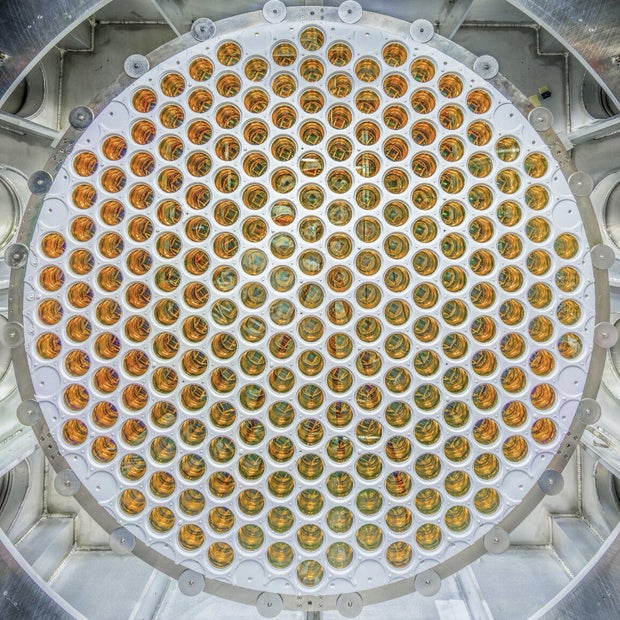
First, the excited xenon atoms emit a flash of ultraviolet light, knocking electrons free. Then, an electric field pulls the electrons up through the liquid and into xenon gas above, resulting in a second flash of light, Northwestern explains.
Scientists measure the two pulses of light to learn about the particle interactions that led to them.
No wimp would have the fortitude or patience to take part in the LUX-ZEPLIN experiment, but WIMPs are critical to the scientists' research. A WIMP is a weakly interacting massive particle — a hypothetical type of dark matter particle that might collide with a xenon item and deposit a minuscule amount of energy.
But the particle that caused the event that has scientists intrigued deposited far more energy than would be expected from a WIMP, while still potentially consistent with complex models of dark matter. If a WIMP caused the event, it would have had to have had a mass 200 times that of a proton, Northwestern said.
"If a dark matter particle struck a xenon atom in our detector, we would expect the particle to give the atom a tiny 'kick,'" Northwestern's Eric Dahl said in a news release. "It's not much, but it's enough that we can see the xenon atom recoil. For the simplest interactions we look for, we would expect that recoil to carry about as much energy as a single X-ray photon. But in this particular event, we see a lot more energy than that. That means, if this is dark matter, dark matter could be more interesting than the simplest thing we could have imagined."

Scientists can't rule out that the mysterious event came from a background source, although the tank where the reactions happened is as removed from the outside world as possible to isolate it from such sources. The South Dakota site where it is located is inside a water tank at the bottom of a former gold mine.
But there are still background signals that could have caused the mysterious interaction with the liquid xenon rather than dark matter. Among those background signals is the radioactive decay in detector tank materials or in the xenon itself.
"My group has spent a lot of time tracking radon in the detector," Dahl said in the release. "Radon is a naturally occurring radioactive gas that often builds up in basements. You can get radon at much lower levels inside the detector, and some of our largest backgrounds come from ways the radon radioactive decay chain can mimic a dark matter signal."
More evidence is needed before scientists can really say they have detected dark matter. But Dahl said in the release that the LUX-ZEPLIN experiment has a long way to go too.


