Can planting trees make Chicago neighborhoods safer? New University of Illinois research suggests it can.

When you look out a window and see a tree, your mood improves. But University of Illinois researchers have found there are more benefits to seeing that greenery than just a mental health boost. And, Chicago is banking on those findings as one strategy to make the city safer.
Green space and violence
The City of Chicago started the Our Roots Chicago initiative in 2022.
"We're in our fifth planting season," said Lindy Wordlaw, Chicago's Deputy Commissioner of the Department of Environment.
Her department, along with the Department of Streets and Sanitation, has been planting trees all over the city.
"We're on our last year of a 75,000 tree planting goal," said Streets and Sanitation Commissioner Cole Stallard.
On the day the CBS News Chicago crew spent with the workers, they were planting a tree in front of Stefania Gomez's house in South Shore.
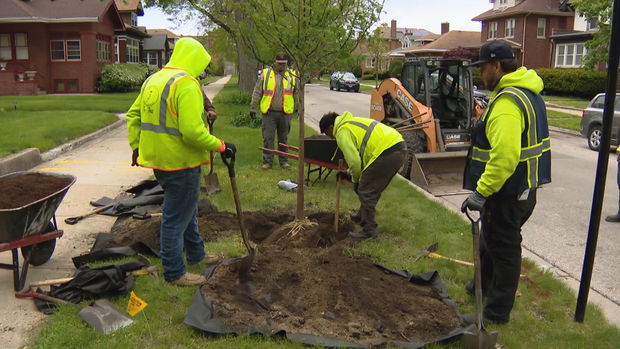
"I know that it'll just be a gift to the community for the next 50 years," she said.
Trees are more than a gift to communities, according to new research from the University of Illinois and Professor William Sullivan's team.
"Is there a relationship between the density of green space in a county and the incidence of fatal police shootings," Sullivan said they sought to determine.
Their findings were published last year in the journal Environment and Behavior
"To my surprise, we found a strong negative relationship; the greener the county, the fewer the fatal police shootings," he said.
The findings show a correlation but not causation, he cautioned.
"You can definitely not say a large amount of green space means no violence," Sullivan said.
But, a number of studies have found similar connections between an increase in green spaces — especially trees that don't block residents' views — and a reduction in violence.
The findings also revealed that the most socially and economically disadvantaged areas benefit the most from green spaces.
His previous research focused on a Chicago public housing project with 98 buildings in the early 2000s.
"We found that the greenest places had 52% less crime, 48% fewer property crimes and 56% fewer violent crimes," he said.
Green space equity
Our Roots Chicago focuses on planting tress on the South and West Sides.
"We know that there are many neighborhoods across the city that do not have the same amount of tree coverage as in other areas," said Wordlaw. "People are the same everywhere in Chicago. They want green space too."
The current tree planting initiative runs through the end of 2026. Call 311 to request a tree for your neighborhood's parkway.
Sullivan believes this program will have a profound impact but cautions that simply planting trees is not the sole solution for making communities safer.
"Trees alone can't overcome systematic disinvestment in a community, so trees should be part of a kind of a comprehensive solution to help create healthier neighborhoods, healthier families, healthier children, healthier adults," he said.
Chicago's recently appointed Deputy Mayor of Community Safety, Emmanuel Andre agrees.
"Studies have shown that in terms of increases in green spaces, you may have correlations with safety," he said.
That's why he wants the city to focus on investing in more green spaces as part of a violence reduction strategy.
"We believe it's a critical part of it. People's mental health, well-being, vicarious trauma is a very, very serious issue … and we think green spaces have a critical role to play in that," Andre said.
A CBS News Data Team analysis of tree canopy coverage data and violent crime data found mixed results. For example, there are communities with fewer shootings and fewer parks like in West Town. Then there are areas like Englewood and East Garfield Park, where there are more shootings and more parks with trees.
Still, Andre believes the investment is worth it.
"The ability for people to just go out and get healthy, go for walks, sit in the park, sit in that green space, instead of a space that's littered with bottles and everything else like that, to be able to bring people out together, we think, has a positive impact on people's mental well-being, because again it pushes this concept of belonging, and which we believe helps the ecosystem of safety," he said.
The initial announcement of the tree equity initiative put the total cost at $46 million.


