Henri Matisse's colorful "Jazz" to go on display at Art Institute of Chicago

Beginning March 7, the Art Institute of Chicago will be displaying an exhibition featuring a colorful unbound book of late-career works by French artist Henri Matisse.
"Matisse's Jazz: Rhythms in Color" features a limited-edition a unbound book made up of 20 color plates and text by Matisse. This will be the first time the works have been on view all together since the Art Institute acquired a copy of the unbound book in 1948.
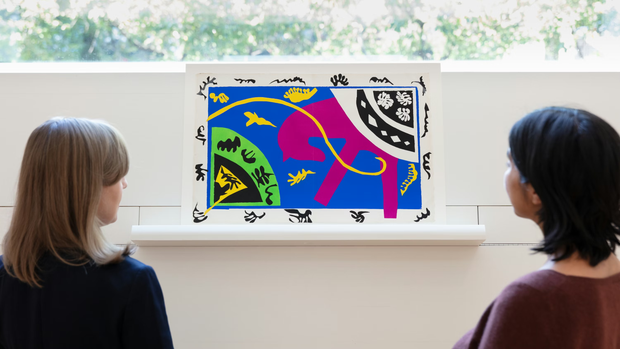
In the early 1940s, Matisse (1869-1954) was bedridden while recovering from "excruciating" abdominal surgery and couldn't paint, the Art Institute explained. Matisse thus turned his focus to cut paper, which he used to create art such as "Jazz."
The cut-paper compositions were then reproduced using stencils and combined with Matisse's original text to create the unbound book, the Art Institute explained. "Jazz" was an immediate success and served as motivation for the aging Matisse.
Matisse completed "Jazz" during the height of World War II. The paper collage prints feature interpretations of scenes from a circus, his visits to Tahiti, and popular myths and stories, the Art Institute said. But they may also be seen as imbued with violence or anxiety.
As explained by the Metropolitan Museum of Art in New York, the titles of each of the 20 plates in "Jazz" each reference something very specific. But none can be simply taken at face value.
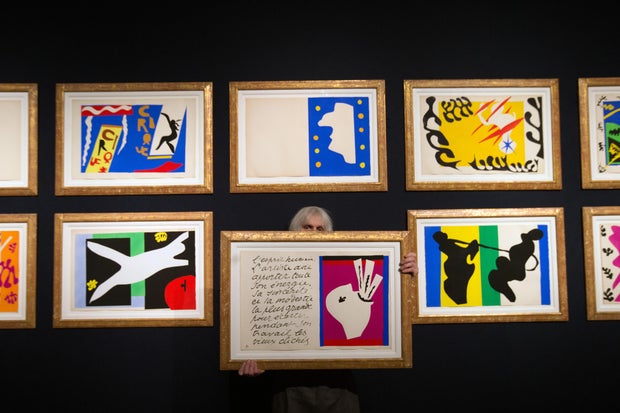
For one, as explained by the Met, "Monsieur Loyal" references the circus — the term means "ringmaster" in French, and its central figure looks like that of another plate, "The Sword Swallower," when turned upside-down, the Met explained, and Free France Leader Charles de Gaulle.
Another plate, "The Wolf," evokes both the Big Bad Wolf from Little Red Riding Hood and Adolf Hitler, the Met explained. Another, "Icarus," references the titular character from Greek mythology who flies too close to the sun with his manmade feathers, as well as a trapeze artist in the circus — but also a figure who has been killed, whether by gunshot, as suggested by a red symbol in his chest, or by bombs, as suggested by yellow blobs all around him, the Met explained.
The contrast of the narrative established by the plates is comparable to jazz music, with its rhythm and repetition broken up by unexpected and sometimes dissonant improvisations, the Art Institute said.
"For Matisse, Jazz was unlike anything that came before it. The syncopation of his vibrantly colored abstractions and his incredibly personal text offers a glimpse into the artist's evolution, and a peak at an artist at his most self-reflective and vulnerable," Emily Ziemba, director of curatorial administration and research curator of Prints and Drawings at the Art Institute, said in a news release. "The juxtaposition between the bright, whimsical images and the darker subtext they mask is a revelation, and I think it will resonate with our visitors."
"Matisse's Jazz: Rhythms in Color" will be on display from March 7 through June 1. The exhibition also features 50 works by Matisse from around the Art Institute's collection.