30 years after the start of Chicago's first citywide recycling program, challenges remain

Thirty years ago, in December 1995, with much fanfare and buildup, the City of Chicago introduced its first citywide recycling program.
The Blue Bag program went ahead despite being savaged by critics for years throughout its planning stages, and was not considered a success when it was scrapped more than a dozen years later for the city's current blue cart program.
But it was the first citywide recycling program in Chicago, which had a reputation for being behind the curve in recycling among major cities in the U.S. Thirty years later, and nearly 18 years since the Blue Bag program ended, that reputation has not changed.
The Encyclopedia of Chicago does not have an entry on recycling — the subject is folded into the topic of "waste disposal." After a survey of Chicago's often filthy and polluted history — debris from the Great Chicago Fire extending the city limits eastward, meatpackers dumping offal into waterways, steel mills dumping slag near adjacent lands, incineration being the norm for Chicago waste disposal for much of the latter 20th century — recycling is addressed in the third-to-last paragraph of the lengthy article, and makes it seem as if the city started recycling under duress from state law:
"The growing costs of landfill and potential disappearance of suitable sites created a sense of crisis in the late 1980s. A few communities adopted user fees to give householders incentives to curb waste generation. The Illinois legislature began limiting what items could be placed in landfills. The law banned putting yard waste — roughly one-fifth of municipal wastes — in sanitary landfills in 1990 and obliged local governments to recycle."
This law, the Solid Waste Planning and Recycling Act, was passed in 1988. It called for counties in Illinois to develop plans with the goal of recycling at least 25% of their solid waste.
There were recycling efforts in Chicago before the Blue Bag program.
One of the criticisms of the Blue Bag program was that it placed a large burden on residents, who had to purchase their own bags and sort their recyclables themselves, but the most readily available options in the pre-Blue Bag days were even less user-friendly. As late as the mid-1990s, the best option for recycling for many Chicagoans was to separate their brown, green, and clear glass bottles into different bags, stuff their newspapers in with cardboard and colored typing paper and stick them in a different bag, and stick their high-grade white typing paper into yet another bag, then head to a recycling center where each bag would be emptied into a large dumpster.
This was such a tedious process that Saint Ignatius College Prep had its own recycling club that mainly involved spending Fridays after school sitting on a classroom floor and separating the recyclables the school had generated throughout the week. Once a critical mass was reached, a student would accompany Father George Menke to the North Park Village Recycling Station near Pulaski Road and Peterson Avenue, miles away from the Near West Side high school.
In addition to subsidizing programs such as the one at North Park Village, the city also tried its own municipal recycling programs.
Discussions of a city-operated recycling program dated back to the administration of Mayor Harold Washington in the 1980s. Shortly before his death, Mayor Washington announced plans for a recycling program to launch in 10 wards by the end of 1988.
But it wasn't until the fall of 1989 that the city launched its first recycling pickup program, collecting glass, aluminum, tin cans, and recyclable plastics at homes in four city wards. By then, local landfills were filling up, and garbage was being shipped downstate or even out of state.
It happens that Tim Harrington, the father of the author of this story and a deputy commissioner at the Department of Streets and Sanitation at the time, was in charge of the pilot program.
The pilot program was enacted in the 31st and 41st wards on the Northwest Side, the 12th Ward on the Southwest, and the 7th on the South. Residents placed their recyclables into blue bins, and city crews picked them up once a week, coming by in separate trucks from the ones that collected the regular garbage.
Tim Harrington, now retired, pointed out that this pilot program suffered from low participation. Meanwhile, he pushed to include newspapers in the pilot program but did not succeed. An archive Chicago Tribune report says this was due to a surplus of newsprint that had ended up lying around at existing recycling operations in the suburbs and run by nonprofits in the city.
There was a scarcity of paper mills that produced recycled paper at the time. As of 1990, there were only eight recycled paper mills in operation nationwide, Bill Kurtis reported for CBS Chicago.
In 1990, the City Council passed an ordinance that called for a mandatory citywide recycling program for all 50 wards by 1993. The ordinance was introduced by Ald. Bernie Hansen (44th), and sponsored by 46 of Chicago's 50 alderpeople.
As Harrington remembers it, a group of stakeholders then met to discuss strategies for how to enact a citywide recycling program. But the group did not end up making the decision on the program — the administration of Mayor Richard M. Daley decided to contract with Waste Management Inc. to go with the Blue Bag program.
Under the Blue Bag program, residents of single-family houses and apartment buildings with four units or fewer would place their glass, aluminum, tin cans, and recyclable plastic in one blue plastic bag and their paper in another. A separate ordinance required residential buildings with more than four units to contract with private recyclers.
DSS crews would pick up the bags and haul them away in the compactors of the same garbage trucks that regular trash went into.
The trucks would then go to one of four Material Recycling and Recovering Facilities, or MRRFs, where workers would rip open the bags and separate out the recyclable items.
A blue bag recycling program in Omaha, Nebraska, in which Waste Management was also involved, was held up as evidence that the strategy worked.
The Blue Bag program was touted by the city, and lambasted by critics, during its planning stages. In a Sept. 19, 1991 cover story, the Chicago Reader's David Moberg complained that the Blue Bag program was chosen without input from any waste collectors, processors, or recycling advocates, that it imposed a single plan on an "extremely varied city" rather than considering the varying needs of different communities, and that tossing the Blue Bags full of recyclables into the same garbage trucks as the regular trash, and the plan involving sorting at MRRFs, did not inspire contents that recyclables would actually get recycled.
"Chicago's got it in the bag!"
The Blue Bag program finally launched citywide on Dec. 4, 1995. It was supervised not by Streets and San, but by the Department of Environment — though the Streets and Sanitation still handled the pickup, while Waste Management ran the sorting centers.
As reported by CBS Chicago at the time, the bags were mailed to consumers and were also flying off Jewel-Osco shelves a day before the program officially began. The late Henry Henderson, then commissioner of the Department of Environment, emphasized at the time that recycling was not only good for the environment, but also saved taxpayers money.
"The less we put in landfills, the less we're spending to do that. That's where the cost comes in," Henderson told reporter Burleigh Hines for a Dec. 3, 1995, report. "If you take the material out, you've got less to pay for disposal."
But the blue bags themselves weren't given away for free; consumers had to buy them from grocery, drug, or hardware stores. The program was also voluntary — if residents saw fit just to throw all their recyclable glass and aluminum and paper into the regular garbage there was nothing stopping them from doing so.
But then-Streets and Sanitation Commissioner Eileen Carey expressed confidence that people would recycle anyway, and emphasized to CBS Chicago that the city had no choice but to recycle given that landfill space was running out.
The citywide launch of the Blue Bag program also involved a $3.5 million public education campaign and an unforgettable series of advertisements featuring a pastiche of James Brown. To the tune and arrangement of "Papa's Got a Brand New Bag," singer Sue Conway sang, "Chicago's got it in the bag!" to accompany scenes of a dog dropping a plastic bottle into a blue bag by mouth, and someone throwing a blue bag from a porch for a neighbor on a landing a story and a half below to catch.
But with the launch of the blue bags came some red flags. That program in Omaha, the only other blue bag recycling program in a major U.S. city, had been abandoned several months earlier due to what the Chicago Tribune reported as "public apathy." Department of Environment officials argued the difference was that Omaha didn't have an education campaign like Chicago.
The "Chicago's got it in the bag!" campaign continued into 1996 when, in April, Eric Zorn wrote a column in the Tribune extolling the virtues of the Blue Bag program while conceding that it may have irked recycling purists who believe in separating materials.
"But blue-bag recycling requires just 10 minutes of extra effort a week, at the very most, and the use of about two brain cells — so seductively easy I could never go back," wrote Zorn. "Yet the sense of doing the right thing — or at least not doing the wrong thing–remains strong."
Zorn also conceded in that column that participation in the Blue Bag program a few months in was "taking off slowly," with 735,000 bags used in March 1996, or about one bag per month for each eligible household.
Critics rip Blue Bag program
The Blue Bag program plugged along through the rest of the 1990s and beyond the turn of the millennium. Yard waste was added to the program early in 1997.
In 2003, Waste Management's contract for the Blue Bag program expired, and the politically connected firm Allied Waste won a new three-year contract.
Meanwhile, critics continued to attack the program. In February 2004, recycling advocates told CBS News Chicago's Antonio Mora that the Blue Bag program was plagued with serious flaws and had been in the beginning.
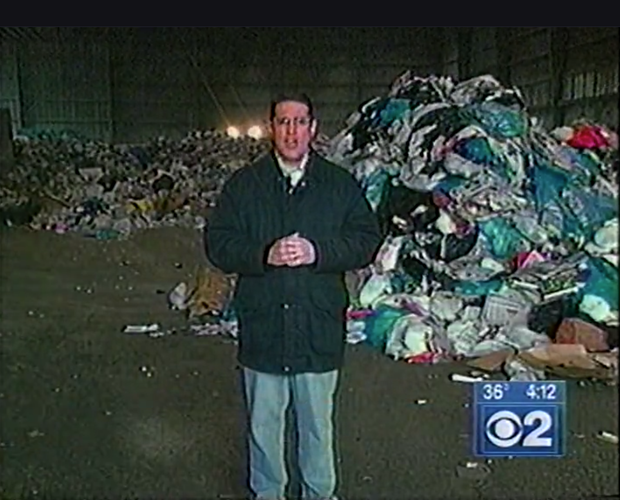
Mora reported that despite the program, an "indescribable" quantity of plastic, glass, aluminum, steel and paper were ending up in landfills. Betsy Vandercook, then president of the Chicago Recycling Coalition, told Mora that Chicago was still way behind the curve among peer cities in terms of recycling at the time.
"Compared to the rest of the big cities in the country, Chicago is pretty close to the bottom," Vandercook said in the 2004 report. "Most cities have fairly respectable programs."
Vandercook told Mora that Chicago residents did not understand the point of sorting out recyclables — bottles and cans in one bag, paper in another, yard waste in a third — when it was all getting compacted with the non-recyclable garbage anyway.
She said consumers thought: "What's the point? Why did I just do all this work, and then a baby blue truck comes down the alley and puts it all back together again?"
Mora reported that as of February 2004, up to three-quarters of all Chicagoans weren't even using blue bags, and many didn't even know about them.
Meanwhile, Mora reported the MRRFs weren't succeeding at weeding out recyclables either. Dirty diapers ended up on the conveyor belt next to bottles and cans, all for an "army of pickers" to deal with.
Mora's report said the process was "extremely labor intensive, prone to contamination, and in the end, yield[ed] a very low percentage of recyclable materials." In fact, industry experts told CBS News Chicago at the time that only 10% of recyclable commodities were being recovered from the waste stream at the time, while Illinois law required 25%.
The city was still able to meet the 25% goal by pumping up the totals to include "screened yard waste," which Mora reported was a mixture of material that mostly was not recyclable at all.
"We don't consider the city of Chicago in compliance," Vandercook told Mora. "The city of Chicago is violating the law, but the law has no teeth. There are no sanctions. They aren't going to get fined for it."
Other communities, including Naperville, were seeing success with a curbside program involving a separate fleet of trucks to pick up recyclables, not unlike the 1989 four-ward pilot program in Chicago. But then-DSS Commissioner Al Sanchez told Mora that a separate fleet of trucks was not financially feasible.
"We put about 360 garbage trucks out on a given day and to put just another whole fleet to maybe go into those same alleys," he said. "It would just be too much money but for right now."
In January 2005, there was more bad news for the Blue Bag program. A news report revealed a study by the Chicago Department of Streets and Sanitation found that the citywide participation rate in the Blue Bag program was just 13.3% in 2003.
In an article on the study, the Chicago Tribune reported that this 13.3% figure was contrary to the fact that the Department of Environment had estimated participation in the program at 34% in 1998, 28% in 2001, and an estimated 30% after that. Streets and San officials still quoted those statistics when pressed by Ald. Joe Moore (49th) about participation rates after the study, which was not made public before the Tribune reported on it, had been conducted.
In fact, the report on the 2003 figures did not show any wards with 30% participation and showed four wards with participation at below 2%, the Tribune reported.
Subsequent reporting by the Tribune in 2005 showed that less and less recyclable material was being pulled from the household garbage stream over time, as nearly 30% of the garbage that once would have gone to MRRFs to be sorted was just being taken to landfills. The Tribune claimed that the city was overstating the success of the Blue Bag program by determining the recycling rate only when considering garbage sorted at MRRFs when, in fact, a lot of recyclables were going to waste transfer stations where they were hauled to landfills.
The Tribune reported that Allied Waste's contract with the city called for the company to recover 25% of the waste taken to sorting centers to be recycled rather than placed in landfills — but unlike the earlier contract with Waste Management, Allied faced no penalty for failing to do so.
From blue bags to blue carts
Mayor Daley defended the Blue Bag program in the wake of the scathing reports. But three years later, the program was dunzo.
In April 2005, 700 households in the 19th Ward, which includes the Beverly and Mount Greenwood communities, became test subjects for a new blue cart program with separate containers for recycling rather than just special bags.
In October 2006, then-Streets and San Commissioner Michael Picardi said the program in the 19th Ward had been a resounding success, with an 80% participation rate among the 700 houses.
At the time, Department of Environment Commissioner Sadhu Johnson still called the Blue Bag program a success, telling CBS News Chicago's Mai Martinez that the program had kept 2 million tons of recyclables out of landfills.
Nevertheless, part of that announcement was a plan to phase out the Blue Bag program and replace it with blue carts.
On May 2, 2008, the Blue Bag program was officially discontinued. By the end of 2011, the entire city was to receive curbside recycling carts.
"We've learned the blue cart system is the system Chicagoans want," Picardi said at the time.
Like the Blue Bag program, the Blue Cart program serves single-family homes and multi-unit buildings with four or more units. Unlike the Blue Bag program, the Blue Cart program involves pickup from separate trucks from the regular garbage truck fleet, which come every two weeks.
But the Blue Cart program ran into its own problems. By March 2012, more than half of Chicago's residents still didn't have access to blue carts, and Ald. Moore said many Rogers Park residents were using drop-off centers in their absence. But in February 2013, then-Mayor Rahm Emanuel announced a plan to complete the expansion of the Blue Cart program by the end of the year.
Today, the Blue Cart program serves about 625,000 Chicago residences, split into six zones. Streets and San handles garbage collection directly for the North and Southwest zones (1 and 4), while the others are served by Lakeshore Recycling Systems, with which the city has contracted for the program since 2021.
Recyclables are sent to transfer stations, and then to material recovery facilities — the old MRRFs again — run by LRS. The current MRRFs are in suburban Forest View and Northbrook and in the Chicago Stockyards Industrial District.
The city now even has a breakdown of where material collected for recycling goes — glass to Wisconsin and elsewhere in Illinois, metal to Illinois and Kentucky, paper to mills in Illinois, Indiana, Iowa, Michigan, and Wisconsin, cartons just to Wisconsin.
Waste diversion rate is still stalling
The Blue Bag program has been gone now for longer than it was around. But waste diversion rates — the amount of garbage being recycled instead of dumped in landfills — remain stubbornly low.
The city's own records show Chicago's waste diversion rate was 9.4% for 2023 and 2024, and 9% for the first 11 months of 2025. By comparison, New York City reported 20.2% in 2024, and Boston 25%. San Francisco, which is working toward a goal of achieving zero waste, has seen more than 50% of its residential and small business waste recovered through recycling and composting in more recent months.
In her studies with the University of Chicago's Harris School of Public Policy, Katherine Tu blamed mistrust in the recycling system dating back to the Blue Bag program for the stubbornly low recycling rates.
"Because of the Blue Bag, I feel like it's just the overall sentiment that, people feel that it's not going do that much, and it's such a nuisance every day," Tu told CBS News Chicago Climate Watch Reporter Tara Molina.
Under Mayor Lori Lightfoot in 2021, the city joined the nonprofit Delta Institute to develop the Chicago Waste Strategy, geared toward an "overhaul" of the city's management of waste. Tu credited the study with "significant positive changes." These included the contract with LRS with tighter rules on how much contamination was required for a cart of recyclables to be sent to the landfill instead.
In an earlier contract with Waste Management — the first Blue Bag contractor, which returned for the Blue Cart program — the city's rules allowed for just one plastic bag or food item mistakenly placed in a recycling cart to be enough for the cart to be deemed "grossly contaminated" and all its contents taken to a landfill, the Better Government Association reported in a 2018 investigation.
Under the LRS contract, a blue cart that is less than 50% contaminated upon visual inspection must have its contents recycled.
Also among improvements in Chicago, Tu also touted the opening of the LRS material recovery facility in the Stockyards Industrial District, which she wrote can process 25 tons of materials an hour and now processes 90% of the recyclables from the Blue Cart program.
The waste strategy also outlined priorities that were trackable on the city's website.
Meanwhile, that sprawling recycling center at North Park Village closed in 2024. Ken Dunn — founder of the Resource Center, a nonprofit that once operated three recycling centers in Chicago — told Block Club Chicago there was no more money to operate it. The other two Resource Center facilities had already closed. Dunn died later that year at the age of 80.
The city itself now runs two recycling drop-off centers, at 6441 N. Ravenswood Ave. in Rogers Park and 1758 S. Clark St. on the Near South Side.
Tu also emphasized the city's efforts to improve public awareness, including a website and app, working with surrounding suburban communities, and cooperation between Streets and San and the Department of the Environment.
"That's how we've been working together, and how that message has been able to get spread, and I think what we're looking at in the future," Department of Streets and Sanitation Deputy Commissioner for Policy and Sustainability Chris Sauve told Molina.
The U.S. Environmental Protection Agency says recycling nationwide keeps more than 190 million metric tons of carbon out of the air. Sauve and Tu both said that urging people to get out and recycle and spread the word is one of the best things environmentally conscious Chicagoans can do.