Canada's tariffs target certain U.S. states. See which regions are most vulnerable.
Canadian trade officials acknowledge that the country's retaliatory tariffs of up to 50% on $20 billion in American goods are intended to exert pressure on the Trump administration by targeting key U.S. states. Although the negotiators haven't identified those regions, the tariffs could hit states in the Midwest and Northeast particularly hard, according to economists' analysis of Canada's new import duties and state export data.
"We are picking products that will target states in the U.S.," Melanie Joly, Canada's industry minister, said Tuesday in announcing the tariffs. "We're being wise and strategic to put political pressure, and that's why we think it's the right thing to do right now."
Canada's tit-for-tat tariffs are the latest volley in a widening trade war pitting two longtime allies against each other, a fight that experts say could hurt both countries economically. The conflict comes after the Trump administration announced 50% tariffs on Canadian products following failed negotiations. On Monday, President Trump also announced 50% tariffs on Canadian automotive and steel imports that, absent a deal, would take effect on Jan. 1, 2027.
Canada's tariffs appear designed to put pressure on U.S. states with competitive midterm elections, economists said. The import duties will be applied to more than 800 types of U.S. goods, impacting everything from American-made cheddar cheese to steel and aluminum products, potentially hurting dairy producers in Wisconsin and Vermont and manufacturers in Michigan and Indiana.
Canada is the top customer for exports from 27 U.S. states, Canadian government data shows. While North Dakota is the state most reliant on trade with Canada, excluding fuel products, a large share of its exports consists of soybeans, wheat and other agricultural products, which are exempt from Canada's new tariffs.
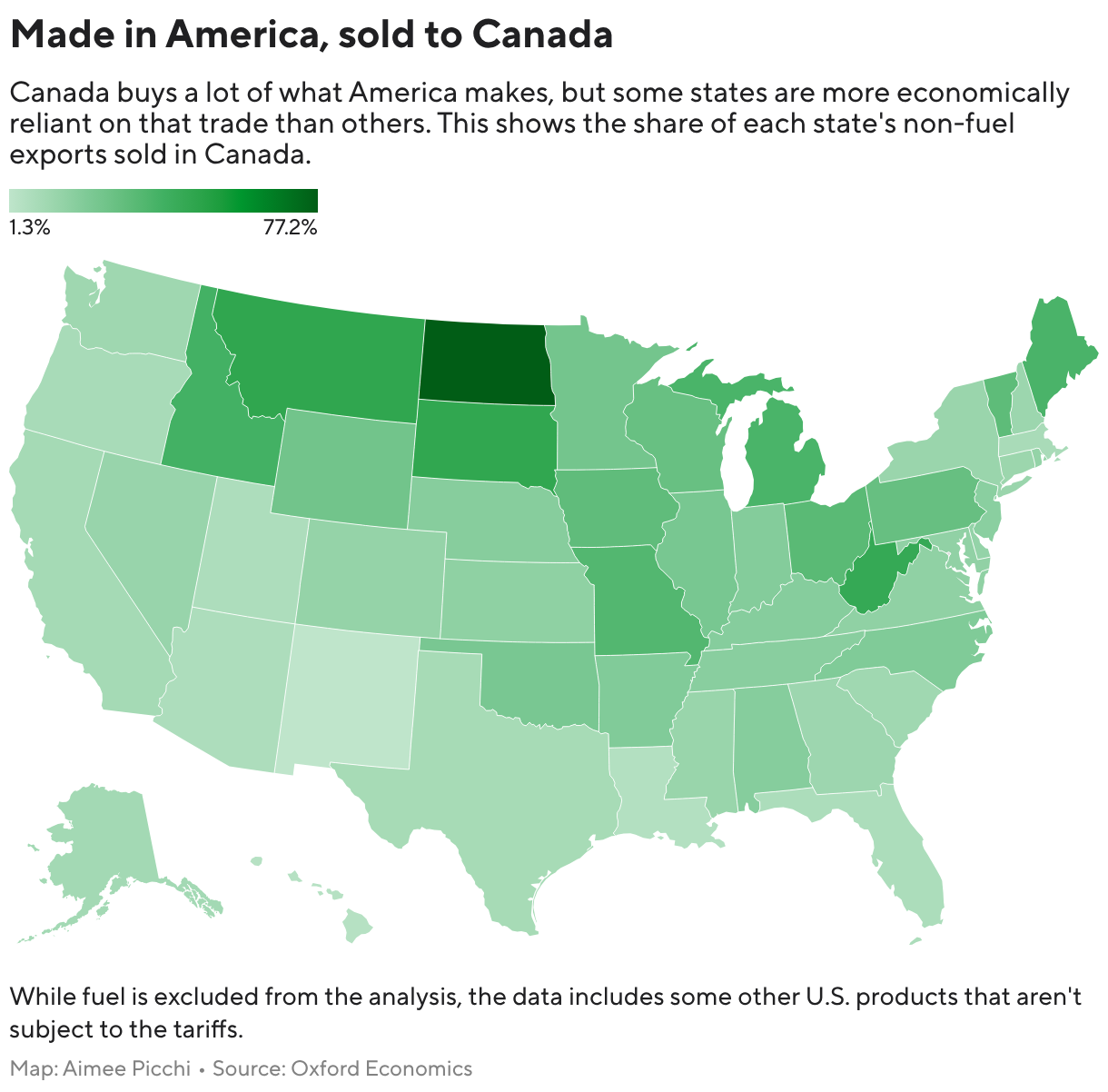
Michigan, Indiana and other states with large manufacturing sectors that ship goods to Canada are likely to feel a bigger impact than agricultural states like North Dakota because the new tariffs will apply to U.S.-made appliances, steel, aluminum and tools, experts said.
The White House said Canada's trade practices particularly harm states in the Midwest.
"America's heartland states like Michigan and Indiana have been some of the worst hit by unfair foreign trade practices, including by Canada, and were resoundingly won by President Trump because of his pledge to put American workers, farmers and businesses first," White House spokesman Kush Desai said in a statement to CBS News. "Canada was offered the best trade deal of any trading partner, and Canada rejected that deal to demand continued one-sided access to the American market with no reciprocity."
Because Canada's tariffs roughly mirror those that the U.S. imposed on Canadian goods, they target hundreds of products across different industries in both Republican- and Democratic-leaning states, Mary Lovely, a U.S. trade expert and senior fellow at the Peterson Institute for International Economics, told CBS News.
"By nature of what we export to Canada, you're going to have a differential impact on states, and the tariffs are going to hit a mix of red, blue and purple states," she said.
The Canadian tariffs, set at rates of 15%, 25% and 50%, are scheduled to take effect on U.S. products on Sept. 8, less than two months before the U.S. general election. That timing is "not lost on the Canadians," said Ed Gresser, director for trade and global markets at the Progressive Policy Institute, a nonprofit think tank.
"Canada buys about one-tenth of all U.S. exports, and they have consulates all over the country, so they know the U.S. economy and U.S. politics very well," Gresser told CBS News.
Lovely said she thinks Canada hopes to negotiate a trade deal with the U.S. before its retaliatory tariffs take effect on Sept. 8.
Urged to buy Canadian
American goods facing 50% Canadian tariffs include some steel and aluminum products, furniture and clothing. Appliances, dairy products including cheese, fish and other seafood, and certain steel and aluminum derivatives will face 25% tariffs. Existing Canadian counter-tariffs on U.S. autos will also remain in place.
Canadian officials said their goals include protecting the country's companies and reducing purchases of U.S. imports. The tariffs will make U.S.-made products more expensive for Canadian consumers, spurring some to switch to lower-priced locally made products.
On Tuesday, Joly also urged Canadian consumers to buy products made in Canada, adding that she had spoken with grocers and other retailers to ensure Canadian-made products are clearly identified.
"If you see a Canadian product, please support it," Joly said in announcing the tariffs. "When you choose a Canadian product, you are not only putting pressure on the U.S., but right now you are protecting jobs."
Seafood, dairy and vehicles
Some of Canada's new tariffs target American products produced in states with competitive political races, such as Maine, where Sen. Susan Collins, a Republican, is facing Democratic challenger Troy Jackson. Canada on Tuesday said it will apply a 25% tariff on lobsters harvested in the U.S., which Gresser said would be the first Canadian tariff on the crustacean.
"That's very specific to Maine, and it's a very emotive industry," Gresser said. "It's very much like if you're from Maine, you're quite proud of it — it's what we do, it's what is special and distinctive about us."
Alaska, Florida and Massachusetts also export seafood products to Canada that are subject to retaliatory levies.
Meanwhile, Canadian tariffs on U.S. dairy products will affect states such as Wisconsin and Vermont, with Canadians buying 80% of the latter's cheese and milk exports.
The automobile sector is a key pillar of the U.S.-Canada trade relationship now at risk from the nations' tariffs and countertariffs, with Canada applying new import duties to motorcycles, tractor-trailers, railroad cars and some auto parts.
"Michigan is very integrated with Ontario. There's a constant flow of parts back and forth across the border," Gresser said, noting that Wisconsin and Ohio also export a lot of auto parts and vehicles to Canada.
Impact on Canada's economy
Canada's new tariffs could also weigh on its own economy, according to an Aug. 24 analysis from Oxford Economics. Because the tariffs are essentially sales taxes, they could push up Canadian inflation by 0.3 percentage points in 2027 and create an equally large drag on economic growth, the investment advisory firm said.
"This won't cause a recession, but greater uncertainty about Canada-U.S. trade policy will weigh on the economy," the economists wrote.
The Canadian officials on Tuesday acknowledged the new tariffs could cause hardship for some domestic businesses and workers, and rolled out plans to extend business loans and unemployment aid to help offset the impact.
"Canadians know how to weather the storm," Patty Hajdu, Canada's minister of jobs and families, said on Tuesday. "Sticking together, we can get through anything."


