Black and gold bumblebee officially designated Illinois State Bee

Illinois Gov. JB Pritzker on Wednesday signed a law designating the black and gold bumblebee as the Illinois State Bee.
The new Illinois State Bee serves as a key pollinator in the state's prairies, sustaining the natural ecosystem, supporting agriculture, and even helping sustain life on Earth, the governor's office said.
The black and gold bumblebee was designated following a year of campaigning by students at Lincoln Junior High School in Naperville, the governor's office said.
Last year, students in Ms. Barbara Bell's eighth-grade science class led the push for the state bee designation, after they completed a research project on bee species native to Illinois, according to the governor's office.
The students created presentations for distribution around Illinois, launched a statewide vote, and testified before lawmakers. Because of their efforts, HB 4438 was approved to designate the state bee.
"Illinois is home to extraordinary insects and wildlife, each with an essential role to play in keeping our ecosystems thriving, and the hardest working of all is the bee," Gov. Pritzker said in a news release. "The students at Lincoln Junior High School recognized the impact the black and gold bumblebee has on our state's natural environment, a source of great pride to all who call Illinois home. They demonstrated the power of young people brought together by curiosity and civic engagement, and in doing so, left their mark on our state."
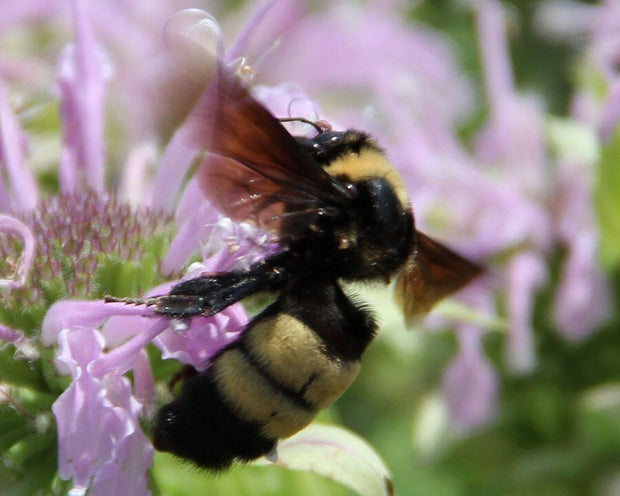
The black and gold bumblebee (Bombus auricomus) is one of the largest bumblebee species — with workers measuring up to half an inch and queens measuring up to an inch, according to the University of Wisconsin-Madison.
"Flying by your head, they'll sound like a helicopter," the university's bumblebee guide said.
As noted by NatureServe, the black and gold bumblebee can be found in the eastern half of the United States south to Florida and as far west as Wyoming and Montana, and in Ontario and possibly from Saskatchewan west to British Columbia in Canada.
The bees have long tongues and nest below the surface of the ground, according to the Illinois Department of Natural Resources. The bee's favorite flowers include thistles, clover, coneflowers, delphinium, St. John's worts, thoroughwarts, bee balms, and nightshades, among others.
Only the queen black and gold bumblebees survive winter to form a colony. She picks a nest site and constructs a nest from plant materials, the Illinois DNR explained. The first brood of bees in a season is made up all of female workers, who are responsible for all the tasks in the hive except egg-laying.
Male bees and other queens are produced late in the season, and males mate with queens in the fall, the DNR said.
The bee uses its fuzzy body to collect nectar and pollen, and keeps prairie systems healthy and vibrant, the governor's office noted.
The black and gold bumblebee is one of numerous bumblebee species native to Illinois. Most are stable and plentiful, but one, the rusty-patched bumblebee, is endangered on the state and federal levels.
In recent years, Illinois has been working to raise awareness about the importance of pollinators in the ecosystem.
The state has used student initiatives to designate several other symbols, including dolostone as the state rock and the giant puffball as the state fungus.


