University of Georgia researchers discover 7 new viruses in threatened sea turtle populations
Researchers at the University of Georgia say they've identified more than a dozen viruses, including seven of which had never been identified before in any species, that could threaten sea turtle species.
The new research, published in August by scientists in UGA's College of Veterinary Medicine, could help establish a foundation that could help with the conservation efforts of the already endangered species.
The university says the researchers used genetic sequences to identify 19 viruses in Atlantic and Pacific sea turtles, one of which they say belonged to a previously unrecognized scientific family of viruses. Other viruses found were genetically related to pathogens known to infect fish and aquatic invertebrates.
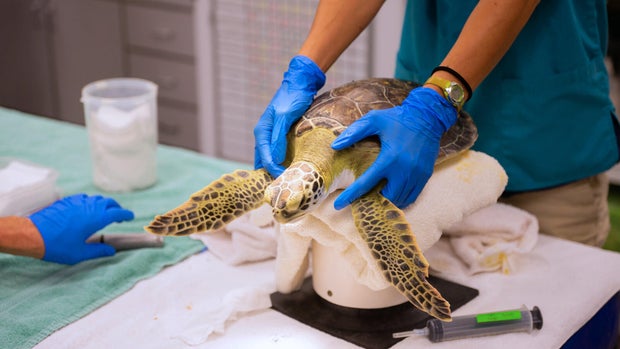
While sea turtles have shown symptoms of viral infections in the past, diagnosing the cause has been difficult, since researchers would have to search from scratch for a possible cause of any viral outbreak. With this new information, scientists have a critical advantage, the university said.
"Viral discovery turns unknown unknowns into known unknowns that we can then target for study," said Dr. James Stanton, corresponding author of the study and interim department head of pathology at the UGA College of Veterinary Medicine. "Most of these viruses may never prove to cause disease, but discovering and cataloging them gives us the foundation to recognize the ones that do and determine whether they pose a meaningful threat to already imperiled sea turtle populations."
While the viruses may never be proven to cause disease, researchers say their discovery will help recognize the ones that do.
Five of the seven species of sea turtle are threatened with extinction, with two of those, Kemp's Ridley and the Hawksbill, are designated as critically endangered.


