Ponce City Market marks 100 years as Atlanta landmark, economic engine and gathering place

For 100 years, the massive brick building now known as Ponce City Market has been part of Atlanta's economic and cultural life, reinventing itself as the city around it changed.
It opened in 1926 as a Sears, Roebuck and Co. retail store and distribution center, later became home to Atlanta city government and, after years when much of the sprawling complex sat unused, was transformed into Ponce City Market.
Now, as the landmark celebrates its centennial, its owners are looking back at the building's many lives and the role the property played in Atlanta even before Sears arrived.
"Even before Sears came in and built on this land, there was kind of an idea of gathering," said Alexandra Kirkland, vice president of development for Jamestown, which redeveloped the property. "There was the ballpark. There was an amusement park. There's always been this sense of community here."
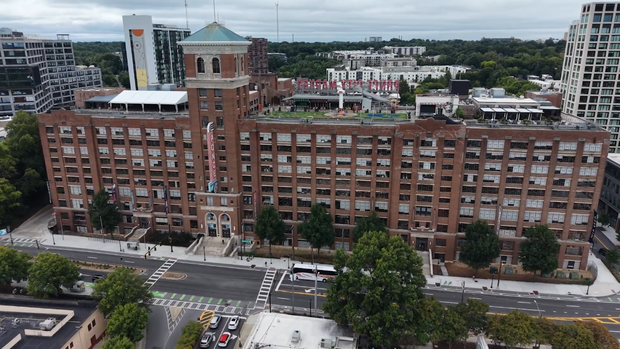
Historian Jerry Hancock of Georgia State University says the location was no accident.
In the 1920s, Sears was expanding beyond the mail-order business that had helped build the company. It began developing facilities that combined retail stores with enormous distribution operations serving catalog customers. Atlanta was among the company's early locations built on that model.
At the time, the property sat on the outskirts of the city, offering Sears room to grow, ample parking for the emerging automobile age and, critically, access to transportation, Hancock said.
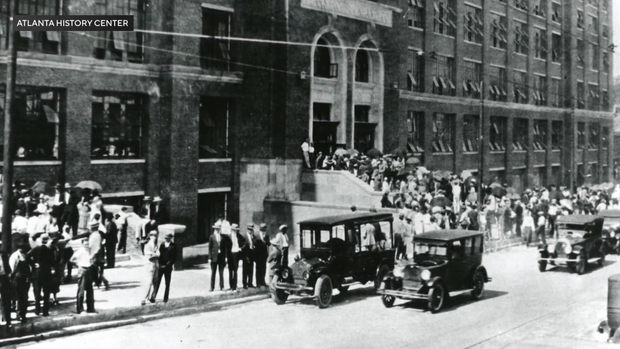
The trolley line ran along Ponce de Leon Avenue and intersected with the railroad corridor that today forms part of the Atlanta Beltline.
"It was sort of at this intersection of two major thoroughfares," Hancock said. "Plus they had plenty of room for growth. And so that really made the location sort of perfect."
When the Sears complex opened in August 1926, some 30,000 people reportedly came through its doors on opening day.
The building would become far more than a place to buy merchandise. Hancock said Sears used its Atlanta operation for community outreach and programs supporting Southern agriculture and industry. A farmers market opened on the property in 1929, bringing farmers from around Georgia and the region directly to Atlanta customers.
The building also played a role in Atlanta's early broadcasting history. Hancock said radio programs were produced from the building's tower, providing farmers with information, including weather reports, along with musical entertainment. Those broadcasts became part of the growing popularity of what was then commonly called "hillbilly music" and what would develop into country music.
"That tower symbolizes so much," Hancock said.
By the latter decades of the 20th century, both Atlanta and American shopping habits had changed. Consumers increasingly shopped at suburban malls and discount retailers, and Sears gradually shifted away from its enormous urban distribution operations. Hancock said many employees from the Atlanta facility were eventually relocated to suburban Sears locations.
After Sears left the building, the city of Atlanta acquired it and turned the complex into City Hall East. The city had ambitious plans for the enormous property, but Hancock said ultimately less than 20% of the building was used.
Much of the rest essentially became a time capsule.
After Jamestown acquired the property, Hancock said remnants of the Sears era were everywhere. During one early tour, he walked into an old electrical room and spotted a piece of paper lying on the floor. It was a wiring schematic, he said, for a Sears popcorn maker dating to roughly 1931.
"There was so much of that stuff that was sort of left over from Sears' time in the building," Hancock said.
Jamestown saw the enormous, largely unused complex as an opportunity not only to preserve a historic building but to reconnect a part of Atlanta.
"When we decided to come in to buy the parts of the building that is now Ponce City Market, we really saw an opportunity to revitalize that idea of community space," Kirkland said.
That meant a place where people could shop, eat and spend time, she said, but also a development that could "bridge the gap between several neighborhoods that had kind of a hole in it."
Ponce City Market's first phase opened in 2014. Today the development includes shops, restaurants, offices and housing. Its original residential component included 259 units, according to Kirkland, and subsequent development has added more housing and hospitality accommodations.
Kirkland said Ponce City Market drew more than 3.9 million visitors in 2025, attracting people from across metro Atlanta as well as tourists from outside the region.
"We really want everyone to just continue to see Ponce City Market as an anchor for the city as well as a gathering place for the community," she said.
Hancock sees another historical symmetry in the building's modern life: The railroad that helped make the Sears operation possible a century ago is now the corridor carrying the Beltline past its doors.
"It represents Atlanta's past in regards to railroads," Hancock said. "It was the lifeblood, not just of Atlanta, but also of this building."
For the centennial, photographs displayed throughout the first and second floors of the food hall show portions of the building before and during its transformation.
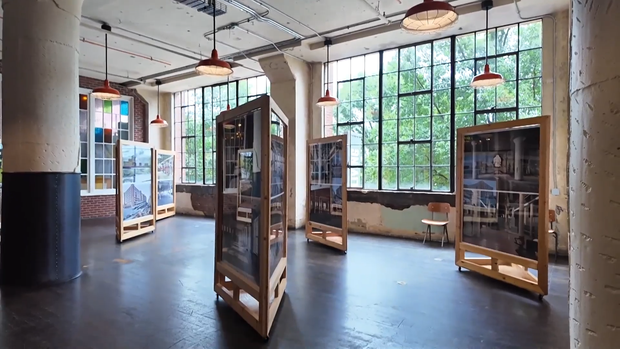
Kirkland said a documentary photographer was brought into the largely unused building after Jamestown acquired it to record what remained.
"We really want everyone to understand that Jamestown came in to celebrate the history, to give new life to a building that was just over 3 million square feet in the center of Atlanta," she said. "There is something beautiful to the remembering of what has been here for a very long time."
On Saturday, Ponce City Market will kick off a month of centennial events with free activities open to the public, including food, live music and programming with tenants.
For Hancock, the building's survival also represents something larger for a city that has not always preserved its past.
"For years, Atlanta was one of the cities in the country that was most known for destroying the past," he said. "And now we seem to be almost at the forefront of saving it and preserving it."


