How Jimmy Carter helped lay the groundwork for MLK Jr. Day

Martin Luther King Jr. and Jimmy Carter never met, never shared a room, or even shook hands. Yet, their lives became deeply intertwined through the enduring connection between the King and Carter families—a bond that helped shape history.
"When Carter was running, Daddy came and they visited together," recalls Bernice King, daughter of Dr. King and CEO of the King Center.
Many people don't realize it, but President Jimmy Carter played a pivotal role in establishing Dr. Martin Luther King Jr. Day. Carter helped turn King's legacy from historical memory into national law.
"In 1979, when he was president, he actually promoted the historical site, and he promoted Jan. 15th as a national holiday," says Paige Alexander, CEO of the Carter Center.
Although the bill did not pass during Carter's presidency, his support helped shift the momentum, ultimately leading to its passage in 1983 and the first national observance in 1986.
Inside the Jimmy Carter Library, a replica of the Oval Office stands as a reminder of Carter's presidency—where ideals became policy.
"My mother called upon him when it was time to establish this King historic district—that was her relationship with Jimmy Carter and the national historical park. That foundation was laid with my mother and Jimmy Carter," Bernice King shares.
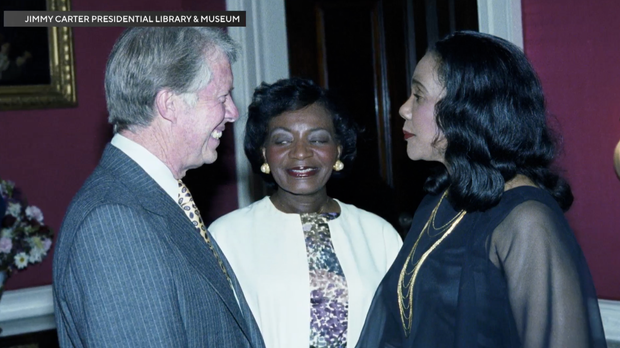
Dr. King once described Carter as "one of the purest of heart." Reflecting on that, Bernice King adds, "I think that Jimmy and Rosalynn Carter both came to this realization—having grown up in a divided town, they recognized that those divisions shouldn't occur, that everyone wants the same."
Carter's connection to civil rights didn't begin in Washington—it started in Plains, Georgia, shaped by a Black woman on his family farm: Miss Rachel. She wasn't a political figure, but her influence ran so deep that Carter honored her throughout his life.
"If you go to the Jimmy Carter Museum, you can see there's a whole wall dedicated to the effect she had on his life," Alexander notes.
Carter also helped elevate Dr. King as a national icon—including honoring him posthumously with the Presidential Medal of Freedom, accepted by Coretta Scott King. And when Coretta Scott King passed, the Carter family was called upon once again.
"President Carter spoke at Coretta Scott King's funeral, and that embodied the closeness they had," says Alexander.
In Atlanta, the connection endures: from the King Center to the Carter Center, the legacy of two men who never met but are forever linked in the story of America.