Georgia's largest battery storage facility unveiled in Ball Ground as backup for power system

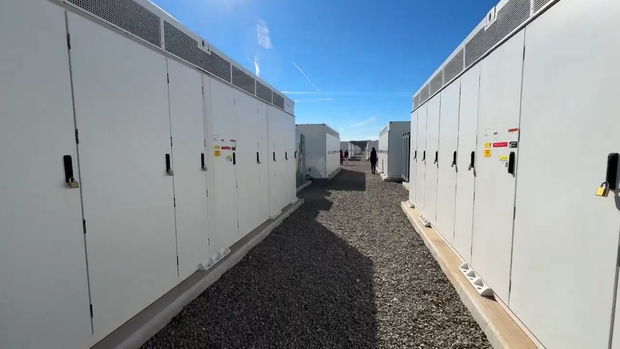
Across 40 acres in Cherokee County, banks of Tesla batteries store something Georgians depend on every day: electricity for when they need it most.
Georgia Power celebrated its McGrau Ford Battery Facility with a ribbon-cutting on Friday. The utility describes the 530-megawatt installation as Georgia's largest battery energy storage system.
The batteries don't generate electricity. They charge from the grid, storing power that can be released when demand rises, such as when households turn on their heat or air conditioning at the same time.
Rick Anderson, Georgia Power's senior vice president and senior production officer, said that also gives the utility a way to manage the cost of supplying electricity.
"You might have at night where costs are really low. You have excess capacity," Anderson said. "You can take the excess capacity stored in a battery."
When electricity becomes more expensive, the utility can discharge that stored power rather than obtain electricity at a much higher cost, he said. Georgia Power says the approach helps control costs for customers. It is not, he said, a promise of an immediate reduction in monthly bills.
The batteries can also respond quickly when demand spikes or another electricity source has a problem.
"If you have an issue with a nuclear unit, gas unit, solar unit, batteries can step up to the plate," Anderson said.
Georgia Public Service Commission Vice Chairman Lauren "Bubba" McDonald Jr. said the ability to help meet those surges is a central benefit.
"It brings reliability. That's the main thing," he said.
The facility feeds electricity into Georgia Power's transmission network, which connects with the broader power system across the Southeast, according to a Georgia Power representative. The electricity is not physically confined to Georgia Power customers.
About 200 people worked to build the facility, which employs 11 people full-time, according to information provided at the event.
The choice of Ball Ground came down to two essentials: available land and access to the transmission system.
"So here's a great place to plug into our grid," Anderson said.
The facility's two phases share transmission infrastructure, an arrangement Georgia Power says helps minimize costs.
More battery sites are planned. Anderson told CBS News Atlanta the utility expects to have 12 sites totaling more than 4,000 megawatts by 2030, along with two additional projects pairing batteries with solar.
For customers, the idea is straightforward: bank electricity when it is available at lower cost, then draw on it when demand puts the grid under pressure.


