Georgia Tech graduate, cancer survivor gets chance to test robotic surgery system that saved his life
Jonathan Sculley was blown away when he got to get up close and personal with the robotic surgery system that saved his life.
"I've never even seen anything like this before," Sculley said. "It's quite easy to use, actually. It's quite intuitive."
It's called the Intuitive da Vinci 5 robotic surgical system, technology that helps doctors perform surgeries with precision in a less invasive way using cameras and robot arms. Intuitive, the developer, says it leads to faster recovery times and minimized risk of complications.
Sculley says he had to have a lobectomy and bronchoplasty to remove a cancerous tumor from his lung. More than 200 of these systems are across Georgia, but Emory Healthcare, where Sculley had his surgery, is leading the way with more than 30.
Dr. Manu Sancheti, the director of robotic thoracic surgery for Emory Healthcare, was Sculley's doctor who performed the surgery.
"Jonathan's case was quite complex in terms of where the tumor was actually located and the amount of lung I had to remove," Sancheti said. "So I knew that I was going to be able to do the surgery, but I wanted to give him the best chance of a full recovery and a quick recovery, as he is. He's young and active, and so I knew this was going to be the technology that I used, and fortunately it was successful for him, and he's back to his normal life."
"Basically, for this procedure, because they're removing a lobe, the traditional way without a robot is they have to make a large incision to be able to go in and take out a full lobe," Sculley said. "But because they're using the robot, they made actually five smaller incisions. I have them down here and then down to my back. They made five incisions, so each of those heals a lot faster."
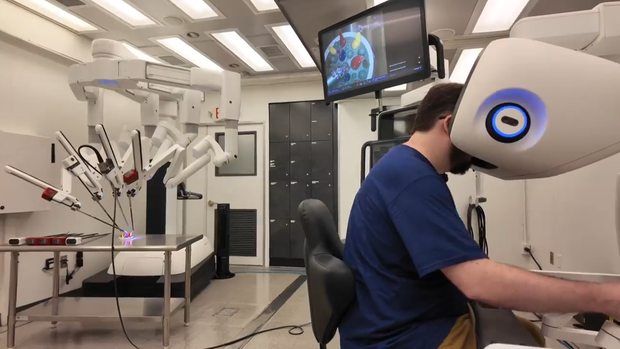
Sancheti says Emory Healthcare uses the system every day on a variety of patients.
"It's fun in the fact that it's advanced technology. It's fun in the fact that we can use these instruments that can provide patients quicker recovery and more complex care. And that's, that's where most surgeons get their fulfillment from," he said.
Sculley says he's grateful to his wife and mother for encouraging him to keep searching for answers for why he was having breathing problems.
"We are thankful that, like, he listened that day and we went to the urgent care and everything," said Aditi Jain, Sculley's wife. "We wished this didn't happen at all. But … it was caught very early, like it was stage 1 and low grade. So it hadn't spread anywhere else."
"Jonathan was not resistant at all, but he had been to many doctors over a couple of years' period, and I think he had been dismissed," said Karen Sculley, his mother. "We're so thankful for the series of events that led up to it being diagnosed correctly and then having a treatment with doctors."
"It was obviously a very tough experience. By far, the hardest thing I've ever had to go through in my life. But coming out the other side, I feel totally fine now," Sculley said. "I feel positive about the outlook."
Sculley is currently in remission. He says he won't have to have another surgery as long as he doesn't develop another tumor.


