Georgia charter school expands inclusive learning model as demand grows

At Tapestry Public Charter School, inclusion is more than a philosophy. It's woven into the daily experience of students with and without disabilities who learn side by side in classrooms designed to support a wide range of learning needs.
The Doraville-based charter school has built its model around bringing neurodivergent and neurotypical students together in the same learning environment. School leaders say the approach has been so successful that Tapestry is opening a second campus in Clayton County this fall.
"The mission is really inclusion, having all students of different abilities, different statuses—whether it's race, social, gender—all in the classroom together, working together and learning together," said teacher Tina Burgess.
The school's classrooms feature flexible seating, allowing students to choose the learning environment that works best for them. Sensory spaces, including quiet rooms and activity rooms, provide opportunities for students to regulate their emotions and focus before returning to class.
"We have this quiet room where students can kind of just chill and like, just let their minds relax," said student Nirvan Ghanta.
Burgess, Tapestry's lead middle school teacher, says the benefits extend beyond students with special needs.
"Students who interact with other students with disabilities are able to gain compassion, and they're able to really learn to work with them in ways that you wouldn't normally see," she said.
Students say the school's structure allows them to develop at their own pace.
"It really just allows for you to grow at your own speed and let you do what you need to do, however fast you need to. And that's really supported through the teachers and everyone around you," said student Bennett Lesesne.
For Ghanta, Burgess played an important role in helping him adjust to school.
"She was really helpful, actually. And especially with my English skills. But also even since then, I mean, she's just been a really nice person to talk to and hang out with," he said.
One of the school's signature programs is "Lunch Bunch," where students are assigned to small groups that eat lunch together with the same teacher throughout the week. Educators say the regular interactions help students build relationships and develop social-emotional skills from middle school to high school.
Burgess has seen firsthand how those connections can transform students.
"They've blossomed. They've been able to go from crying and kicking and screaming when they first enter middle school, to being able to advocate for themselves, ask questions, and self-regulate," she said.
Students credit Burgess with helping shape not only their academic growth but also their confidence and character.
"If I have something heavy on my mind, she's one of the first people I go to," said student Simon Neill.
"She was always there to show me what I needed to do and really help me develop who I was going to be as a person. She was always an inspiration for how I wanted to present myself to people," Lesesne said.
Zachary Laney said Burgess continued encouraging him even when he struggled academically.
"I was kind of a horrible student throughout most of seventh grade. I didn't do too good, but she kept on going. She stayed encouraging even through all that," he said.
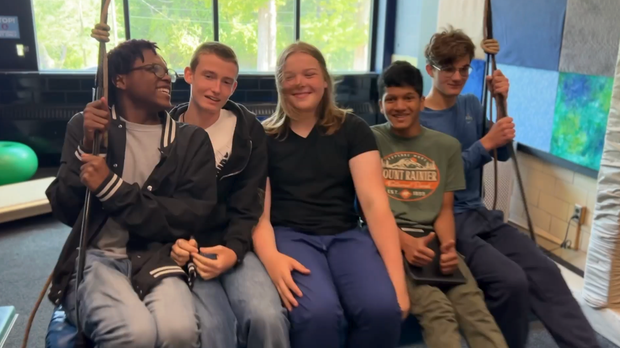
Laney believes attending school alongside students with different abilities has broadened his perspective.
"Getting to hang around people who are different from you in all sorts of ways really makes you a little more open-minded," he said.
Teacher Pritul Patel said the school's culture embraces students' differences rather than treating them as obstacles.
"I feel like the school helps the students become better themselves. They celebrate the differences. And the school does it. The peers do it. Everyone around the people do it. So everybody buys it," Patel said.
"What we've realized here at Tapestry is that although they may have different needs, they're neurodiverse. They might also be gifted. So we have our twice-exceptional students that don't have the opportunity to reach their potential if we don't have a school like this that includes everyone," Burgess added.
As Tapestry prepares to open its second campus, Burgess will help lead the effort, bringing the school's inclusive model to a new community.
"Opening the second campus is really just a dream because the need is out there in different areas," she said.
Burgess hopes the expansion will allow more families to access a learning environment where students feel supported, accepted and capable of success.
"Having a school like this where we can have inclusion and we can have neurodiverse children with our general population and not feel left out and not feel that they're being bullied, not feel that they're not included, it gives hope to our community and to the parents for the future," she said. "Because really, in order to have a future where we are successful and where we have everyone meet their potential and their goals, we need to have inclusion."
For information on Tapestry's expansion and enrollment, click here.


