Following an Atlanta food delivery robot reveals how sidewalk automation really works

Six-wheeled delivery robots weaving through Atlanta sidewalks have been turning heads and going viral, but they're not lost. They're part of a growing wave of autonomous delivery robots now making food runs across midtown and downtown.
CBS News Atlanta recently followed one of those machines, a robot named Matin, to see exactly how they work and what their expanding presence could mean for human delivery jobs.
Matin rolled out of Rreal Tacos in Midtown, beginning a little more than a one-mile trip to a customer on Spring Street.
"It really does help out on the weekends when we have a lot of traffic," said Diana Carrillo, a manager at Rreal Tacos.
We tracked Matin the entire way, watching how he handled narrow sidewalks, crowds, and curious pedestrians. For a robot on the job, he's kind of a celebrity, even appearing in viral TikTok videos.
"I think they're having a beef because that other one just bugged his eyes out," one TikToker joked in a clip.
Videos often show the robots clustering together or pausing at corners, leading some viewers to believe they're confused or frozen. That's not the case, according to Serve Robotics.
"No. Most of the time people perceive the robots are stuck. They're idling, waiting between orders," said Aduke Thelwell of Serve Robotics.
Thelwell said Matin may look cute, but the 250-pound robot is not a toy, and definitely shouldn't be picked up.
During the trek, Matin asked for a bit of human help at one intersection: "Push the crosswalk button for me?" he prompted.
"We've found again our delivery completion rate is over 99.8%, and we've found that Atlanta really does have really strong infrastructure," Thelwell said.
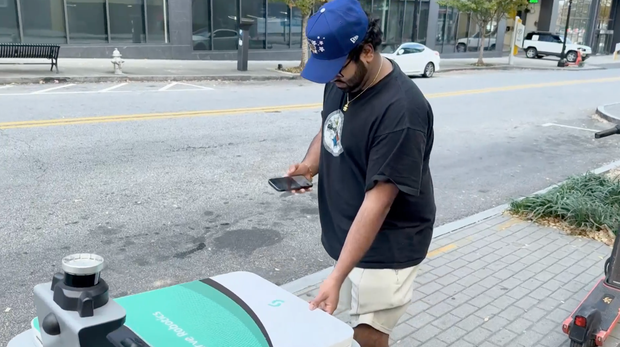
Once Matin arrived at the Spring Street building, the customer unlocked the robot's lid with his phone. The top popped open, revealing the food inside. The trip took 16 minutes and 10 seconds — not including restaurant prep time.
"Our average delivery time is around 18 minutes from pickup to drop-off, which is very much comparable to couriers and your typical delivery methods," Thelwell said.
The customer said his total wait was about 30 minutes.
Although he's used delivery robots before, he admitted he still has concerns.
"I'm a little worried about it," he said. "Because I think if you cross that line into too much automation, you start making people lose jobs."
We asked an economist whether robots like Matin are replacing workers or simply changing the work.
"At some point in time, some of these jobs will be replaced by machines," said Ramnath Chellappa, a professor at Emory University. "I would say we are not there yet. I think the cost of fully replacing human labor is right now prohibitive."
After finishing his delivery, Matin rolled a few feet away, parked at the edge of the sidewalk, and waited quietly for his next order.