Civil rights advocates push to preserve Atlanta home at center of landmark LGBTQ court case

A race is underway in Atlanta's Virginia-Highland neighborhood to save a home at the center of a landmark U.S. Supreme Court case from demolition.
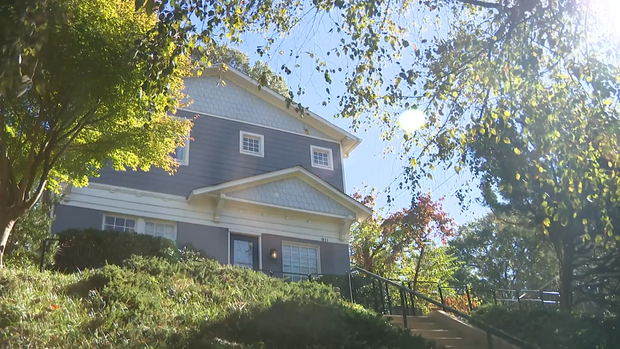
Set on an urban hill at 811 Ponce de Leon Place, the bungalow is where Michael Hardwick lived in the early 1980s, when his name became synonymous with the national fight for LGBTQ+ rights. His arrest inside the home sparked a constitutional battle that drew national attention and a march on Washington.
The property's new owners want to tear the structure down and build a home. City of Atlanta officials and civil rights advocates are hoping to preserve it as a historic landmark.
"You really can't talk about the right to privacy or gay rights in the last century without thinking about Bowers versus Hardwick," law professor Fred Smith said.
At Emory and Stanford Universities, Smith has educated law students about the landmark U.S. Supreme Court case. It began in 1982 when an Atlanta police officer went to Hardwick's home to serve a warrant for a traffic violation. Inside the residence, the officer observed Hardwick engaging in a sexual act with his male partner. Hardwick was arrested and charged with sodomy.
"The reason why the officer was able to do that is that there was a law on the books that made such conduct unlawful, that made it a felony," Smith said.
Hardwick sued the state of Georgia. Although he won in a U.S. Court of Appeals, the Georgia attorney general took the case to the U.S. Supreme Court, which ruled against Hardwick in 1986. As a result of the decision, laws prohibiting sodomy remained on the books for another 17 years.
"The justice who wrote that opinion, Byron White, later admitted that the ruling that gay people had no right to private intimacy, he said, he got that wrong," said Carl Charles, an attorney with Lambda Legal, the organization that eventually helped overturn the Supreme Court ruling. "So Lambda Legal in 2003 brought another case, Lawrence versus Texas, and we struck down once and for all the sodomy laws across the United States when we won that case."
Today, Hardwick's former home holds deep sentimental and educational value in the LGBTQ+ and civil rights communities.
"I taught at Emory for 10 years, and I was able to say to students, 'You know, 811 Ponce de Leon Place, if you want to see where this happened, you can see the very place where this happened," Smith said. "And I think that there's something about that that connects people to a moment in a unique way."
With the current owners seeking to demolish the house and build something new, the Atlanta City Council recently passed a resolution to start the process of designating the property as a historic landmark.
Despite the resolution, however, The Advocate reports that zoning officials approved a request last week to demolish the house.
"The stakes on the historic Hardwick house could not, frankly, be higher in terms of the value to our community and movement," Charles said.
Through their attorney, the home's owners said they would not comment for the time being. Under a city ordinance, if the Atlanta Urban Design Commission introduces a formal notice of intent to nominate the home as a designated landmark, an automatic 120-day freeze on all demolition permits goes into effect.


