After beating rare cancer, Cobb County young man continues dream of becoming a pilot
From a young age, Nico Leonardo knew he wanted to become a pilot.
A rare cancer diagnosis put the Pope High School graduate's plans on pause, but he's continued to fight to return to the skies.
His dreams of flying started with a role model close to him.
"My grandfather was a pilot, and I grew up watching him fly," Leonardo said. "He used to do aerobatics and air shows, and as a kid I just thought it was the most fascinating thing."
Last year, the Auburn University student dealt with turbulence on the ground.
"So last September, I was diagnosed with a rare form of bone cancer called Ewing sarcoma. And we had originally thought that it was a muscle injury, such as a hip flexor tear, which … it ended up being something a bit more serious," Leonardo said.
His treatments at Children's Healthcare of Atlanta's Aflac Cancer and Blood Disorders Center started shortly after - 14 rounds of chemotherapy and a leg surgery to remove the tumor.
"There are only about 200 new diagnoses of this tumor a year in the United States. It's 1% of all pediatric cancer and so it's relatively rare," pediatric oncologist Dr. Claire Stokes said.
Stokes says treating Ewing sarcoma demands a lot from the patient.
"Admissions to the hospital every other week for about nine months. And then either surgery or radiation to remove the tumor or to treat the tumor. And some kids like Nico have both," she said.
"It was very difficult day-to-day, just knowing that I didn't have the energy that I used to have, and for a short period of time there I wasn't able to walk," Leonardo recalled. "But looking back at it, I think it all worked out for the better because now I'm so much more blessed for all of the little things in life."
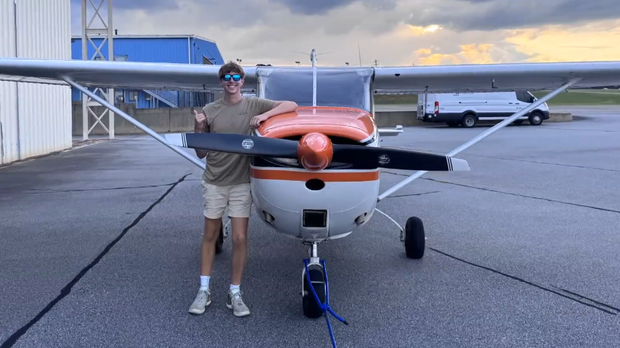
Leonardo didn't let the hard times ground his dreams.
"He rarely had a bad attitude. He was almost always positive and focused on getting through it and what life would be like after he was done with his treatments for Ewing," Stokes said.
Even with treatments happening, he was still able to fly with the help of his instructor. On May 11, he rang the end-of-treatment bell.
"Having a couple low times that the good, happy times wouldn't seem as good as they are without being beaten down every now and then then the victories don't seem as large, and that, even though it may not be great right now, it's going to get better, and your life is going to be even better when you finish it all," he said.
Fighting cancer and sickle cell in metro Atlanta
The Aflac Cancer and Blood Disorders Center is one of the largest cancer centers and the largest sickle cell disease program in the nation.
The center says it treats more than 500 new cancer patients and more than 2,000 unique sickle cell disease patients every year.
Many of them call Georgia home.
Stokes says Ewing sarcoma is treated with five chemotherapy drugs.
The newest one is 38 years old. The oldest one was approved before the United States landed on the moon in 1969.
Stokes says lack of funding has slowed progress.
"So pediatric cancer, as you can imagine, is not very profitable for a drug company if there are only 200 new diagnoses a year. So even though we found the genetic driver of Ewing sarcoma 40 years ago, we haven't been able to target it," she said.
She says despite that challenge, Children's continues to work every day to improve the lives of pediatric patients.
"We have awesome supports for families, child life to help explain in a developmentally appropriate way what's happening to kids. We have school teachers to help keep them on track with the very important adventure of school and a whole kind of supportive team around family talk therapy, music therapy, and that makes being here in the hospital a little bit easier," Stokes said.
You can learn more about the Aflac Cancer and Blood Disorders Center on its website.


