A long road to care: One Georgia mom's story highlights gaps in prenatal health care
When Destiny watches her baby boy toddle across the floor, those quiet moments feel hard-earned.
"I'm excited to have him walking," she said with a smile, soaking in a milestone that once felt far from guaranteed.
Destiny, a mother of two who asked that her last name not be used, was thrilled when she found out she was pregnant. But joy quickly collided with crisis. While expecting her son, she made the difficult decision to leave an abusive relationship — a turning point that thrust her into a custody battle, a divorce, and a maze of uncertainty surrounding her prenatal care.
"I just kind of got to the point where things got physical once I was pretty pregnant with him," Destiny said. "For everybody's safety, I knew I had to call it quits."
At the same time, Destiny was trying to navigate Georgia's Medicaid system to get prenatal care — a process she describes as overwhelming and slow.
"I actually didn't get seen for quite some time initially," she said.

Destiny's experience reflects a troubling trend across the state. According to the March of Dimes, one in four women in the U.S. does not receive prenatal care during the first trimester. In Georgia, the situation is worsening: the number of women receiving inadequate prenatal care has increased for four consecutive years.
Healthy Mothers, Healthy Babies Coalition of Georgia — a nonprofit focused on improving maternal and infant health — says the problem spans far beyond one income group or insurance type.
"In our Georgia OASIS data, we see a big jump in inadequate prenatal care across all payer types," said Margaret Master, Interim Executive Director of HMHBGA. "This is not just a Medicaid issue. We're seeing even greater jumps among the privately insured — and the highest rates among self-pay individuals."
Still, Medicaid remains a significant barrier for many pregnant women.
"There's confusion about how to get coverage quickly, including presumptive eligibility," Master said. "And delays can push care further and further into pregnancy."
For Destiny, even reaching someone for help felt impossible.
"You have to be established before they even answer the phone," she said. "You need a Medicaid number. It's automated. So, you really have to go in person, wait in long lines, and hope someone can answer your question."
As the weeks passed without care, anxiety took hold. "I was having panic attacks. I wasn't sleeping," Destiny said. "I kept thinking — what is this doing to him?"
That stress is not just emotional — it can be dangerous. Dr. L. Joy Baker, an OB-GYN with Wellstar West Georgia, says she routinely sees patients arriving far later than recommended.
"In my clinic, moms are coming in during the second or third trimester," Dr. Baker said. "Some are almost at the point of delivery."
Late entry into care leaves fewer opportunities to diagnose and manage conditions like high blood pressure, diabetes, or mental health concerns.
"When we don't diagnose and treat things early in pregnancy," Baker said, "we see a significantly higher rate of severe maternal morbidity."
Insurance is only one piece of the problem. Transportation challenges, rigid work schedules, lack of paid leave, and limited access to primary care all compound delays.
"People will say, 'I want to come to appointments, but I just can't leave work,'" Baker said. "And if someone doesn't have access to primary care before pregnancy, they may not even know they're pregnant until the first trimester is nearly over."
She calls the system itself "complex," even for medical professionals.
"I remember thinking — I might need more than an MD degree to figure this out," Baker said. "If you have low health literacy or limited support, it can be incredibly challenging."
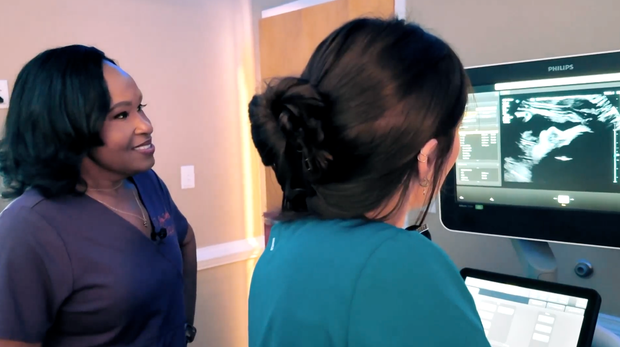
Georgia also faces maternity care deserts, where women must travel an hour or more to see an OB-GYN — a burden that disproportionately affects rural communities.
Destiny's turning point came when she connected with Healthy Mothers, Healthy Babies Coalition of Georgia, which helped her enroll in coverage and connect to care.
Programs like HMHBGA provide advocacy, education, and navigation support, helping pregnant people move through a system that often feels stacked against them.
"These resources are lifelines," Baker said.
HMHBGA and healthcare experts like Baker point to several solutions:
- Increased state funding for nonprofits providing prenatal navigation
- Mobile clinics and expanded telehealth
- Investment in remote monitoring technology for high-risk pregnancies
- Greater education about prenatal care and workplace protections
"There are devices now that can monitor blood pressure, blood sugar, even a baby's heart rate — all from home," Baker said. "That could be transformative for communities far from care."
Wellstar's Healthy Start Program offers wraparound services from pregnancy through 18 months postpartum, addressing both physical and mental health needs. Baker notes this is especially critical, as perinatal mood and anxiety disorders account for roughly 23% of maternal deaths in the U.S., often due to suicide or overdose.
"Making the system easier to navigate — that support — it's huge," she said. "It can be the difference between life and death."
Today, Destiny calls the birth of her healthy son the beginning of a second chance.
"I've had to learn this year that sometimes just surviving is enough," she said. "Sometimes taking care of my kids — that's enough."
She compares the system to a familiar frustration. "It's like going to Walmart and only two registers are open," she said. "We don't need more rules — we need more people helping."
By sharing her story, Destiny hopes the next mother won't have to struggle as hard just to get basic care.
"The process needs to be more seamless," she said. "Especially when you already have another kid, when you're postpartum, when you're dealing with personal issues."
For advocates at both Wellstar and Healthy Mothers, Healthy Babies Coalition of Georgia, that goal is clear: earlier care, simpler systems, and stronger support — before another mom falls through the cracks.