The Customer-Centered Innovation Map
The Idea in Brief
We all know that people "hire" products to get jobs done. Office workers hire word-processing software to create documents. Surgeons hire scalpels to dissect soft tissue. But few companies keep this in mind while searching for ideas for breakthrough offerings. Instead, they rely on inquiry methods (such as customer interviews) that don't generate the most promising ideas or exhaustive sets of possibilities.
To systematically uncover more--and better--innovative ideas, Bettencourt and Ulwick recommend job mapping: Break down a job that customers want done into discrete steps. Then brainstorm ways to make steps easier, faster, or unnecessary.
For example, while cleaning clothes, people don't notice stubborn stains until they've taken the clothes from a dryer and started folding them. If they find a stain, they must repeat the job. A washer that detects persistent stains and takes appropriate action before consumers execute the rest of the job would have huge appeal.
The Idea in Practice
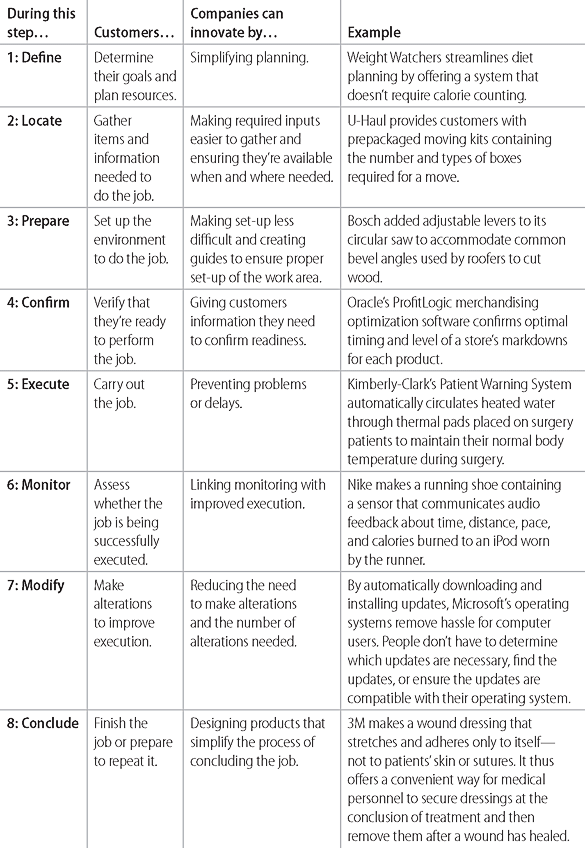
All jobs have the same eight steps. To use job mapping, look for opportunities to help customers at every step:
- Purchase the full-length Harvard Business Review article here.
- Visit Harvard Business Online.
- See more on Leadership and Managing People at Harvard Business Online.
Copyright (c) 2008 Harvard Business School Publishing Corporation. All rights reserved.
Further Reading
Articles
Breakthrough Thinking from Inside the Box
Harvard Business Review
December 2007
by Kevin P. Coyne, Patricia Gorman Clifford, and Renee Dye
Once you've analyzed the jobs your customers want to get done, brainstorm new ways of doing them. But be systematic about it, using the approach recommended in this article. For example, pose concrete questions that focus people's thinking in ways that spark fresh ideas. Helpful questions include "Who uses our product in ways we never expected or intended?" "How would our product change if it were customized for every customer?" "Who spends most of our product's cost to adapt it to their specific needs?" "Which technologies embedded in our product have changed the most since the product was last redesigned?" and "What breakthroughs in efficiency or effectiveness have we made that could be applied in another industry?"
Harvard Business Review
October 2004
by W. Chan Kim and Renée Mauborgne
When searching for innovative ideas, look beyond jobs customers know they want done. Also consider jobs customers haven't yet dreamed of but would want to get done if they knew about them. In these uncontested market spaces, competition is irrelevant. You invent and capture new demand, offering customers a leap in value while streamlining your costs. Result? Brand equity and profitability that last for decades while rivals scramble to catch up. Examples include Cirque du Soleil, which invented a new industry that combined elements from traditional circus with elements from sophisticated theater, enabling customers to be entertained in an entirely novel way. In just 20 years, Cirque du Soleil scored revenues that Ringling Bros. and Barnum & Bailey (the world's leading circus) needed more than a century to attain.