Measles outbreaks worsen in South Carolina, Arizona and Utah
Measles outbreaks are growing along the Utah-Arizona border and in South Carolina, where hundreds are in quarantine.
Between Friday and Tuesday, South Carolina health officials confirmed 27 new measles cases in an outbreak in and around northwestern Spartanburg County. In two months, 111 people have been sickened by the vaccine-preventable virus.
More than 250 people, including students from nine area elementary, middle and high schools, are in quarantine — some for the second time since the outbreak began in October. Most of the state's new cases stemmed from exposures at Way of Truth Church in Inman. Church leaders have been "very helpful," said state epidemiologist Dr. Linda Bell.
"We are faced with ongoing transmission that we anticipate will go on for many more weeks, at least in our state," Bell said.
In Arizona and Utah, an outbreak has ballooned since August. Mohave County, Arizona, has logged 172 cases and the Southwest Utah Public Health Department has logged 82 cases. The border cities of Colorado City, Arizona, and Hildale, Utah, are the heaviest hit. Overall, Utah has confirmed 115 measles cases this year. Arizona has confirmed 176.
Nationally, the measles case count is nearing 2,000 for a disease that has been considered eliminated in the U.S. since 2000. Cases have mostly spread among people who were unvaccinated.
Last month, Canada lost that designation — which applies when there is no continuous local spread of the virus — as did the larger health region of the Americas.
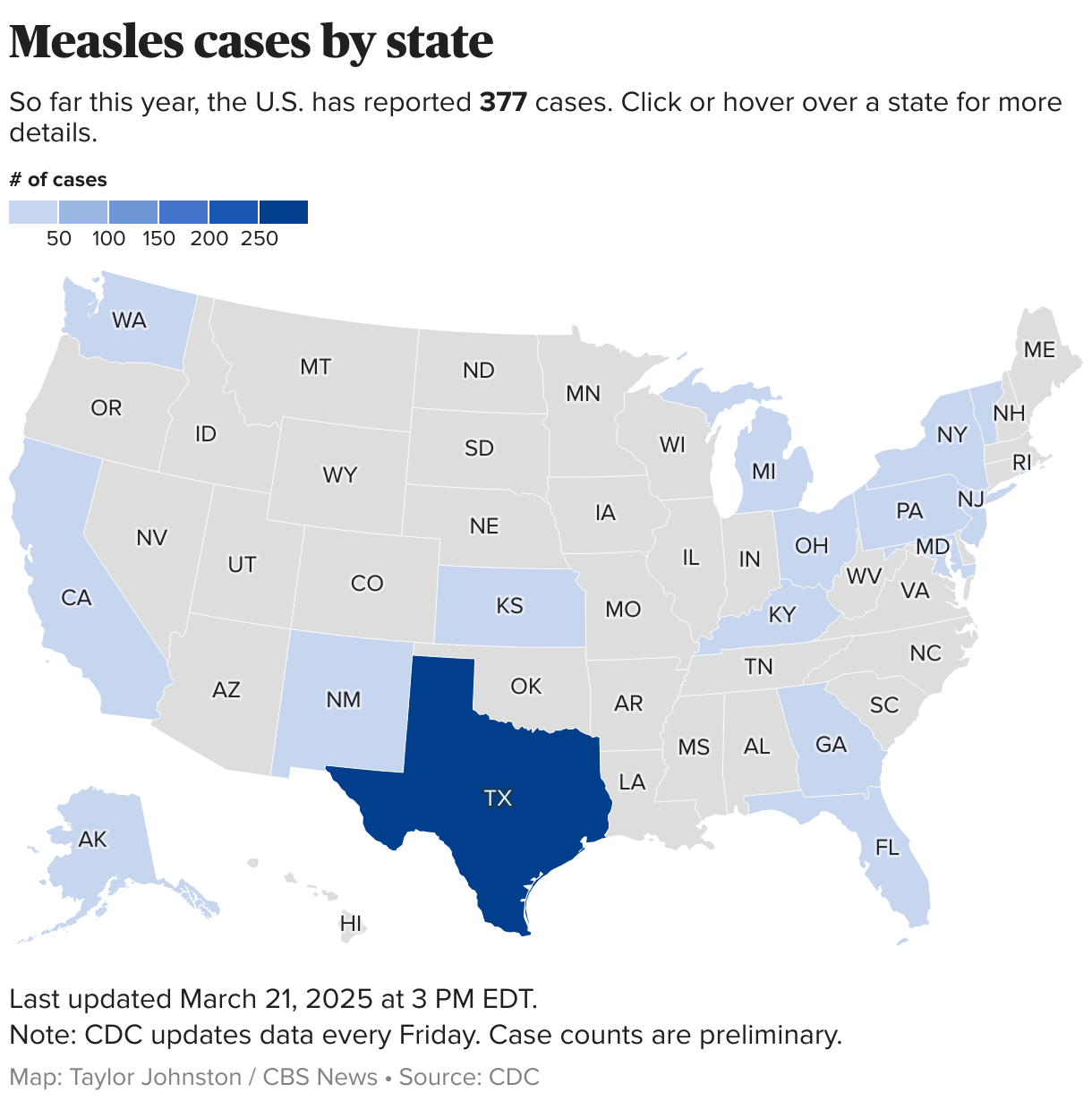
Experts say the U.S. is also at risk of losing that status. For that to happen, measles would have to spread continuously for a year. A large outbreak in Texas, New Mexico and Oklahoma that started in January sickened nearly 900 and kicked off the United States' worst measles year in more than three decades.
All but eight states have logged at least one measles case this year, according to the Centers for Disease Control and Prevention. The CDC has confirmed 47 outbreaks this year, compared with 16 in 2024. Three people — two of them Texas school children — have died.
Dr. William Schaffner, a professor of infectious disease at Vanderbilt Medical Center who has served as a liaison to the ACIP, told CBS News in an interview Tuesday that the "simple answer" behind the spread of the outbreaks is that "parents are withholding their children from vaccination."
"You know, vaccination is so very effective that ... by comprehensively vaccinating all of our children, eliminated measles from the United States," Schaffner said, later adding that "we are turning the clock back."
The combined MMR vaccine is safe and provides 97% protection against the disease after two doses, according to the CDC. Most children in the U.S. are required to get the MMR shot to attend school. But vaccination rates have declined as more parents waive the shots or have fallen behind on recommended vaccination schedules.
In September, the CDC's vaccine recommendation committee voted to recommend that the combined measles, mumps, rubella and varicella vaccine, or MMRV, be separated into MMR and varicella shots for children under the age of 4.
The Advisory Committee on Immunization Practices made the change after undergoing a complete overhaul by Health and Human Services Secretary Robert F. Kennedy Jr. in June. Several of those new members have a history of being vaccine skeptics.
According to CBS News medical contributor Dr. Céline Gounder, while the combined MMRV vaccine offers the convenience of one shot instead of two, it does carry a slightly higher risk of fever-related "febrile" seizures when used as the first dose in young toddlers aged 12-23 months. The side effect is most common between the ages of 14-18 months. Gounder says that while febrile seizures are rare and almost always resolve without lasting effects, they are frightening for families and can erode trust in vaccines.
Studies show there is no elevated risk when MMRV is given for the second dose at ages 4 to 6 years old, after children have outgrown the highest-risk window, Gounder says.