Former Angels Employee Eric Kay Convicted In Tyler Skaggs' Overdose Death
LOS ANGELES (CBSLA) — Former Angels employee Eric Kay was convicted Thursday of providing drugs to pitcher Tyler Skaggs, who died of an overdose in 2019.
Kay, 47, is facing at least 20 years in prison when he is set for sentencing on June 28. Following the decision, Kay was immediately taken into custody in Forth Worth, Texas.

The jury convicted Kay of distribution of controlled substances resulting in death and conspiracy to possess with intent to distribute controlled substances. The panel sided with prosecutors who argued during the trial that Kay gave Skaggs oxycodone laced with fentanyl.
CBS reporters learned that it took the jury just around three hours to decide on a guilty verdict for Kay.
Following the trial, Kay's defense attorney Reagan Wynn was quoted as after the trail as saying, "This is a tragedy all the way around," he said. "Eric Kay is getting ready to do minimum 20 years in a federal penitentiary, it goes up from there, and Tyler Skaggs is gone. It's a tragedy. There's no winners."
Five other players, unnamed at the time of this report, also provided testimonies where they detailed that they had also been given pills by Kay.
Prosecutors in the trial argued that Kay was likely the last person who spoke with Skaggs prior to his death.
Kay, who was a media relations director for the team, was initially arrested by federal authorities on Aug. 7 in Fort Worth on a drug distribution charge.
The 27-year-old Skaggs was found dead in a suburban Dallas hotel room on July 1, 2019, while the Angels were on the road playing the Texas Rangers. A toxicology report later determined Skaggs died of an accidental overdose from a mix of alcohol, fentanyl and oxycodone.
Kay had provided Skaggs with drugs prior to his death on several occasions, prosecutors said. Drug Enforcement Administration special agent Geoffrey Lindenberg alleged in court papers that Kay and others conspired to distribute fentanyl beginning in 2017.
"During the course of the investigation, I learned that (Skaggs) and Kay had a history of narcotic transactions, including several exchanges wherein Kay acquired oxycodone pills for (Skaggs) and others from Kay's source(s) in the days leading up to and surrounding (Skaggs') overdose death," Lindenberg wrote in the affidavit.
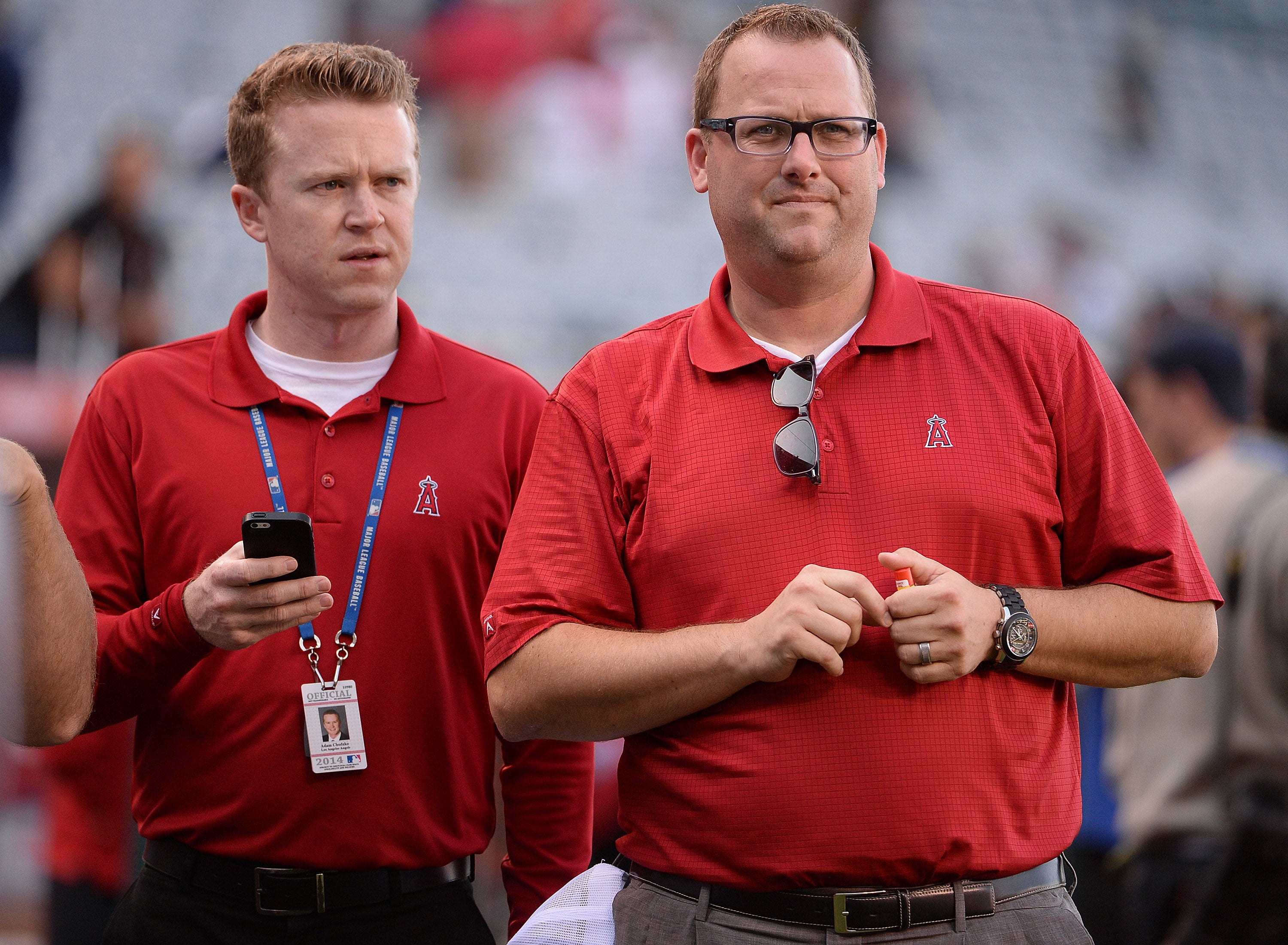
When he was first interviewed by DEA agents, Kay denied knowing Skaggs used drugs, prosecutors said.
However, according to the criminal complaint which was filed July 30, text messages between Kay and Skaggs, along with other evidence, revealed that Kay had stopped by Skaggs' hotel room late on the night before he died to deliver pills to him.
When authorities searched Skaggs' hotel room, they found several white and pink pills, along with one blue pill, the complaint reads. The white pills were a prescription anti-inflammatory and the pink pills were a prescription oxycodone. However, the blue pill found in the room was determined to be a counterfeit pill laced with fentanyl marked "M/30," and which investigators learned Kay informally dubbed a "blue boy."
DEA investigators discovered that Kay dealt blue boys to Skaggs and others at Angel Stadium, the criminal complaint alleges.
The Los Angeles Angels of Anaheim denied having knowledge that Kay was distributing pills to players, and on Thursday the franchise issued a statement via President John Carpino Thurday evening, which stated:
"On behalf of the entire Angels Organization, we are saddened by the devastating heartache that surrounds this tragedy, especially for the Skaggs family. Our compassion goes out to all families and individuals that have been impacted.
The players' testimony was incredibly difficult for our organization to hear, and it is a reminder that too often drug use and addiction are hidden away. From the moment we learned of Tyler's death, our focus has been to fully understand the circumstances that led to this tragedy.
We are thankful that Major League Baseball and the Major League Baseball Players Association have taken the Important step to update their drug policies for players using opioids so that they can receive help."
Skaggs, who attended Santa Monica High School where his mother is a softball coach, was drafted by the Angels back in 2009. He was traded to the Arizona Diamondbacks in 2010, but was then traded back to the Angels in 2013, and had been with the Angels ever since. He had married his wife Carli in the offseason just prior to his death.
He underwent Tommy John surgery that kept him out of action during the 2015 season. He had a career record of 28-38.
Skaggs' death sent shock waves around the sports world. In December of 2019, Major League Baseball announced it would begin drug testing players for opioids, a move which was precipitated by Skaggs' death.
CBS reporters spoke with Jessica Joiner, a clinical social worker, who disclosed the unfortunate reality of the effects that the opioid crisis has on athletes. She noted how easy it is for a player to get a months' supply of an opioid, as opposed to someone who isn't an athlete, who might get a few day's supply following an injury.
She mentioned that the necessity for a player to be on the field at the highest level of performance is one of the driving factors behind what she said is "not an uncommon phenomenon."
"There's a shift in culture that probably needs to happen in order for this to change," she said.
(© Copyright 2020 CBS Broadcasting Inc. All Rights Reserved. City News Service contributed to this report.)