VLADIMIR DUTHIERS:
00:00:00
This is the sobering news that many are waking up to this morning. For those that are still holding out hope in the wake of that condo collapse in Surfside, Florida. Florida officials say the search for survivors is officially over. Miami-dade's county's mayor fought back tears when she made the announcement.
DANIELLA LEVINE CAVA:
00:00:17
It is with deep, profound sadness that this afternoon I'm able to share that we made the extremely difficult decision to transition from operation search and rescue to recovery.
VLADIMIR DUTHIERS:
00:00:36
Well, after that heartbreaking announcement, rescue crews gathered and with their helmets over their hearts held a moment of silence for the victims of the collapse. The mission now is to find every person who is still missing. And officials say the work will not stop until every family gets closure. 54 people are confirmed dead, while up to 86 are still unaccounted for. Manuel Bojorquez has been covering the rescue efforts from the beginning. He reports on what comes next.
MANUEL BOJORQUEZ:
00:01:04
The search does continue. Officials made it clear the trucks aren't leaving and the workers will continue to dig. But the transition from a rescue mission to a recovery operation acknowledges the tragic reality here. At the rubble of the Champlain Towers South, the solemn work goes on. But after two weeks of around the clock searching, local leaders were forced to face a painful truth. - Our heart still hoped to find survivors. But our experience and expertise indicated that was no longer possible.
MANUEL BOJORQUEZ:
00:01:38
The search moves now to recovery. In a tribute to those lost, the rescue teams held a moment of silence and prayer before returning to the pile again in an effort officials believe will take several more weeks. But in those first hours after the collapse, a small few were rescued from the rubble. Devin Gonzalez was one of them, a 16-year-old who dreams of playing college volleyball. She's a star player on Coach Amy Morgan's club team. - She apologized for missing practice.
MANUEL BOJORQUEZ:
00:02:08
She apologized for missing practice? - She apologized for missing practice. Like that same day that it happened, she was apologizing for missing practice. That's who she.
MANUEL BOJORQUEZ:
00:02:17
The night of the collapse, Devin fell four floors, breaking her femur. She and her mother, Angela Gonzales, were both rescued. But her father Edgar has yet to be found. - I just know she's so young. Edgar's such an amazing person. And I feel so bad for her because she's not going to have her dad at these amazing years that he should be there.
MANUEL BOJORQUEZ:
00:02:40
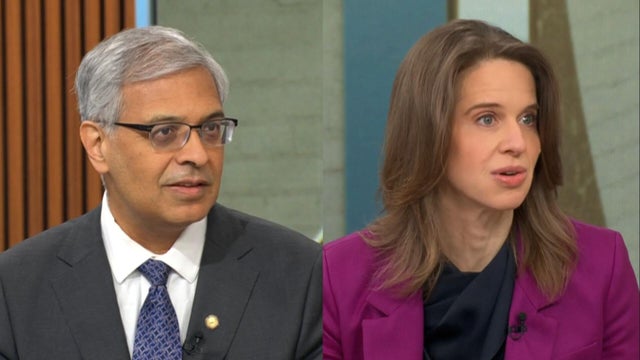
After several surgeries on her fractured femur, Devin has been able to take her first few steps again. But according to a family Facebook post, she's had to do it using a walker. She did tell her coach she is determined to get back on the volleyball court. But her family, like so many others here in Surfside, are dealing with immense loss. Vlad Anne-Marie? ANNE-MARIE GREEN: Manney, thank you so much. So right now, we want to bring in Dr. Christopher Valerian. And he is the medical manager for New Jersey Task Force One, which is in Florida right now assisting with the search efforts at the collapsed site. Thank you so much for joining us. I can only imagine you must be exhausted, both physically and emotionally. So I really appreciate you taking the time out to talk to us. Can you tell us a little bit more about New Jersey Task Force One? What does the team do? DR. CHRISTOPHER VALERIAN: Sure, my pleasure. And good morning, thanks for having me. New Jersey Task Force One is one of the 28 FEMA urban search and rescue teams. Our primary mission is search and rescue, obviously. In this particular case, it's originally starting around finding survivors. And as you mentioned, it will be switching to a recovery mode.
VLADIMIR DUTHIERS:
00:03:55
So explain to our viewers what is a day at the collapse scene like. I mean, it's got to be heartbreaking because you were trying to, before this moment, rescue people who may still be trapped under the rubble. But not finding a lot of success, as we've indicated. DR. CHRISTOPHER VALERIAN: Yeah. And it is tough, as you could probably imagine. And the pictures just don't do it justice. Everything from the particles floating in the air that you're walking through that, at the end of the day, you're all dusty. The smells, which are just indescribable and we'll stay with you. Walking past the families to get to the site itself and looking them in the eye. It is heartbreaking. But we have a mission to do. And we have dedicated individuals that are committed to that mission. And we want to do everything that we possibly can. I've treated multiple team members for heat exhaustion, for bumps and bruises related to the difficulties of being on the pile. And it's not easy. ANNE-MARIE GREEN: You know, you're the second person today to say that to me, that the pictures don't do it justice. And the pictures are horrific. So I can only imagine what you're experiencing. Just back to what a day on the site is like, I want to get a sense of what's the actual work being done there. Are people literally picking up each piece and moving it aside? Is there equipment that's coming in there? And what is the expectation in terms of how the day's moving forward will change now that this has gone from a rescue effort to a recovery effort. DR. CHRISTOPHER VALERIAN: Sure. So yeah, the crews are working 12 hour shifts. So we're divided into two different teams. And they are noon to midnight and midnight to noon. And that's mostly because of the heat issue and trying to spread out the workload there. Basically, you arrive at the scene, you go through security, which is pretty stringent. You start working on the pile, literally walk up to the top of the pile. Your assigned a location. And, like you described, just start moving rocks, moving debris, looking for, originally, for survivors. We're directed. There's locations that are targeted, so we have targeted searches. Maybe there was a canine unit that had located a potential victim. Or maybe you see flies circling around or maybe you see remnants of a bedroom where there was bed clothes or even a mattress or something. So it's not a random search, it's a targeted search. But literally, once you identify those locations, you'll go in and start digging, literally, by hand, cutting concrete with machines as necessary, and looking for the victims. Now there's multiple layers of the building, so machines-- you'll see a lot of those cranes and front loaders and things like that. So they will help us sort of move the big debris out of the way, get down to a smaller location. And then the teams are broken into six. So six of us will get down literally on our hands and knees digging looking for those survivors.
VLADIMIR DUTHIERS:
00:07:24
You know, Doctor, when this first happened, Anne-Marie and I were anchoring our broadcast. And I remember we talked about the idea that we would probably find more survivors in the days ahead because having covered the earthquake in Haiti back in 2010, I know first responders like yourself were finding people three, four, five-- there was one woman who was in her 90s was pulled out of a church after six days and she was still alive and she was able to recover. But then I realized that unlike Haiti, this building is a massive structure. Most of the homes that collapsed in Haiti were, at most, two or three stories max. And here you've got, basically, the equivalent of a skyscraper when you compare it to the island. So is that what probably made it much harder for first responders, like your team, to find more survivors? DR. CHRISTOPHER VALERIAN: Yeah. So I've been on this team for 20 years. Right after 9/11, I was recruited to the team. And usually in a building collapse like this, you will find what we call "void spaces," spaces that are created by objects that stop the falling debris above your head. And that's sort of where you find victims. And for us, that's golden. We find a void space. We can click a canine unit there or a search camera or some of the other technology that we have to sort of look for those survivors. In this particular case-- and I'm not a structural engineer, however, the way it's been explained to me is that the way that the building sort of pancaked down and the pressure from the floors above just created so much downward force that those normal void spaces where survivors would be located just don't exist. And I got to tell you, it's true. I said to myself, where all the appliances, where's the refrigerators, the stoves, the ovens? We're just not finding large objects. All we're finding are small crushed pulverized pieces of metal and concrete and steel. So it's amazing the force that this building fell at. And I think that's part of the problem with not being able to find survivors.
VLADIMIR DUTHIERS:
00:09:37
Dr. Christopher Valerian. Thank you very much for what you and your team are doing. I know it's been heartbreaking work. But certainly, the families appreciate it and we do as well. Thank you. DR. CHRISTOPHER VALERIAN: Absolutely. Thank you very much.