
Watch CBS News
One of the hardest-fought political battles in 2024 happened inside California's Capitol between a group of grieving parents who lost their kids to fentanyl and a handful of powerful politicians who were opposed to increasing criminal penalties.
This year-long investigation, led by CBS News California investigative correspondent Julie Watts, combines gripping statehouse investigative reporting with groundbreaking AI-assisted data journalism to provide an unprecedented look at how California's one-party supermajority legislature systematically avoids transparency and accountability by killing controversial legislation without voting on the record.
They fought for fentanyl legislation, but it was killed before lawmakers even got to vote. Four grieving moms wanted to know why.
We begin with their uncovering of the truth using a new AI tool designed to help everyday Californians hold lawmakers accountable.

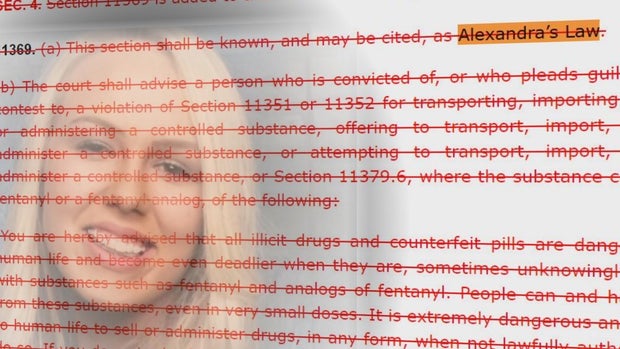
In 2024, CalMatters' new Digital Democracy Database gave us the tools to analyze hundreds of thousands of votes and dozens of hours of legislative hearings in ways that simply weren't possible before.However, it was Alexandra's Law that gave us a case study and exposed California's supermajority politics at its best, or worst, depending on who you ask.
If you ask Alexandra's parents, they'll tell you lawmakers used their daughter as a political pawn.
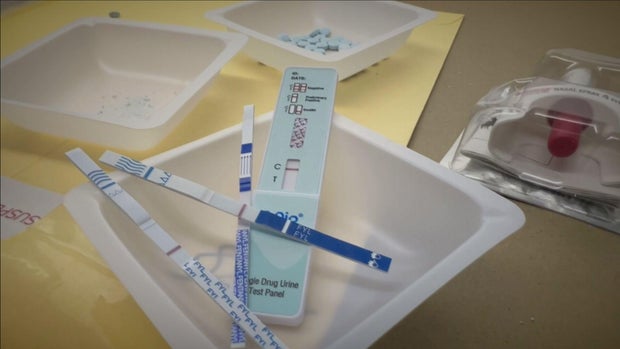
While California lawmakers would not increase criminal penalties for fentanyl, they did decriminalize fentanyl test strips, which were considered drug paraphilia until 2022. Along with Narcan, state law now requires test strips on college campuses.
However, as fentanyl test strips are normalized, our testing found that test strips alone can provide a false sense of security. That is one of the many lessons learned from the increasing number of fentanyl death investigations... Lessons grieving parents and law enforcement hope you'll share.
One of the hardest-fought political battles in 2024 happened inside California's Capitol between a group of grieving parents who lost their kids to fentanyl and a handful of powerful politicians who were opposed to increasing criminal penalties.
This year-long investigation began as an examination of California's fentanyl fight and evolved into a narrative case study of California's supermajority politics.
With the help of new artificial intelligence from CalMatters' groundbreaking digital Democracy database, this year-long investigation provides an unprecedented look at the largely unchecked power of California's one-party supermajority legislature through the eyes of grieving parents who discover how California lawmakers avoid transparency and accountability by killing controversial legislation without voting on the record.
For years, California lawmakers have been allowed to operate without much scrutiny due to a shrinking California Capitol Press Corps and a growing "super(duper)majority" in the state Senate and Assembly.
However, in 2024, CalMatters' new Digital Democracy database gave journalists - and members of the public - new access to the inner workings of the Capitol.
This collaboration between CalMatters and CBS News California Investigates combines gripping statehouse investigative reporting with groundbreaking AI-assisted data journalism to provide an unprecedented look at how consequential decisions and votes are made in secret with little trace of responsibility.
While Digital Democracy enabled us to analyze millions of votes and hundreds of hours of legislative hearings in unprecedented ways, "California's fentanyl fight" presented a unique opportunity to produce this narrative case study of California's supermajority politics.
Relying on deep sourcing and traditional statehouse investigative reporting, CBS News California obtained critical non-public documents, memos, emails, and voicemails that helped reveal the story behind the data.
In an effort to translate our findings in a way that was understandable to the general public, we told the story through the lens of the people who were impacted by these complicated and opaque policy practices.
Not only does this reporting serve to educate viewers about the reality of how their elected lawmakers work (or don't work) on their behalf, but it also arms the public and other journalists with the tools to hold lawmakers accountable.
"CBS News California Investigates" launched in 2024 with the goal of making the capitol more transparent by bringing capitol accountability journalism to a broader audience.
In order to do that - especially for a TV audience - we strive to translate complicated policy issues for an audience outside of the statehouse. Digital democracy gave us unprecedented statehouse data analysis tools, but a combination of good old-fashioned shoe-leather reporting, thoughtful storytelling and passionate parents enabled us to demonstrate the real-life implications of our findings for a general audience.
In the wake of this investigation, the governor replaced his chief of staff, and several influential state senators are renewing calls for increased transparency related to voting abstentions.
Additionally, both the Senate and Assembly leadership reduced the number of bills that each lawmaker is allowed to introduce in 2025, which is intended to allow for more careful consideration and public discussion of each bill moving forward.
THE INVESTIGATIVE REPORTERS & EDITORS JOURNAL: "Crunching legislative data with AI in California"
VARIETY: "CBS Invests in Statehouse Investigative Reporting With 'California's Fentanyl Fight' Special"
TV NEWS CHECK: CBS News California Investigates Debuts New Year's Day Special 'California's Fentanyl Fight: Politicians V. Parents'
NEWS BLUES: CBS O&O Stations in California Investigate How Lawmakers Oppose Fentanyl Fight