Israel-Lebanon ceasefire begins as Iran keeps Strait of Hormuz gridlocked
Follow updates on the war in the Middle East for Friday, April 17, here. See earlier developments below.
What to know about the Iran war:
- A 10-day ceasefire deal between Israel and Lebanon took effect at 5 p.m. Thursday, after Israel's continued attacks on Lebanon-based militant group Hezbollah — an Iranian proxy — had threatened the ceasefire in the wider Iran war.
- An Israeli official told CBS News the country agreed to only respond to "imminent threats from Hezbollah." But it remains uncertain how Hezbollah will respond, or whether the Lebanese armed forces can quell the powerful group. Israeli Prime Minister Benjamin Netanyahu said he rejected the terms demanded by Hezbollah.
- Top Pakistani officials are visiting Iran and other Gulf states — and possibly returning to Washington soon — as they race to orchestrate a new round of U.S.-Iran talks. President Trump has voiced optimism that the war will end soon, and that the next, still-to-be-scheduled round of talks will yield "amazing" results.
- The Strait of Hormuz remains effectively closed to most commercial shipping traffic due to Iran's threats and despite an ongoing U.S. military blockade of Iranian ports aimed at forcing a reopening. The tanker gridlock is keeping global oil and gas prices high and keeping pressure on all parties to the conflict to find a solution.
Lebanon ceasefire seems to be holding for most part
A 10-day truce appeared to be mostly intact in Lebanon early Friday, promising a pause in fighting between Israel and the Hezbollah militant group and possibly clearing one major obstacle to a deal between Iran and the United States and Israel to end weeks of devastating war. The ceasefire began at 5 p.m. EDT.
But it remained unclear whether Israel and Hezbollah would completely stop strikes on one another and whether the militant group would recognize a deal it did not play a role in negotiating and that will leave Israeli troops occupying a stretch of southern Lebanon.
The Lebanese army posted on social media that there had been "a number of violations of the agreement, with several Israeli attacks recorded, in addition to intermittent shelling targeting a number of villages." And French President President Emmanuel Macron said Friday he was concerned that the ceasefire "may already be undermined by ongoing military operations," French news agency AFP reported.
Still, barrages of gunshots rang out across Beirut as residents fired into the air just after midnight to celebrate the beginning of the truce, and displaced families began moving toward southern Lebanon and Beirut's southern suburbs despite warnings by officials not to attempt to return to their homes until it became clear whether the ceasefire would hold.
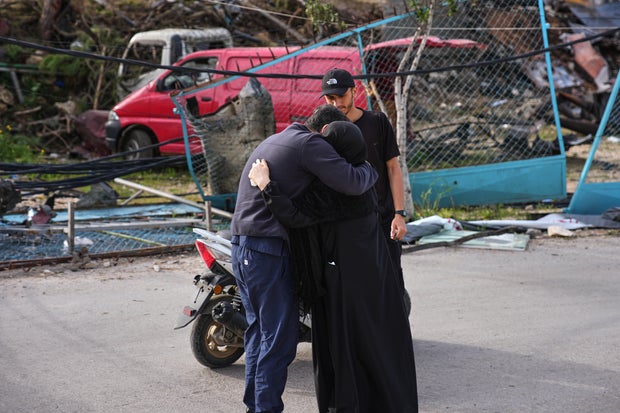
CBS/AP
Trump hails possible "historic day for Lebanon"
President Trump said on his Truth Social platform late Thursday night that it "May have been a historic day for Lebanon. Good things are happening!!!"
He was referring to the ten-day ceasefire between Israel and the Lebanese government that took effect at 5 p.m Thursday.
The open question is how the Iran-backed militant group Hezbollah will react. Israel and Hezbollah have been trading fire since the U.S. war with Iran began.
Earlier Thursday, Mr. Trump said on Truth Social that he hopes Hezbollah "acts nicely and well during this important period in time. It will be an GREAT moment for them if they do. No more killing. Must finally have PEACE!"
UAE official says Iran is viewed as the "main enemy"
Anwar Gargash, diplomatic advisor to the United Arab Emirates president, said Gulf states have a different view of Iran, seeing it as the "main enemy," citing its missile and drone attacks despite.
"We are fully aware of the position of many Arab societies in viewing Israel as the primary enemy, but the view in the Gulf states may be different...Iran is the one that attacked the Gulf states with thousands of missiles and drones, and for this reason we do not trust it, and we view it as a primary enemy," he said during a media briefing Thursday at Dubai Press Club.
Gargash added that the UAE has questions over Iran's nuclear program as well as its ballistic missiles and drones, and said that just as Tehran is seeking guarantees and reparations for war damage, the UAE also wants assurances that such "cowardly" attacks will not happen again.
Trump says Iran war is "going along swimmingly" and "should be ending pretty soon"
President Trump said Thursday night that "the war in Iran is going along swimmingly."
"We had to do a little journey down to Iran, and I didn't want to do that, but we had to because we can't let them have a nuclear weapon," the president said during an event in Las Vegas.
The president also predicted that the war "should be ending pretty soon," a prediction he has made in the past. The U.S. and Iran are currently nine days into a two-week ceasefire, buying the two sides time to negotiate, and Mr. Trump told reporters earlier Thursday that "if there's no deal, fighting resumes."
U.S. intelligence detects signs China is weighing giving Iran advance radar systems
Days after the U.S.-Israel led war with Iran kicked off last month, American intelligence agencies detected signs that the war risked widening beyond the immediate battlefield as Russia and China sought to support Iran to blunt U.S.-Israeli military operations.
Analysts at the Defense Intelligence Agency, the Pentagon's arm for military intelligence, assessed that China was weighing whether to provide Tehran with advanced radar systems, according to multiple U.S. officials familiar with the matter.
The deliberations came amid separate reports that Russia had shared intelligence with Iran on American military positions across the Middle East.
While Moscow's transfer of information to Tehran has been previously reported by CBS News, China's apparent willingness — early in the conflict and potentially over a protracted timeline — to assist Iran points to a broader, if informal, alignment among powers seeking to counterbalance U.S. ambitions in the region.
Trump says he hopes Hezbollah "acts nicely and well" during 10-day ceasefire
President Trump on Thursday evening addressed the militant group Hezbollah after Israel's 10-day ceasefire in Lebanon had taken effect.
The president wrote on Truth Social that he hopes Hezbollah, a proxy of Iran, "acts nicely and well during this important period in time. It will be an GREAT moment for them if they do. No more killing. Must finally have PEACE!"
Earlier in the day, the president had announced that a ceasefire deal between Israel and Lebanon had been reached following his "excellent conversations" with Lebanese President Joseph Aoun and Israeli Prime Minister Benjamin Netanyahu.
It's unclear how that deal will impact the ongoing conflict between Israel and Hezbollah, however. The two sides have exchanged strikes since early March, when Hezbollah launched rocket attacks on Israel in solidarity with Iran following the U.S.-Israeli strikes targeting Tehran's regime. Israel has also deployed troops into southern Lebanon, and Israel said those troops will remain in place during the ceasefire.
An Israeli official told CBS News that Israel will only respond militarily during the ceasefire to "imminent threats from Hezbollah."
Netanyahu said Thursday that a more lasting peace deal will require that Hezbollah be disarmed.
Pentagon approached U.S. car companies about helping boost weapons production, sources say
The Pentagon has approached the CEOs of major U.S. car companies about the possibility of helping boost weapons production by using their personnel and large factories, sources familiar with those conversations told CBS News.
It would be similar to how the government used car companies for weaponry production during World War II, the sources said.
So far, no deals have been made, and talks are ongoing, the sources said.
The Pentagon has been trying to replenish low stockpiles reduced by both the wars in Ukraine and Iran.
Israeli military warns Lebanese civilians not to travel south of the Litani River during ceasefire
The Israeli military confirmed that the 10-day ceasefire agreement in Lebanon had taken effect, but said that it would keep its troops in southern Lebanon amid its ongoing conflict with the militant group Hezbollah.
Israel Defense Forces spokesperson Avichay Adraee stated in a Telegram post that during the ceasefire, Israel would "maintain its positions in southern Lebanon in response to Hezbollah's ongoing terrorist activities."
It warned Lebanese civilians not to travel south of the Litani River, which runs east-west approximately 20 miles north of the Israel-Lebanon border.
Israeli troops were deployed to southern Lebanon after Hezbollah, an Iranian proxy, joined the Middle East conflict in early March.
U.S. using more than 10,000 troops to blockade Iran's ports, Pentagon says
U.S. Central Command said Thursday that it is using more than 10,000 U.S. service members — along with at least 12 ships and 100 aircraft — to enforce its ongoing blockade of Iranian ports.
CENTCOM, which oversees U.S. military operations in the Middle East, reiterated in a social media post that U.S. forces are not blockading the Strait of Hormuz itself, but instead "Iran's ports and coastline."
The U.S. began its blockade on Monday. CENTCOM said earlier Thursday that 14 vessels have so far "turned around to comply with the blockade" since it took effect.
Gen. Dan Caine, chairman of the Joint Chiefs of Staff, said in a news conference earlier in the day that the U.S. would "use force" on any ships that do not comply.
10-day ceasefire takes effect in Lebanon
A 10-day ceasefire between Israel and Lebanon has taken effect. It was not immediately clear though how the ceasefire would impact the conflict between Israel and the militant group Hezbollah, a Lebanon-based Iranian proxy.
An Israeli official told CBS News that Israel would only respond militarily to "imminent threats from Hezbollah" during the ceasefire.
President Trump had previously announced that a ceasefire deal had been reached following conversations with Lebanese President Joseph Aoun and Israeli Prime Minister Benjamin Netanyahu.
Israel striking Hezbollah rocket launchers ahead of ceasefire, IDF says
The Israeli military said it was launching strikes on rocket launchers for the Lebanon-based terrorist group Hezbollah ahead of a ceasefire between the two sides scheduled to take effect at 5 p.m. ET.
The Israel Defense Forces wrote on social media that it was "now attacking launchers from which the terrorist organization Hezbollah launched rockets toward northern communities a short while ago."
Earlier Thursday, President Trump said Israel and Hezbollah, a proxy of Iran, had agreed to a 10-day ceasefire.
Hezbollah joined the regional conflict in early March when it began firing rockets toward Israel in response to the strikes from the U.S. and Israel on Iran. Israel then retaliated with its own strikes. It also deployed troops into southern Lebanon. At least one million Lebanese residents have been displaced by the fighting, according to Lebanese officials.
Israeli and U.S. officials had said the two-week ceasefire reached earlier this month with Iran did not apply to Lebanon.
Trump says gas prices are "not very high" as Americans feel the pinch
President Trump said gas prices are "not very high," certainly compared to what they could be, as 51% of respondents in a recent CBS News poll said high gas prices are posing a financial hardship or financial difficulty.
A reporter at the White House on Thursday asked the president how much longer Americans will continue to see high gas prices.
"Well they're not very high," the president responded. "If you look at what they were supposed to be in order to get rid of a nuclear weapon, with the danger that entails. So the gas prices have come down very much over the last three, four days."
The reporter pointed out that gas prices are still $4 a gallon. According to AAA, national gas prices are averaging just over $4.
"That's what ABC says," the president responded. "But the fact is that if you look at the stock market's up, everything's doing really well."
The president's own administration officials, including Treasury Secretary Scott Bessent on Thursday, acknowledge that gas prices are above $4.
Netanyahu discusses "opportunity" for "historic peace agreement," but rejects Hezbollah demands
Israeli Prime Minister Benjamin Netanyahu struck a positive tone about the 10-day ceasefire between Israel and Lebanon, but also said he rejected the two conditions for peace made by Iran-backed proxy Hezbollah.
"We have an opportunity to make a historic peace agreement with Lebanon," Netanyahu said in a Thursday night video address, translated from Hebrew. "President Trump intended to invite me and the president of Lebanon to try to advance this agreement. This opportunity exists because since the War of Independence, we have fundamentally changed the balance of power in Lebanon."
Netanyahu said he began receiving calls from Lebanon a month ago to hold direct peace talks.
"I responded to this call and agreed to a timeout, or rather a temporary ceasefire, of 10 days to try to advance the agreement that we began discussing with the ambassadors' meeting in Washington," he said. "For these peace talks, we have two fundamental demands: one, the disarmament of Hezbollah. Two, a sustainable peace agreement, peace from strength."
Netanyahu, though, said Hezbollah requested two things: Israel withdraw from all Lebanese territory and "a ceasefire in the form of silence for silence."
"I agreed to neither of these, and indeed both of these conditions are not being met," he said.
Trump says next in-person talks on Iran will be "probably, maybe" over this weekend
President Trump told reporters the next in-person talks negotiating a deal for Iran will "probably, maybe" happen this weekend.
He didn't say where, and other U.S. officials haven't confirmed any details.
Trump says "I have a right to disagree with the pope," sees no need to meet with him
President Trump said he doesn't think meeting with Pope Leo XIV is "necessary," as the president has criticized him for being "weak on crime," among other things.
The pope has been critical of the war in Iran. On Monday, Mr. Trump told CBS News senior correspondent Norah O'Donnell that the pope is "wrong on the issues."
On Thursday, the president told reporters on the White House South Lawn he has a "right to disagree with the pope."
"If the pope looked at the 42,000 people that were killed over the last two or three months, as a protester, with no weapons, no nothing," he said. "I mean, you take a look at that, so I can disagree with the pope. I have a right to disagree. I have a right to disagree with the pope."
The president added, "The pope can say what he wants. And I want him to say what he wants. But I can disagree. I think that Iran cannot have a nuclear weapon. If they do, the whole world would be in jeopardy, the Middle East would blow up and the whole world would be in jeopardy."
"This is the real world, it's a nasty world," he said. "But as far as the pope and saying what he wants, he can do that."
Trump says meeting with Israeli and Lebanese leaders will happen in a "week or two"
President Trump said the meeting with Israeli Prime Minister Benjamin Netanyahu and Lebanese President Joseph Aoun will take place in a "week or two," possibly at the White House.
The president called them the first "meaningful talks" between the two countries since 1983.
The president said he'll also visit Lebanon "at the right time."
Trump says if there's "no deal" with Iran then the "fighting resumes"
Speaking to reporters on the White House South Lawn, President Trump said he's "not sure" the U.S. will need to extend the ceasefire with Iran. Without an extension, the ceasefire would expire April 22.
But if the U.S. and Iran can't reach a deal before then, he suggested the war would continue.
"I would say if there's no deal, fighting resumes," he said.
10-day ceasefire aims to grow momentum generated in Tuesday's talks, Israeli official says
The ceasefire in Lebanon aims to grow momentum that was generated in talks on Tuesday between Israeli and Lebanese officials, an Israeli official told CBS News. Those talks were held in Washington, D.C., and led by Secretary of State Marco Rubio.
Israel has agreed it will only respond militarily during the ceasefire to "imminent threats from Hezbollah," the official said, who described it as in keeping with a November 2024 Biden-era deal. Hezbollah is a Lebanese militia backed by Iran as well as a political force within Lebanon, and Tehran has historically used it to project power in the region.
The truce will test whether the Lebanese state military — the Lebanese Armed Forces — is able to take on Hezbollah in Lebanon. It is unclear to what extend the U.S. military will be providing support to enforce or monitor the ceasefire.
It is clear that much of what happens next is also dependent on what materializes with the U.S.-Iran talks. In the days following the Feb. 28 beginning of the war, Hezbollah fired missiles across the border into Israel, which sparked this part of a regional war. Israel responded with a ground invasion of Lebanon as well as widespread bombardment of the country.
The U.S. and Israel are allied in their joint war against Iran.
After Mr. Trump accepted the two-week ceasefire with Iran last week, Israel said it did not extend to its war with Hezbollah although the mediator, Pakistani officials, had announced it did.
China's U.N. envoy calls U.S. blockade a "dangerous and irresponsible move"
Chinese Ambassador to the U.N. Fu Cong said the Strait of Hormuz "should be safeguarded" for international navigation, and he called on Iran to take "proactive measures" to open the waterway.
"The issue of navigation in the Strait of Hormuz is a spillover effect of the conflict in Iran," he said. "Only a complete ceasefire can fundamentally create conditions for easing the situation."
Fu told the U.N. General Assembly on Thursday that Beijing is engaged "in intensive mediation with all parties to actively promote talks for peace"' and an end to the war in Iran.
The 193-member world body was meeting to hear China and Russia explain why they vetoed a Security Council resolution backed by the U.S. and Gulf nations aimed at opening the Strait of Hormuz.
Fu claimed the resolution would have given "a carte blanche for the continuation of aggressive actions and further escalation" rather than de-escalate the conflict and promote negotiations.
Iran "cautiously optimistic" about peace talks with U.S., says ambassador to U.N.
Tehran is "cautiously optimistic" about its negotiations on ending hostilities with the United States, the Iranian ambassador to the United Nations said Thursday, expressing hope for a "meaningful outcome."
"Despite our deep mistrust of the United States, stemming from its repeated betrayal of diplomacy, we nevertheless entered the negotiations in good faith and remain cautiously optimistic," Amir Saeid Iravani said during a meeting of the U.N. General Assembly.
He added that if Washington adopts "a rational and constructive approach … these negotiations can lead to a meaningful outcome."
House votes down latest effort to rein in Trump's military action in Iran
The latest vote in the House to block President Trump from taking further military action against Iran narrowly failed Thursday as the war approaches its third month and the off-ramp remains uncertain.
The war powers resolution, introduced by Democratic Rep. Gregory Meeks of New York, failed in a 214-213 vote, with one voting present. One Republican, Kentucky's Thomas Massie, voted with nearly all Democrats, several votes shy of the support it needed for passage.
Meeks' resolution would have directed the president to remove U.S. armed forces from hostilities against Iran, unless explicitly authorized by Congress.
Trump says leaders of Lebanon and Israel agreed to 10-day ceasefire
President Trump said in a Truth Social post that he spoke with Lebanese President Joseph Aoun and Israeli Prime Minister Benjamin Netanyahu, and that they each agreed to a 10-day ceasefire, set to begin later Thursday.
"I just had excellent conversations with the Highly Respected President Joseph Aoun, of Lebanon, and Prime Minister Bibi Netanyahu, of Israel," he wrote. "These two Leaders have agreed that in order to achieve PEACE between their Countries, they will formally begin a 10 Day CEASEFIRE at 5 P.M. EST."
Mr. Trump also said he directed Vice President JD Vance and Secretary of State Marco Rubio to work with Chairman of the Joint Chiefs of Staff Gen. Dan Caine to help "Israel and Lebanon to achieve a Lasting PEACE."
The president said he will also be inviting Netanyahu and Aoun to the White House for talks.
"Both sides want to see PEACE, and I believe that will happen, quickly!" he wrote in a second post on Truth Social.
The ongoing conflict in Lebanon has been between Israel and Hezbollah, Iran's proxy in Lebanon.
Lebanon's president thanks Trump for efforts "to reach a ceasefire in Lebanon" and the wider Mideast
President Trump spoke Thursday on the phone with his Lebanese counterpart President Joseph Aoun, who "renewed his thanks for the efforts Trump is exerting to reach a ceasefire in Lebanon and secure lasting peace and stability, paving the way for achieving the peace process in the region," according to a readout of the call provided by the Lebanese president's office.
Mr. Trump "responded with his support for President Aoun and Lebanon, and his emphasis on his commitment to meeting the Lebanese request for a ceasefire at the earliest possible time," the statement said.
There was no immediate statement on the conversation from the White House or from President Trump on his Truth Social platform, on which he had said earlier that Aoun would hold a phone call with Israeli leader Benjamin Netanyahu.
"It has been a long time since the two leaders [of Israel and Lebanon] have spoken, like 34 years," Mr. Trump said in his post, which was published late Wednesday evening Eastern time. "It will happen tomorrow. Nice!"
Lebanon's government never confirmed that a call between Aoun and Netanyahu would take place, and there were reports in Lebanese media saying Aoun had told Marco Rubio earlier that he would not call Netanyahu.
Israel has waged an intense military campaign against the Iranian-backed group Hezbollah in Lebanon for more than six weeks, killing more than 2,000 people, according to the Lebanese health ministry, and sending ground forces in to occupy a significant portion of the country's south. The ongoing Israeli operations have forced more than 1 million people from their homes in Lebanon, according to the government in Beirut.
Why China is stressing Iran's sovereignty, and the need to reopen the Strait of Hormuz
A deal to end the Iran war would serve China's economic interests, as Beijing wants to resume normal trade with Iran and other countries in the Persian Gulf. Almost 20% of China's oil comes from Iran, and more than half its overall energy supplies come via the Strait of Hormuz.
The U.S., by enforcing its naval blockade of Iranian ports, is likely trying to put pressure on China to push Iran back to the negotiating table and make a deal.
China's Foreign Minister stressed to his Iranian counterpart in a phone call on Thursday that "working to resume normal passage of the strait is a unanimous call from the international community," urging calm and restraint by all sides, according to the government in Beijing.
Foreign Minister Wang Yi urged Iran's Abbas Araghchi to make efforts to restore normal navigation in the Strait of Hormuz.
While stressing that Iran's sovereignty and security should be respected and safeguarded, Wang said freedom and safety of navigation through the vital shipping lane should also be guaranteed.
While many Asian nations rely heavily on gas and oil imported from the Persian Gulf, China has significant fuel reserves and a diverse mix of energy supplies that would help it mitigate the impact of a prolonged closure of the Strait of Hormuz.
China's economy actually beat market expectations in the first quarter of this year, with its gross domestic product rising 5%.
But Beijing has still warned that the conflict in the Middle East has created a "complex and volatile" environment, and as the world's biggest overall energy importer and a manufacturing powerhouse, soaring oil prices are threatening to drive up production costs, which could impact China's economy.
Europe has "maybe 6 weeks or so (of) jet fuel left," the head of the International Energy Agency
Europe has "maybe 6 weeks or so (of) jet fuel left," the head of the International Energy Agency said Thursday in an interview with The Associated Press, warning of possible flight cancellations "soon" if oil supplies remain blocked by the Iran war.
IEA Executive Director Fatih Birol painted a sobering picture of the global repercussions of what he called "the largest energy crisis we have ever faced" stemming from the pinch-off of oil, gas and other vital supplies through the Strait of Hormuz.
"In the past there was a group called 'Dire Straits.' It's a dire strait now, and it is going to have major implications for the global economy. And the longer it goes, the worse it will be for the economic growth and inflation around the world," he said.
The impact will be "higher petrol (gasoline) prices, higher gas prices, high electricity prices," Birol told AP.
Economic pain will be felt unevenly, with some countries "hit worse than the others," he said, naming Japan, Korea, India, China, Pakistan and Bangladesh as being on the front line of the energy crisis.
"The countries who will suffer the most will not be those whose voice are heard a lot. It will be mainly the developing countries. Poorer countries in Asia, in Africa, and in Latin America," he said.
"Then it will come to Europe and the Americas," he added, speaking from his Paris office looking out over the Eiffel Tower.
If the Strait of Hormuz isn't reopened, he said that for Europe, "I can tell you soon we will hear the news that some of the flights from city A to city B might be canceled as a result of lack of jet fuel."
CENTCOM says 14 ships have "turned around to comply with the blockade at the direction of American forces"
The U.S. military's Central Command said Thursday that after the first 72 hours of the U.S. blockade of Iranian ports, "14 vessels have turned around to comply with the blockade at the direction of American forces."
Chairman of the Joint Chiefs of Staff Dan Caine said earlier at a Pentagon news conference that no ships had been boarded by U.S. forces thus far as part of blockade enforcement efforts. Those efforts were expanded Thursday to include not only vessels calling at Iranian ports, but also ships currently under U.S. sanctions, or suspected to be carrying contraband goods.
Pakistan says "no dates yet" for next round of U.S.-Iran talks
Pakistani Foreign Ministry spokesman Tahir Andrabi told reporters in Islamabad on Thursday that there was still no date or location set for a second round of direct talks between Iran and the U.S.
President Trump voiced optimism earlier this week, predicting the war would end soon and that the next round of talks, which he said he expected in the coming days, would yield "amazing" results.
Pakistan brokered and hosted the first round of talks, which led to the two-week ceasefire between the U.S. and Iran set to expire early next week, and it continues to act as the primary intermediary between the two nations.
Speaking Thursday afternoon, Andrabi said "regarding the next round of talks, well, there are no dates yet. There were a number of questions on when and where these talks would take place. I requested all our media colleagues that we should refrain from the speculations and wait for the official announcements."
"We would announce the timing of these talks as and when it is decided," he said.
Lebanon's president thanks Rubio for work toward ceasefire, but doesn't confirm he'll speak with Netanyahu
The office of Lebanon's President Joseph Aoun said the leader received a phone call from Secretary of State Marco Rubio, during which Aoun "thanked him for the efforts Washington is undertaking to reach a ceasefire and its support at all levels."
In a statement on social media, the Lebanese president's office said "Rubio affirmed his continuation of the ongoing efforts to achieve a ceasefire as a prelude to establishing peace, security, and stability in Lebanon, confirming his support and appreciation for President Aoun's positions."
Lebanese media reported, citing sources, that Aoun had also told Rubio he would not be speaking with Israeli Prime Minister Benjamin Netanyahu on Thursday.
Earlier, President Trump said Aoun and Netanyahu would speak.
Israeli Army Radio, also known as GLZ Radio, also said the leaders were set to speak Thursday, citing Israeli Intelligence Minister Gila Gamliel.
Hegseth says status of Iran's new supreme leader believed to be unchanged: Alive but wounded
Secretary of Defense Pete Hegseth said Thursday that the status of Iran's new supreme leader, Ayatollah Mojtaba Khamenei, has not changed and he is believed to be alive, but wounded and disfigured.
Khamenei is believed to have been wounded in the same airstrike that killed his father and predecessor in the first wave of joint U.S.-Israeli strikes on Iran that sparked the ongoing war.
Hegseth says Iran has "high incentive" to maintain ceasefire, accuses allies of inaction on Strait of Hormuz
Secretary of Defense Pete Hegseth said Thursday that Iran's command and control capabilities were "highly degraded," and its motivation to adhere to the ceasefire with the U.S. is "very high" because any violation would be met by further attacks.
"They have a high incentive to maintain that ceasefire even though they can't talk and organize as well as they'd like to," Hegseth told reporters at the Pentagon.
Asked about progress with other countries on efforts to clear the Strait of Hormuz and keep it open to all commercial traffic, Hegseth said that apart from Persian Gulf allies, other nations close to the U.S. "have talked a lot and haven't done anything."
"You can't live in a world in perpetuity … where you just rely on America to do the heavy-lifting," he said.
U.S. CENTCOM commander says American forces remain "vigilant" and "ready" amid Iran ceasefire
U.S. Navy Admiral Brad Cooper, commander of the U.S. military's Central Command, joined Hegseth and Caine at the Pentagon news conference Thursday after returning from the Middle East and said U.S. forces remained "highly motivated, they're focused, they're vigilant and they're ready."
More than half way through the two-week ceasefire with Iran, Cooper said U.S. forces are rearming, retooling and adjusting tactics and procedures.
Joint Chiefs chair Caine says 13 ships have been turned around by U.S. blockade, but none boarded yet
Chairman of the Joint Chiefs of Staff Gen. Dan Caine said that while the ceasefire with Iran remains in place, U.S. forces are "postured and ready to resume major combat operations at literally a moment's notice."
Caine provided an update on the ongoing U.S. blockade, saying it applies to all ships, regardless of nationality, heading to or from Iranian ports, and now vessels subject to U.S. sanctions or carrying suspected contraband.
"The U.S. action is a blockade of Iran's ports and coastline, not a blockade of the Strait of Hormuz," he stressed.
Caine said enforcement of the blockade was taking place in the waters around Iran as well as international waters, and he reiterated that it now includes "dark-fleet" vessels carrying Iranian energy products that seek to evade international regulations, sanctions or insurance requirements.
Caine said more than 10,000 U.S. sailors, Marines and airmen, as well as 12 ships and dozens of aircraft, were part of the operation enforcing the blockade.
He said 13 ships had thus far made the "wise choice" to turn around, and no ships have been boarded by U.S. forces yet as part of the blockade enforcement.
"If you do not comply with this blockade, we will use force," Caine warned.
Hegseth attacks media for "unpatriotic" coverage of Iran war
Hegseth launched a broadside against unspecified news outlets for their coverage of the Iran war, calling it "incredibly unpatriotic."
"I just can't help but notice the endless stream of garbage, the relentlessly negative coverage you cannot resist peddling despite the historic and important success of this effort," he said.
Hegseth claimed the mainstream media's "politically motivated animus" for President Trump "completely blinds you from the brilliance of our American warriors," and touted military successes including recruitment figures and the rescue of two crew members from an F-15E fighter jet that was shot down in Iran.
Hegseth warns U.S. blockade will continue until Iran stops threatening shipping, and bombing could resume
Defense Secretary Pete Hegseth said Thursday that the U.S. military blockade of Iran's ports was "iron clad" as he warned Iran's military leaders: "We're watching you. Our capabilities are not the same - our military and yours. Remember, this is not a fair fight."
Hegseth said the Defense Department knows what military assets the Iranians are moving, which he said exposes them to the U.S.
"We are locked and loaded on your critical dual-use infrastructure, on your remaining power generation and on your energy industry," he said.
Hegseth said the ongoing blockade is "the polite way this could go."
"If Iran chooses poorly, then they will have a blockade and bombs dropping on infrastructure, power and energy," he warned.
He dismissed Iran's threats to international shipping, which have prevented most fuel tankers from leaving the Persian Gulf for a month and a half, as "piracy" and "terrorism."
Iran stops exporting petrochemicals until further notice, report says
Iran has stopped exporting petrochemicals until further notice due to the impact of the U.S. and Israeli war with the country, according to a report in a widely circulated Iranian economic newspaper not directly linked with the Islamic Republic regime.
The Donya-e-Eqtesad newspaper cited an order issued by Iran's Director of Development of Petrochemical Industries, Mohammad Motaghi, on April 13, in which he told the managing directors of Iranian petrochemical companies of the halt to all exports due to the country being "in a war situation and … subjected to severe sanctions."
"In order to prevent shortages in the domestic market and to meet internal demand — especially in downstream industries — it is essential that [petrochemical] exports be halted or managed in a way that ensures adequate domestic supply," the paper cited Motaghi as saying. The order has not been reported by Iran's official state-run news outlets or confirmed publicly by the government.
According to the Iranian news agency Fars, which is closely linked with its powerful Islamic Revolutionary Guard, Iran typically exports around $13 billion worth of petrochemical products every year. The Reuters news agency says production hubs in Mahshahr and Asaluyeh were targeted by Israeli strikes in recent weeks.
Petrochemicals include a wide range of non-fuel products derived from oil that are essential to the production of plastics, electronics, fertilizers, medicines and many other items.
The U.S. began enforcing a maritime blockade of shipments to and from Iranian ports this week which the Trump administration is aimed, in part, at stifling Iran's export revenues as diplomats push for another round of talks to end the war.
Iran, Lebanon and Pakistan stress deal to end Israel's war with Hezbollah in Lebanon essential to wider peace
The speaker of Iran's Parliament Mohammad Bagher Qalibaf told his Lebanese counterpart that his country was not forgotten and that Tehran considered achieving an agreement to end Israel's ongoing war with Hezbollah in Lebanon as important as its own ceasefire with the U.S.
The office of Lebanese Parliament Speaker Nabih Berri said earlier that, in his phone call with Qalibaf, both men stressed the necessity of achieving a ceasefire in Lebanon as a priority for regional peace and stability.
Qalibaf told Berri, according to a readout of his phone call from Iranian state media, that during the previous round of U.S.-Iran talks in Islamabad and afterwards, efforts have continued toward a lasting ceasefire "across all conflict zones in accordance with agreed frameworks, emphasizing that a ceasefire in Lebanon is as important to Iran as a ceasefire in Iran itself."
The spokesman for the Foreign Ministry of Pakistan, which has acted as the primary intermediary between the U.S. and Iran, echoed that sentiment on Thursday.
Spokesman Tahir Andrabi said "peace in Lebanon is essential for (Iran-U.S.) peace talks," according to the Reuters news agency.
Hegseth, Caine to hold news conference on Iran war
Defense Secretary Pete Hegseth and Gen. Dan Caine, chairman of the Joint Chiefs of Staff, will hold a news conference Thursday on the Iran war. It's expected to begin at 8 a.m. Eastern, according to the Defense Department's announcement on X.
CBS News 24/7 will stream the news conference live, and it will be available in the player at the top of this live blog.
Israeli strikes destroy bridge that was last link between two southern Lebanese cities
Lebanon's National News Agency NNA reported Thursday that Israeli warplanes had carried out two consecutive airstrikes on the Qasimiyeh Bridge, the last remaining route connecting the coastal cities of Tyre and Sidon, south of capital Beirut.
The strikes destroyed the bridge completely, according to the NNA, which said a drone had earlier carried out two separate strikes in the area before the jets launched the main strikes.
More than a month of Israeli airstrikes have decimated infrastructure across a vast swath of southern Lebanon, killed more than 2,000 people in the country and forced more than 1 million to flee from their homes, according to Lebanese officials.
President Trump and Israeli officials say the Israeli and Lebanese leaders are to speak later Thursday, in what would be the first direct communication between the neighboring countries' top leaders in decades.
While the U.S. and Israel have insisted Israel's war against Iranian-backed Hezbollah in Lebanon is not part of the tenuous two-week ceasefire between Tehran and the Trump administration, Iran has consistently stressed that until the fighting stops in Lebanon, there can be no lasting end to the war launched by the U.S. and Israel on Feb. 28.
U.S. expands Iranian port blockade to include sanctioned ships "and vessels suspected of carrying contraband"
U.S. Naval forces will now board sanctioned ships "and vessels suspected of carrying contraband," regardless of their location in the waters around Iran, Naval Forces Central Command (NAVCENT) said Thursday, after a number of U.S.-sanctioned ships were tracked entering the Strait of Hormuz despite the ongoing blockade of Iranian ports.
In an update published Thursday, first shared by the U.K. Maritime Trade Operations Center, NAVCENT said all Iranian vessels, vessels with active sanctions, and those suspected of carrying contraband will be subject to interdiction, search and seizure regardless of their location in the Arabian Gulf, Strait of Hormuz, Gulf of Oman and Arabian Sea.
The list of contraband includes petroleum, oil and lubricants that the Navy says are key to Iran's military operations and sustaining its war-time economy.
It came after CBS News tracked two Iran-flagged container ships and multiple tankers under active U.S. Treasury sanctions transiting the Strait of Hormuz on Wednesday. The ships were visible on open-source tracking websites. Data from the tracking website MarineTraffic.com showed at least one sanctioned crude oil tanker that made the journey had previously called at Iranian ports.
Any ships calling at Iranian ports can be stopped under the terms of the U.S. blockade, but the Pentagon has said American forces will not impede freedom of navigation for vessels transiting the Strait of Hormuz to and from non-Iranian ports.
The U.S. Navy said Wednesday that it had turned back 10 Iranian-flagged oil tankers attempting to evade the blockade.
Thursday's update means some ships that entered the Persian Gulf after the blockade began on Monday could now be stopped and searched by U.S. forces if they attempt to exit the strait again. One sanctioned crude oil tanker that entered the Gulf Wednesday has since turned off its transponder multiple times near Iran's Kish Island, possibly indicating it intends to call at an Iranian port.
Ships can turn off their AIS transponders, or even broadcast false locations to conceal their true whereabouts.
Top Pakistani officials shuttle across Mideast as part of "collective efforts" to end Iran war
Pakistan's Prime Minister Shehbaz Sharif arrived Thursday in Qatar as part of a regional visit aimed at discussions on the ongoing U.S.-Iran peace process and efforts to promote stability in the Middle East.
According to a statement from the prime minister's office, Qatar's Minister of State for Foreign Affairs Sultan bin Saad Al-Muraikhi received Sharif upon his arrival in Doha on Thursday. Sharif is scheduled to meet Emir Sheikh Tamim bin Hamad Al Thani.
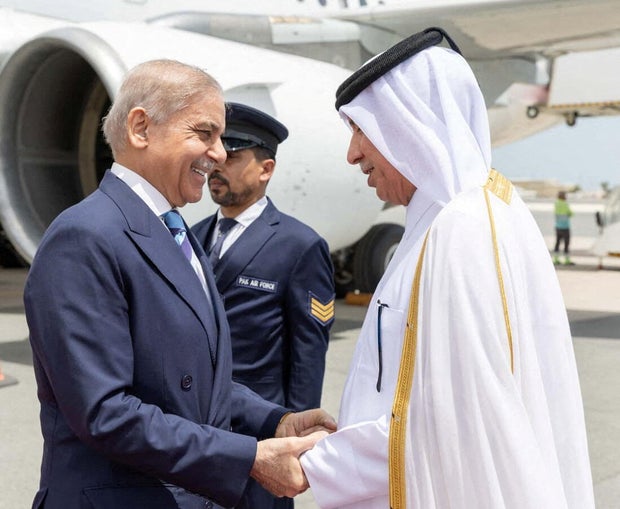
From Qatar, Sharif will travel to Turkey before returning home on Saturday.
Sharif's visit to countries including Saudi Arabia, where he was earlier Thursday, and Army Chief Field Marshal Asim Munir's trip to Iran this week are part of "collective efforts" aimed at promoting regional peace and de-escalation, the Pakistani Foreign Ministry said Thursday.
"Pakistan is being recognized for its constructive diplomatic engagement in supporting de-escalation, ceasefire efforts and a broader pursuit of stability between the United States and Iran," ministry spokesman Tahir Andrabi said.
Pakistan has encouraged dialogue, facilitated message exchanges and helped create a peaceful space for meaningful negotiations such as the recent talks between the U.S. and Iran, Andrabi said.
Lebanon's president says Israeli withdrawal would be "essential step" in a ceasefire
Lebanon's President Joseph Aoun stressed the importance of a ceasefire with Israel in a conversation with British Minister of State for Middle East Affairs Hamish Nicholas Falconer, the office of the Lebanese Presidency said in a social media post Thursday.
President Trump has said the leaders of Israel and Lebanon will speak Thursday, though Lebanon has not confirmed that the talks will take place.
Aoun said a ceasefire would be a natural starting point for direct talks between Israel and Lebanon, stressing that negotiations would be conducted by "the Lebanese authority alone," the implication being that members of Hezbollah, an Iran-allied U.S. and Israeli-designated terrorist organization that has been exchanging fire with Israel across Lebanon's southern border, would not be involved.
Aoun said Lebanon was eager to stop the violence, and an "essential step" to consolidating a ceasefire with Israel would be the withdrawal of Israeli forces from the south of Lebanon and the deployment of the Lebanese army all the way down to the two country's shared border.
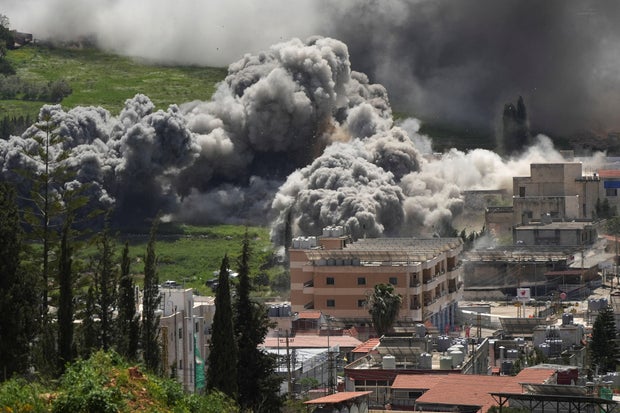
The U.K. offered Lebanon nearly 28 million dollars worth of humanitarian assistance to support the hundreds of thousands of Lebanese people who have been displaced from their homes due to the conflict with Israel, the office of the Lebanese presidency said.
Pakistan's prime minister, Saudi crown prince meet on Iran
Pakistan Prime Minister Shehbaz Sharif met Saudi Crown Prince Mohammed bin Salman during a visit to the Kingdom Wednesday, briefing him on Pakistan's efforts to ease U.S.-Iran tensions and assuring him of Islamabad's "full support," his office said before dawn Thursday.
Wednesday's meeting lasted more than two hours, and Sharif was accompanied by Pakistan Foreign Minister Ishaq Dar.
The statement said the crown prince praised what it described as the constructive role played by Sharif and Pakistan's army chief, Field Marshal Asim Munir, in the peace process.
Sharif dispatched Munir to Tehran for talks with Iranian leaders.
Pakistan has long maintained close ties with Saudi Arabia while also keeping relations with Iran.
Trump says Israel, Lebanon leaders to speak Thursday
President Trump says leaders of Israel and Lebanon will speak Thursday, as Washington pushes to ease hostilities after the rivals' first direct talks in decades on Tuesday.
"Trying to get a little breathing room between Israel and Lebanon," Mr. Trump said late Wednesday on his Truth Social platform, apparently referring to the meeting held in Washington the day before - the first direct negotiations between senior officials from the two countries since 1993 — and to Thursday's planned discussion.
He didn't identify Thursday's participants or give details but said, "It has been a long time since the two leaders have spoken, like 34 years. It will happen tomorrow. Nice!"
Israeli Army Radio, also known as GLZ Radio, said Thursday that, "Intelligence Minister Gila Gamliel confirmed in an interview that Prime Minister Benjamin Netanyahu will speak with Lebanese President Joseph Aoun."
GLZ quoted Gamliel as saying, "I hope that this move will ultimately lead to prosperity and flourishing for Lebanon as a country. This is a move that was conceived over time."
A senior Trump administration official said earlier that the president would "welcome" an end to hostilities between Israel and Hezbollah in Lebanon, but stressed that any such outcome isn't part of talks between Washington and Tehran.
Iran disagrees strongly, and called Israel's ongoing attacks in Lebanon a violation of the ongoing two-week ceasefire between Tehran and Washington. The ceasefire has held, however, after Israel scaled back its strikes in Lebanon's capital and other areas away from the south of the country, where it continues to occupy ground.
Lebanon was pulled into the Middle East war on March 2 after the Iranian-backed group Hezbollah attacked Israel.
Since then, Israeli strikes have killed more than 2,000 people in Lebanon, health officials there say, and displaced more than one million in that nation, and Israeli ground forces have invaded Lebanon's south.
China's foreign minister stresses to Iran that Strait of Hormuz needs to reopen
Chinese Foreign Minister Wang Yi told his Iranian counterpart that reopening the Strait of Hormuz was a unanimous demand from the international community.
Wang Yi told Iran's Foreign Minister Abbas Araghchi in a phone call late Wednesday that Iran's sovereignty, security, and legitimate rights should be respected as a littoral state of the Strait of Hormuz, but freedom of navigation and safety through the strait should be ensured.
"Working to resume normal passage of the strait is a unanimous call from the international community," Wang was quoted as saying in a government statement.
Wang noted that the current situation had reached a critical juncture between war and peace, and also said that the window of peace was opening.
Earlier Wednesday, President Trump said that China had agreed not to send weapons to Iran. China has long been a supporter of Iran's ballistic missile program.
Mr. Trump's trip to China, originally scheduled for early April, was delayed to mid-May because of the Iran War.