On face value, civil rights attorney Jeffrey Kravitz says grabbing the phone could be seen as an unjust use of force.
"What happened here was sort of right here on the border," he said.
As far as whether Stevenson could record the training, Kravitz says there's no question.
"He absolutely has the right to stand in public and film what the police are doing in public," he said.
Tracy Police say while the incident is under review, the video doesn't show Stevenson looking into an unmarked police van.
"YouTube tells part of the story but there is more to it," he said. "We in law enforcement are used to being recording at this point, whether it's an iPhone, whether it's our own video cameras. This was a unique circumstance where an actual SWAT exercise was going on."
He said that is what made Stevenson suspicious, and officers concerned, since in the training, they weren't armed.
"I'm still not sure if those officers you know didn't know the laws, or weren't very educated on the constitution or they simply didn't care, and that's the scary part," Stevenson said.
In general, you are not required to identify yourself, unless police believe you may have been involved in a crime. Whether or not Stevenson legally had to identify himself is a matter of opinion, and an official review will likely determine that.
The issue of recording police in public is a hot-button issue in most states, especially in light of recent arrests in Ferguson, Missouri.
According to the National Press Photographers Association, there is no law anywhere in the United States that prohibits people from recording the police in any place where the public is allowed.
Several high-profile court cases have taken up the issue, and in all cases, a judge has ruled that police cannot reasonably expect privacy while out in public.
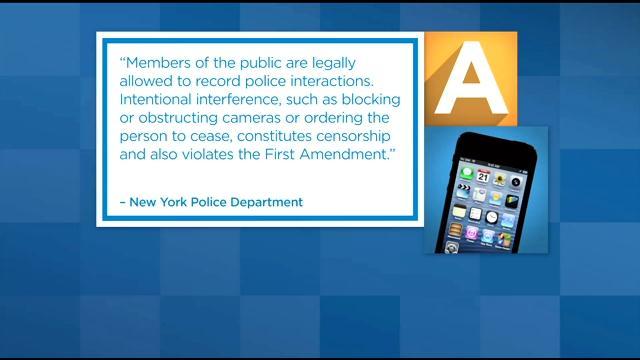
The New York Police Department, which has faced scrutiny for the way it handles being filmed in public, sent out a memo to officers this summer reminding officers that the public is allowed to record police interactions and "Intentional interference such as blocking or obstructing cameras or ordering the person to cease constitutes censorship and also violates the First Amendment.
Several states, including California, do prohibit people from recording private conversations without consent from both parties involved.
We and our partners use cookies to understand how you use our site, improve your experience and serve you personalized content and advertising. Read about how we use cookies in our cookie policy and how you can control them by clicking Manage Settings. By continuing to use this site, you accept these cookies.